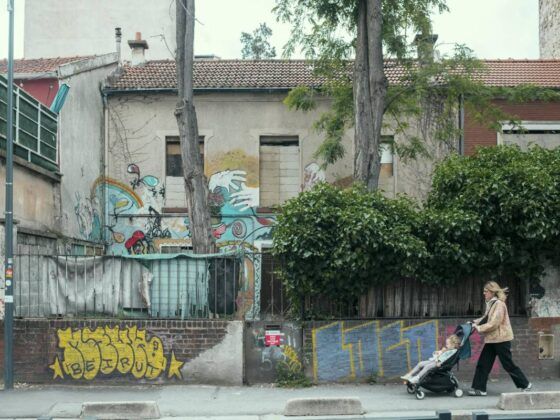
No concept is born out of nowhere. Nor is informal gentrification. We propose this concept to analyse a specific form of urban revalorization: one in which informality does not disappear, but is tolerated, reorganized, aestheticized, commodified or selectively incorporated as part of the new value of the neighbourhood.
The central idea is simple: in many urban contexts, especially in cities of the Global South, gentrification does not always advance through immediate demolition, direct expulsion or the visible replacement of one population by another. Sometimes the process is more ambiguous. The neighbourhood is revalorized; it attracts visitors, investment, new residents or discourses of renewal, but the informal forms that sustained it are not completely eliminated. They remain. But they begin to fulfil a different function.
What was previously presented as a problem —self-construction, street vending, popular markets, workshops, precarious housing, unregulated uses of public space or ambiguous forms of tenure— can be transformed into authenticity, neighbourhood identity, cultural appeal, tourist experience or real estate resource. Informality ceases to be only something to be corrected and becomes part of the symbolic and economic value of the neighbourhood. This is where the paradox we want to name appears: the city can include the informal without protecting those who sustain it. We call this paradox informal gentrification.
Gentrification theory was consolidated through very specific urban contexts. From Ruth Glass, who used the term to describe the transformation of working-class neighbourhoods in London, to Neil Smith, Sharon Zukin or Loretta Lees, the concept has served to think about capital reinvestment, social replacement, the production of authenticity, the symbolic transformation of space and the global expansion of urban inequalities.
But this theoretical edifice carries a problem: it often presupposes formalized real estate markets, recognized private property, registered rents, stable contracts and a clear separation between legality and illegality. This structure may work to analyse many urban processes in the Global North, but it becomes insufficient when we observe cities where informality is not marginal, but structural.
In many cities of the Global South —although not only there— housing, commerce, work and everyday life are organized through hybrid arrangements: incomplete titles, tolerated occupations, self-construction, informal rentals, street markets, popular economies, ambiguous permits, community networks and partial forms of state recognition.
This is where the key question arises: what happens when there is urban revalorization, but not full real estate formality? Should we stop talking about gentrification? Or should we rethink how gentrification works when informality is not eliminated, but managed?
Roy and Robinson: urban informality and theory from the South
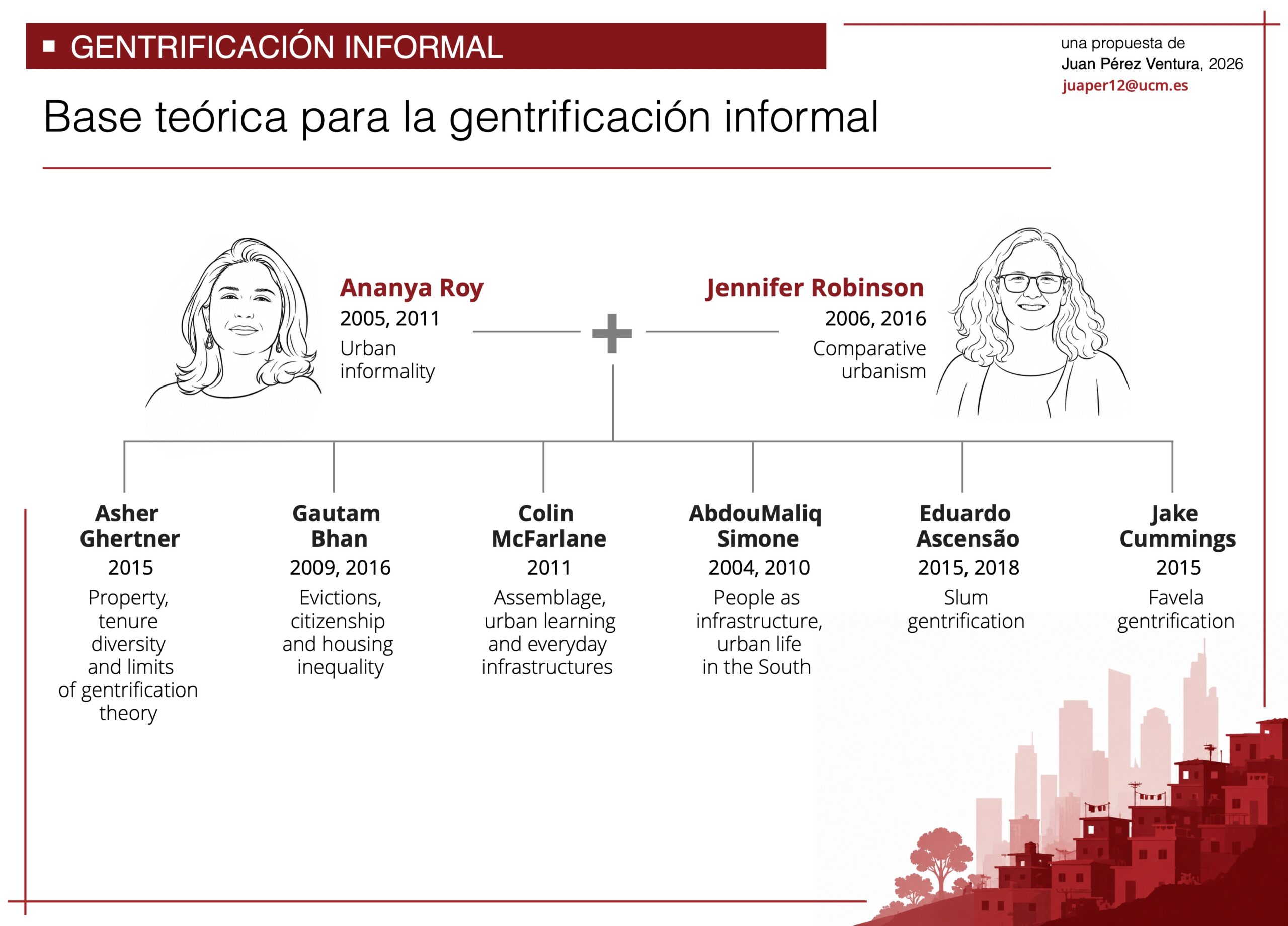
The two main pillars of this framework are Ananya Roy and Jennifer Robinson. The former allows us to think of informality not as an urban residue, but as a way of producing and governing the city. The latter allows us to think of cities in the Global South not as mere “cases” that confirm theories born in the North, but as places from which urban theory is also produced.
Ananya Roy is fundamental because she breaks with the idea of informality as the mere absence of planning, absence of the state or absence of legality. For Roy, urban informality is not a separate sector, but an organizing logic of urban transformation. In other words: informality is not outside the formal city; it cuts across markets, public policies, state decisions, forms of tenure, popular economies and elite spaces.
This idea is decisive for informal gentrification. If informality is a mode of urbanization, then gentrification does not need to eliminate it in order to advance. It can operate through it. It can take advantage of its flexibility, its legal ambiguity, its popular economies, its networks of proximity, its low cost or its cultural appeal.
Jennifer Robinson provides the second shift: the Global South should not be treated as an incomplete, backward or deviated version of the Global North. Her proposal of ordinary cities and comparative urbanism allows us to think of all cities as relevant spaces for theory. It is not a matter of simply applying concepts produced in London, New York or Paris to Mumbai, Lagos, Rio de Janeiro or Mexico City. It is a matter of allowing those cities to transform the concepts themselves.
Informal gentrification emerges precisely from this intersection: from thinking informality as an urban regime, with Roy, and from taking seriously the theoretical capacity of cities in the South, with Robinson. We do not propose the concept in order to add an exotic variant to classical theory, but to name processes that classical theory has not always been able to see.
Ghertner: the problem of formal property
Asher Ghertner helps identify one of the most important limits of classical gentrification theory: its excessive property-centrism. That is, its tendency to presuppose that formal private property is the dominant form of urban tenure.
But in many cities, reality is much more complex. There are public, communal, customary, occupied, tolerated, semi-legalized lands or lands subject to hybrid arrangements. There are neighbourhoods where people do not have full ownership, but do have forms of permanence, recognition, material investment, social networks and everyday legitimacy.
Ghertner’s critique is essential because it forces us not to apply classical theory mechanically. However, our proposal does not consist of abandoning the concept of gentrification, but of reformulating it. If theory fails when it demands full formality, the problem is not gentrification as a critical category, but its overly narrow definition.
Informal gentrification appears here: as a way of analysing urban revalorization when it operates in contexts of ambiguous tenure, hybrid markets and selective regulation.
Cummings: the favela can gentrify without disappearing
One of the closest antecedents to the concept can be found in Jake Cummings’ work on the favelas of Rio de Janeiro. His analysis of favela chic shows that neighbourhoods such as Rocinha or Vidigal can enter processes of revalorization without necessarily being demolished.
In these cases, informality does not prevent gentrification. On the contrary: it can become part of the attraction. Popular culture, music, views, community life, tourist routes, hostels, the presence of foreigners and the search for authenticity transform the favela into an object of urban desire. The neighbourhood does not cease to be informal, but its informality begins to be consumed.
Cummings offers a key warning: “social integration” does not necessarily mean social inclusion. Policies of pacification, connection, improvement or integration can open the neighbourhood to new flows of capital, tourism and residents without guaranteeing the secure permanence of the original population.
This point is central: informal gentrification does not always expel immediately. Sometimes it produces deferred, intra-neighbourhood or generational displacement. Residents may remain there, but with greater economic pressure, less autonomy, more insecurity and fewer possibilities for their children to remain in the neighbourhood.
Ascensão: slum gentrification as a direct antecedent
Eduardo Ascensão provides another fundamental antecedent with his concept of slum gentrification. His work on Lisbon shows that informal settlements can also become objects of revalorization, rehousing, demolition, public investment and transformation of land value.
His contribution is important for two reasons. First, because it shows that informality is not exclusive to the Global South: it also exists in European cities. Second, because it shows that displacement is not always produced through the market. Sometimes it is produced through censuses, eligibility criteria, rehousing programmes, bureaucratic categories and technical decisions about who counts as a legitimate resident and who does not.
Ascensão allows us to understand that gentrification in informal contexts can take many forms: from gradual processes of improvement, touristification or rebranding to more abrupt operations of demolition, eviction or urban renewal.
However, informal gentrification is not simply a translation of slum gentrification. The difference is important. Slum gentrification still refers to a type of place: the slum, the favela, the informal settlement. Informal gentrification, by contrast, names a mechanism: urban revalorization through a regime of informality.
That is why it can also be applied to medinas, kampungs, urban villages, popular neighbourhoods with traditional markets, tenement-like housing, workshops, street commerce or former industrial spaces with informal uses. It is not only about where it happens, but how it happens.
Other references to refine the concept
In addition to Roy, Robinson, Ghertner, Cummings and Ascensão, there are other authors worth keeping close. They do not necessarily form the hard core of the concept, but they help situate it more precisely, prevent it from being overstretched and avoid turning informal gentrification into a label for any unequal process of urban transformation.
Hyun Bang Shin and Ernesto López-Morales are important because they insist that gentrification cannot remain confined to its places of origin. It is not a process exclusive to Ruth Glass’s London, nor to formalized real estate markets in the Global North: it travels, changes and mutates according to context. From this perspective, informal gentrification can be understood as one of these mutations: a form of urban revalorization that appears where informality, state action, hybrid markets and tenure insecurity are central to the functioning of the city.
Matthias Bernt helps further nuance this position. His reading of the debate between Ghertner and López-Morales avoids two overly simple exits: reserving the word gentrification only for a few Western cities, or applying it carelessly to any unequal urban transformation. Informal gentrification does not seek to call everything gentrification, but to identify a concrete mechanism: urban revalorization through the persistence, management or selective incorporation of informality.
Rowena Guthrie works as a contrast. Her work on Lagos shows the difficulties of applying classical criteria of gentrification to contexts where there is no clear sequence of investment, abandonment and reinvestment, and where urban value has often been produced by residents themselves through self-construction, occupation and incremental improvement. This reinforces the need to look less at closed checklists and more at the concrete mechanisms of revalorization, pressure, displacement and loss of permanence.
Gautam Bhan allows us to shift the gaze from housing as an isolated unit to housing as a support for life, work and everyday reproduction. His work on Delhi and Indian cities shows that popular settlements are not merely housing deficits or illegality, but relational spaces where housing, informal employment, proximity networks, self-construction and urban citizenship are articulated. For informal gentrification, this is key: displacement does not only destroy houses, but also livelihoods, domestic economies, care networks and everyday forms of survival.
Colin McFarlane contributes the idea of the city as assemblage, learning and urban composition. Although he does not work directly on gentrification, he allows us to think of informality as practical knowledge: a capacity to adapt materials, infrastructures, knowledges, social relations and survival tactics. From this perspective, informal gentrification does not only transform prices or land uses; it reorders the assemblages that allowed residents to live, work and remain in the neighbourhood.
AbdouMaliq Simone is useful because he allows us to understand informality as social infrastructure. His concept of people as infrastructure shows that popular urban life is sustained through flexible relationships, provisional collaborations, networks of trust, exchanges and everyday agreements. Informal gentrification can capture this infrastructure as “atmosphere”, “authenticity” or “neighbourhood life”, while weakening the social conditions that make it possible. The city consumes the informal vitality of the neighbourhood, but does not always recognize those who produce it as subjects with the right to decide on its future.
Finally, Josep Maria Montaner helps mark a fundamental limit: not every urban improvement in an informal neighbourhood is gentrification. His work on slum upgrading argues that self-built neighbourhoods should not be seen as incomplete forms of city, but as urban forms with their own logic. This idea is fundamental. Improving infrastructure, housing or services is not in itself a problem. The problem appears when that improvement increases the value of the neighbourhood without protecting those who inhabit it. If an intervention strengthens the right to remain, stabilizes costs and preserves social networks, we are dealing with urban improvement with spatial justice. If, instead, it beautifies, revalorizes and makes the neighbourhood more attractive without guaranteeing residents’ permanence, then it can become an entry point into informal gentrification.