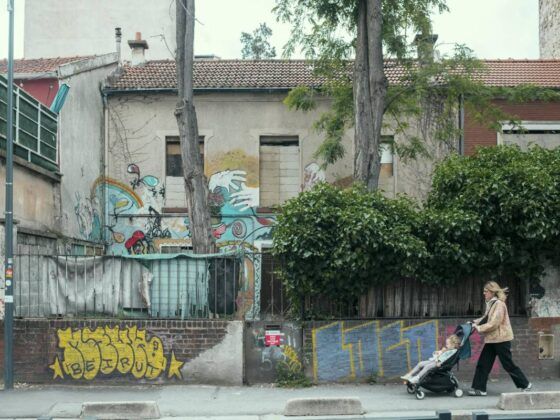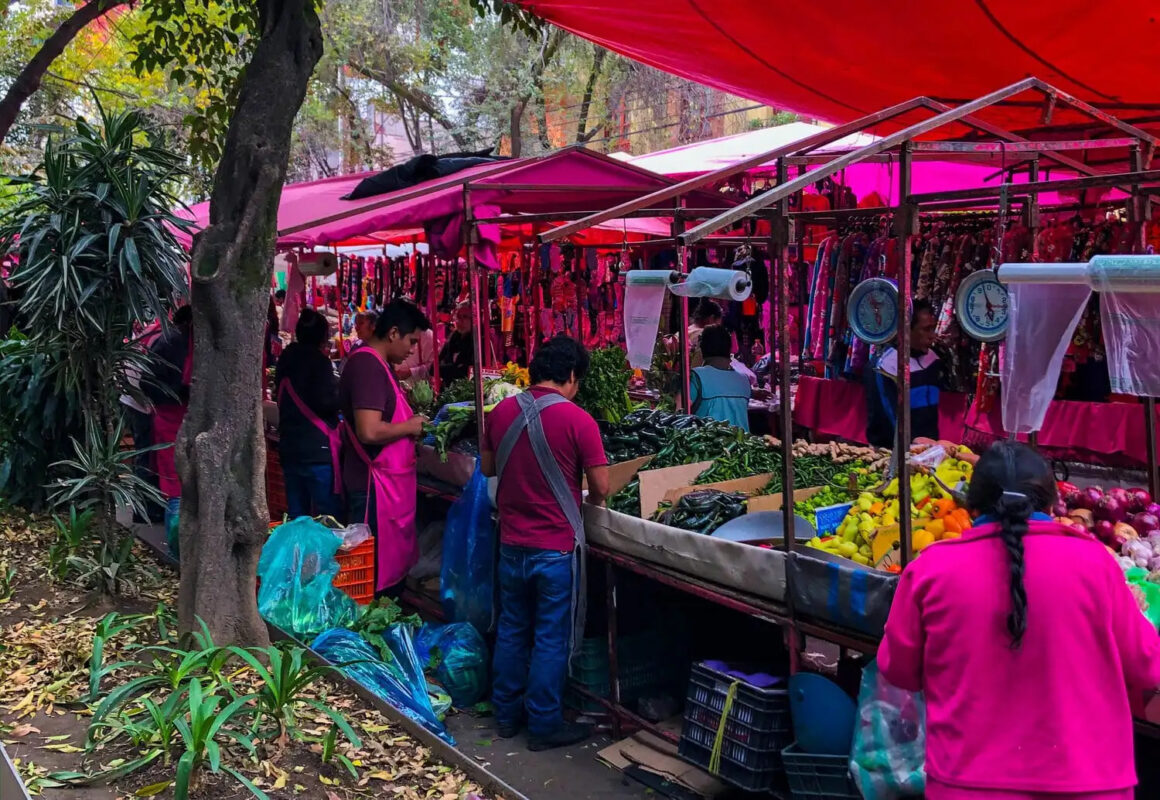
There are neighbourhoods that change without disappearing. Places where bulldozers do not arrive immediately, where residents are not expelled overnight, and where popular ways of living, working or trading remain present for years. Yet something profound begins to change.
The neighbourhood becomes more visible. Visitors arrive, new businesses open, small investors appear, along with narratives of authenticity, cultural routes, temporary accommodation and discourses of renewal. What was once described as an urban problem —self-construction, street vending, popular markets, precarious housing, workshops, unregulated uses of public space or ambiguous forms of tenure— begins to be read differently. It ceases to be merely a deficit and starts to become value. We call this process informal gentrification.
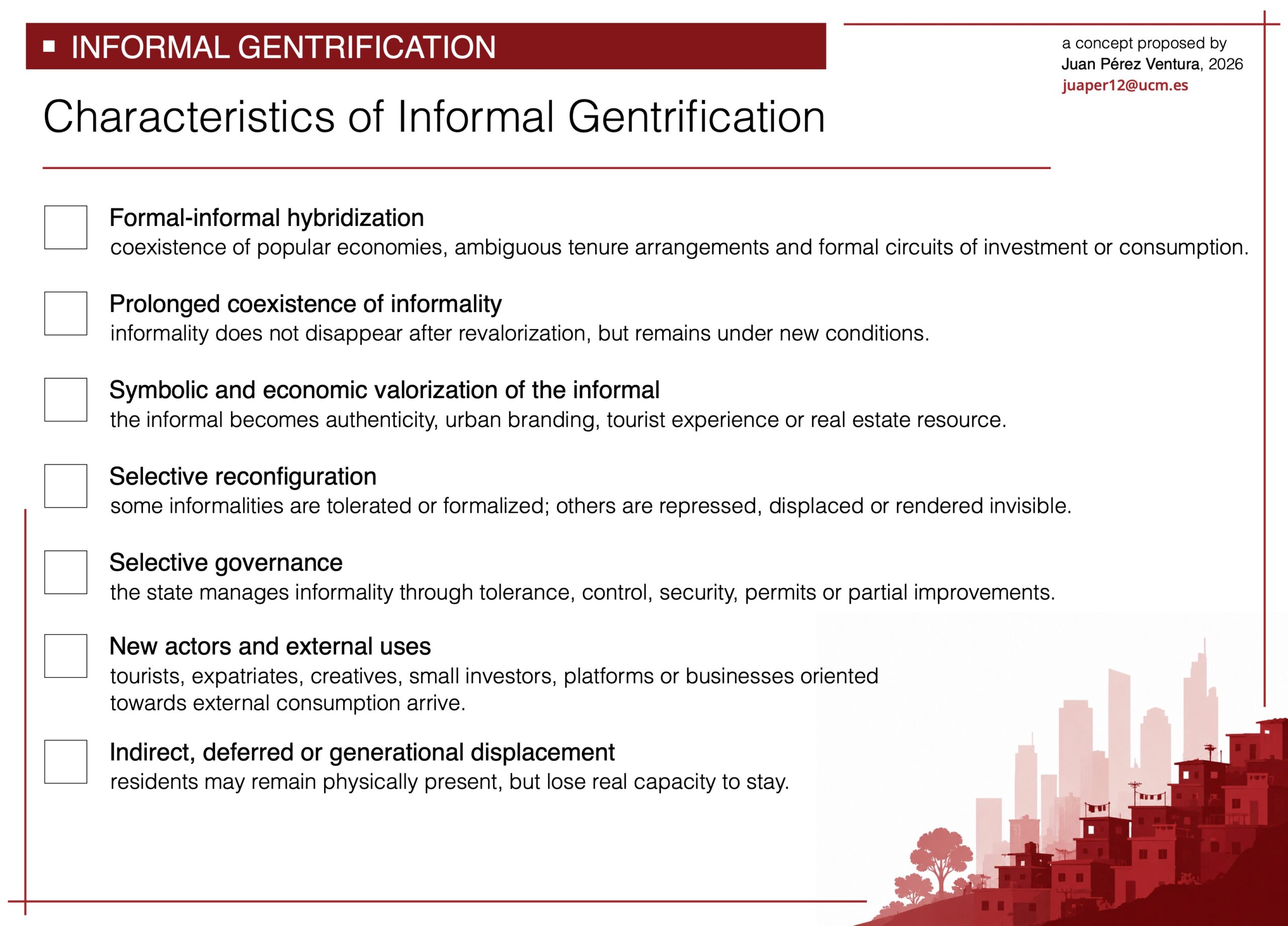
The central idea is simple: informal gentrification describes processes of urban revalorization in which informality does not disappear immediately, but persists, is managed, aestheticized, partially formalized, filtered or selectively incorporated into the new value of the neighbourhood. Its main outcome is not always direct expulsion, but a more ambiguous situation: spatial inclusion without residential security. In other words, residents, traders or popular workers may remain physically present in the neighbourhood, but with a reduced real capacity to stay.
In these cases, the city does not necessarily erase the informal. Sometimes it incorporates it. It makes it attractive, profitable, visitable or consumable. But this incorporation does not always protect those who produced that neighbourhood life. This is the paradox that summarizes the concept: the city can include the informal without protecting those who sustain it.
It is not simply gentrification in informal neighbourhoods
This should be made clear from the outset: informal gentrification does not simply mean “gentrification in an informal neighbourhood”. Nor is it equivalent to any urban improvement, any process of touristification, or the mere arrival of new cafés, visitors or residents. The concept seeks to name something more precise: a form of urban revalorization that operates through informality, not necessarily against it.
In the more classical models of gentrification, we usually imagine a relatively recognizable process: a popular neighbourhood loses resident population, higher-income groups arrive, prices rise, commerce changes, housing is rehabilitated and the image of the place is transformed. This framework remains useful for many cases, but it becomes insufficient in contexts where housing, commerce, work and access to land are not fully formalized.
In many cities of the Global South —although not only there— informality is not an anomaly. It is a structural part of urban life. There are incomplete titles, tolerated occupations, unregulated rentals, self-construction, street markets, family economies, ambiguous permits, community networks and partial forms of state recognition. In these contexts, gentrification does not always appear as a clean substitution of one population by another. It may appear as a gradual, ambiguous and selective reorganization of the neighbourhood.
That is why the question is not only “is there direct expulsion?”, but also: what happens when the neighbourhood is revalorized, while those who sustain it lose security, autonomy and the capacity to remain?
Informality does not disappear: it changes function
One of the main features of informal gentrification is that informality remains. But it does not remain unchanged.
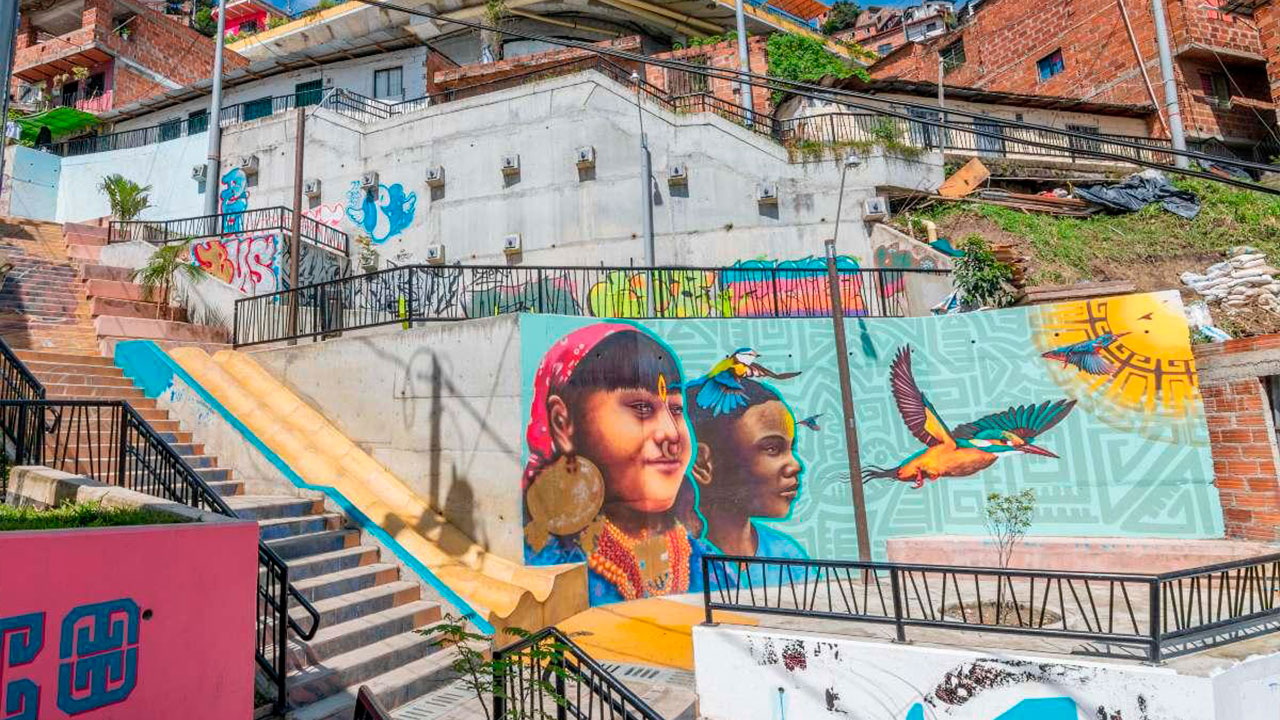
A popular market may continue to operate, but now integrated into gastronomic or tourist routes. A formerly stigmatized street may become a photographic setting. Street food may shift from being seen as disorder to being sold as a local experience. A self-built neighbourhood may begin to be presented as authentic, creative or “undiscovered”. Graffiti, workshops, music, views, social density or street life may be transformed into an urban brand. Informality, then, ceases to be only something to be corrected. It begins to function as a cultural, economic and real estate resource.
But this valorization is selective. Not all informality is of interest. The forms that can become landscape, authenticity or consumption are preserved; those that are uncomfortable, conflictive or unprofitable are repressed. A decorative mural may be protected, while a political tag is erased. A “picturesque” food stall may be tolerated, while a subsistence vendor is persecuted. A popular market may be celebrated as heritage, while its workers lose stability or decision-making power.
The central question is no longer whether informality disappears or not. The question is different: which informality remains, under what conditions, and in whose interest?
Displacement does not always begin with moving out
One of the greatest challenges in studying informal gentrification is that its effects are not always immediately visible. If there are no mass evictions, if many families remain in the neighbourhood, if the market stays open or if some popular businesses survive, it may seem that there is no gentrification. But physical permanence does not always mean real permanence.
A family may continue living in the neighbourhood, but with greater insecurity over its housing. A trader may keep working, but with higher costs, more controls or fewer local customers. A young person may feel part of the neighbourhood, but have no possibility of becoming independent there. A market may continue to operate, but increasingly oriented towards visitors rather than neighbours. A neighbourhood culture may be celebrated, while those who produce it lose power over their own space.
That is why, in informal gentrification, displacement can be slow, indirect and difficult to register. It does not always appear as physical departure. It may appear as loss of networks, autonomy, everyday viability and future. Put simply: informal gentrification does not always expel current residents first; it often expels their future first.
Not every urban improvement is informal gentrification
This point is fundamental. The concept is not meant to suggest that every intervention in a popular or informal neighbourhood is negative. Improving infrastructure, housing, services, facilities or public spaces may be necessary and just. The question is not whether the neighbourhood improves. The question is who can remain after the improvement.
If an intervention improves the neighbourhood, stabilizes costs, protects tenure, preserves social networks, guarantees commercial continuity and strengthens residents’ ability to remain, then we are not dealing with informal gentrification. We can speak of urban improvement with spatial justice.
But if an intervention beautifies, makes visible, formalizes or revalorizes the neighbourhood without protecting those who inhabit and sustain it, then it may open the door to informal gentrification.
Urban improvement is not automatically urban justice. It can produce value without producing rights. It can make a neighbourhood more attractive and, at the same time, less habitable for those who made it possible.
Why we need this concept
Informal gentrification allows us to name processes that fall between already known categories. It is not simply slum upgrading. It is not only touristification. It is not classical urban renewal. It is not merely persistent informality. Nor is it a minor variant of traditional gentrification. Its usefulness lies in shifting the gaze from the type of neighbourhood to the mechanism of transformation.
It does not only matter whether we are speaking of a favela, a medina, a popular settlement, an urban village, a kampung, a tenement-like neighbourhood, a traditional market or a popular area with informal economies. What matters is whether urban revalorization operates through the persistence, management or selective incorporation of informality.
The concept also allows us to compare cities of the Global North and South without reducing the South to an exception or turning the North into a universal model. Informality may be more visible and structural in many cities of the South, but it also appears in informalized enclaves of the North: unregulated rentals, migrant economies, street vending, occupations, substandard housing, opaque platforms, workshops, subdivided rooms or unregulated uses of urban space. Informal gentrification helps us think through these connections without erasing the differences.
Informal gentrification occurs when informality is not eliminated, but incorporated into the new value of the neighbourhood, while those who produce it lose their real capacity to remain. That is its key. It is not only about the arrival of tourists, cafés, investors or new residents. It is not only about the neighbourhood becoming more visible or more attractive. It is not only about urban improvement.
It is about a deeper paradox: informality produces value; others capture it; those who sustain it lose the capacity to remain. That is why we need this concept. Because the city does not always expel by erasing. Sometimes it expels by incorporating.