In major global cities, the word “renewal” often sounds appealing. It evokes new buildings, cleaner streets, investment, modernization, efficiency, the future. But sometimes, behind that friendly word, much harsher processes are hidden: expulsions, loss of businesses, the breaking apart of communities, and institutional violence. The case of Yongsan, in Seoul, is one of the most dramatic examples of this other side of contemporary urban transformation.
Yongsan is a central district of the South Korean capital. Its strategic location, close to the Han River and in a key area for the expansion of major real-estate projects, made it an especially coveted space from the early twenty-first century onwards. It was in this context that the Yongsan-4 Redevelopment Project emerged: an urban redevelopment operation aimed at replacing a popular urban fabric with new high-value developments. This was not a slow improvement of the neighbourhood, nor a spontaneous transformation driven by small everyday changes. It was a top-down intervention, articulated by public administrations, property owners, developers, and construction companies.
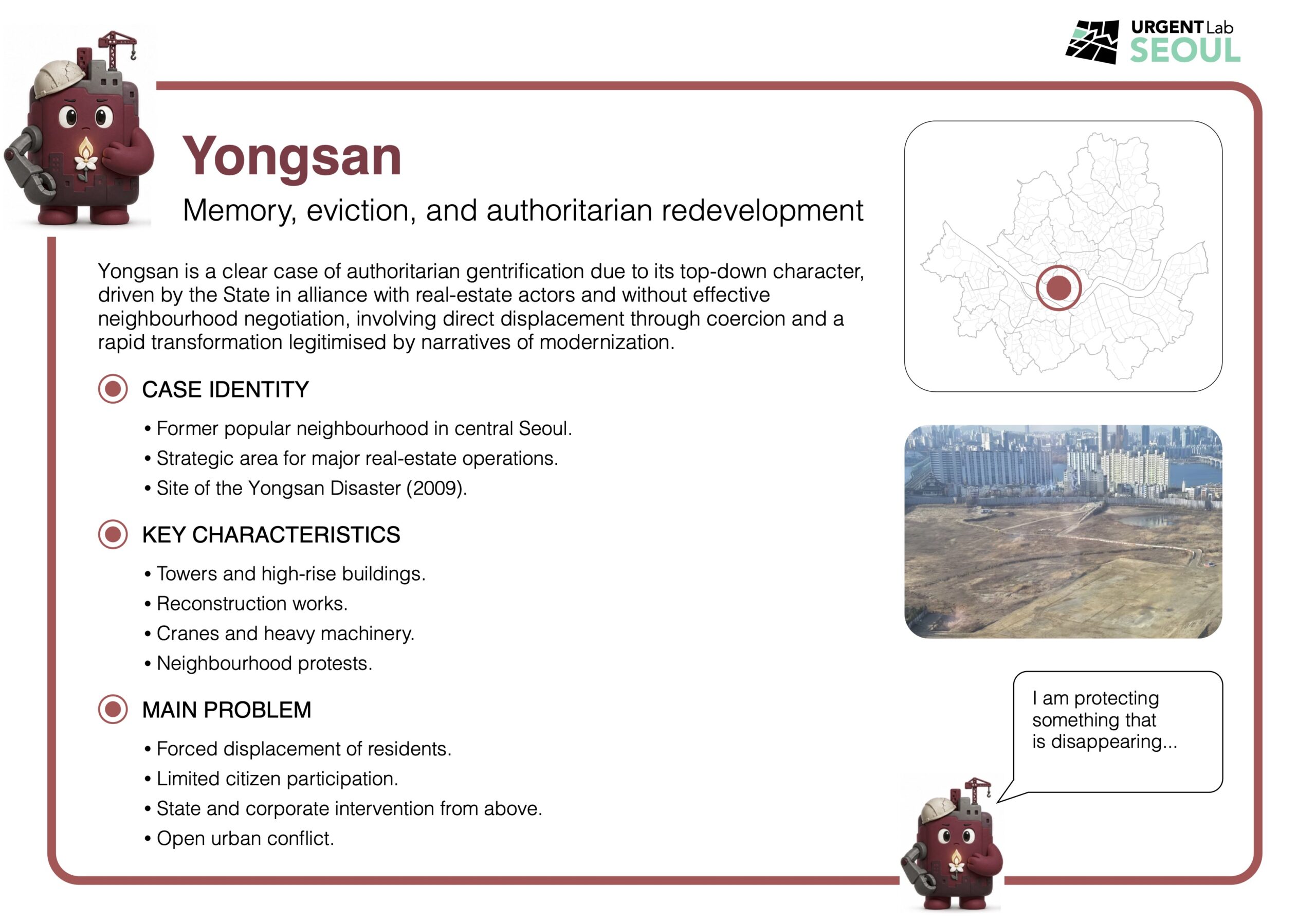
The episode that turned Yongsan into an international symbol took place on 20 January 2009. A group of tenants and small business owners, affected by the project and dissatisfied with the compensation offered, occupied the rooftop of a building as a form of protest. The police response was forceful. The operation mobilized around 1,400 riot police officers and even used a container lifted by a crane to access the building. During the intervention, a fire broke out. Five protesters and one police officer died. Since then, the case has been known as the Yongsan Disaster.
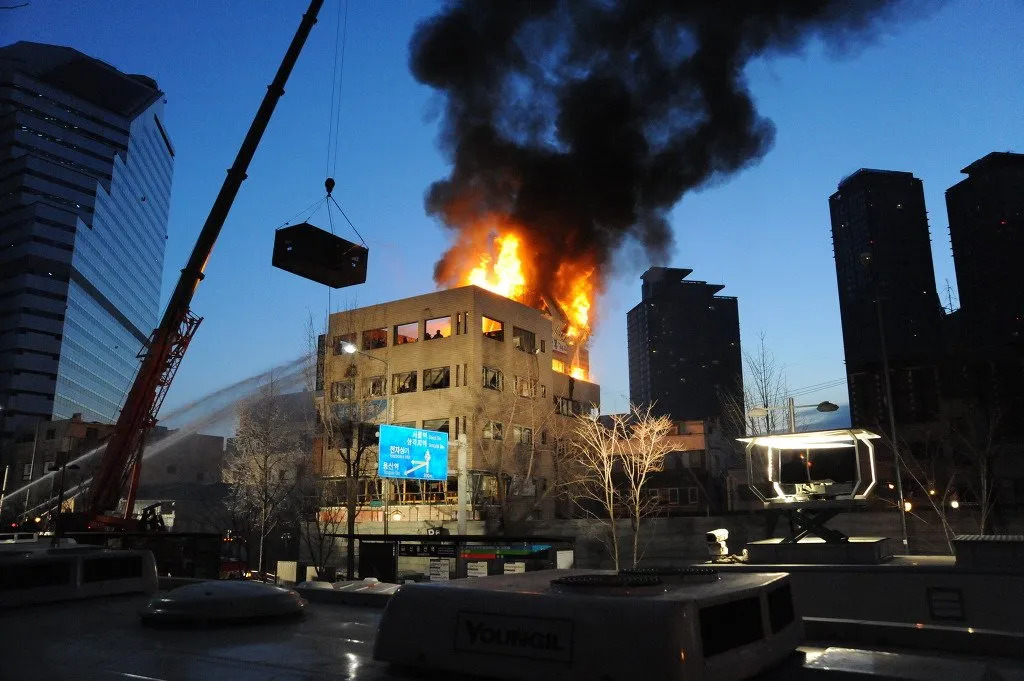
The significance of Yongsan lies not only in the tragedy itself, but in what it reveals about a specific way of making the city. In South Korea, and especially in Seoul, redevelopment has been closely linked to the demolition of older neighbourhoods, the construction of new residential and commercial complexes, and the production of high-value urban land. Hyun Bang Shin and Soo-Hyun Kim explain that gentrification in Seoul should not be understood as a simple importation of Western models, but as a process of its own, connected to the Korean developmental state, real-estate speculation, and the alliance between governments, property owners, and major construction companies.
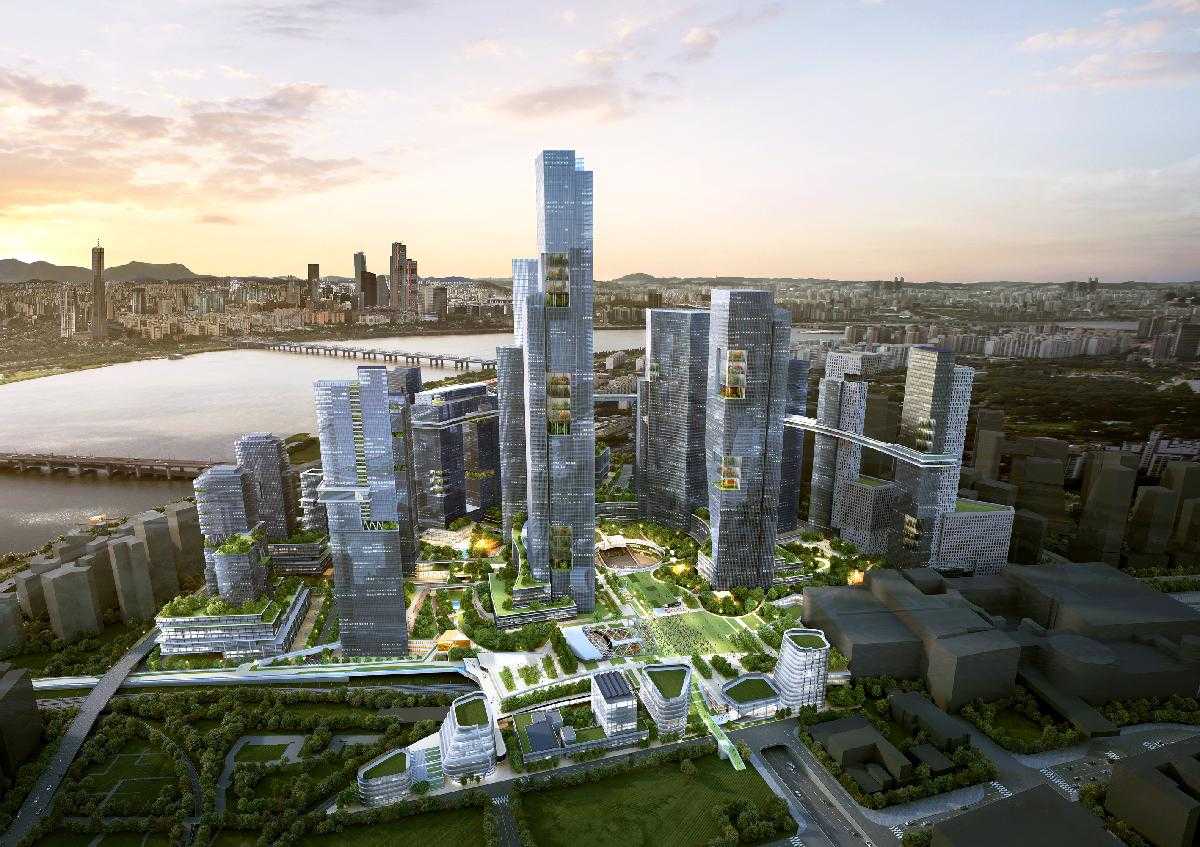
This is why Yongsan is a good example of what we might call authoritarian gentrification. In this type of process, urban revalorization does not occur primarily through the gradual arrival of higher-income new residents, nor through the emergence of cafés, galleries, or creative spaces, as happens in other gentrified neighbourhoods. Here, the main driving force is different: a vertical intervention, led by institutions and real-estate actors, which imposes a new urban model onto an existing territory.
The case shows several very clear features. First, the transformation was designed from above. The affected residents and shopkeepers were not central actors in the decision-making process. Second, the project was justified through narratives of modernization, competitiveness, and urban improvement. Third, the operation depended on freeing up land; in other words, on displacing those who were already there. And fourth, when resistance appeared, the conflict was resolved through police coercion.
RELATED PAPER: Urban Redevelopment, Displacement and Anti-Gentrification
Movements (Seon Young Lee, 2014)
Seon Young Lee’s research on Yongsan is especially revealing. The author shows that commercial tenants were almost completely excluded from urban planning decision-making procedures. Although redevelopment plans created serious problems for them, there were no effective mechanisms through which they could participate in planning. They were weak actors within a system dominated by property owners, developers, and public administrations.
This inequality of power is crucial. Many small business owners not only lost their premises, but also their livelihood. In some cases, home and business were closely connected. However, the system tended to treat them as administrative obstacles: subjects who could receive compensation, but not decide the future of the neighbourhood. Lee notes that many tenants did not mobilize not because they fully accepted the project, but because they felt powerless, poorly informed, and without any real right to oppose it.
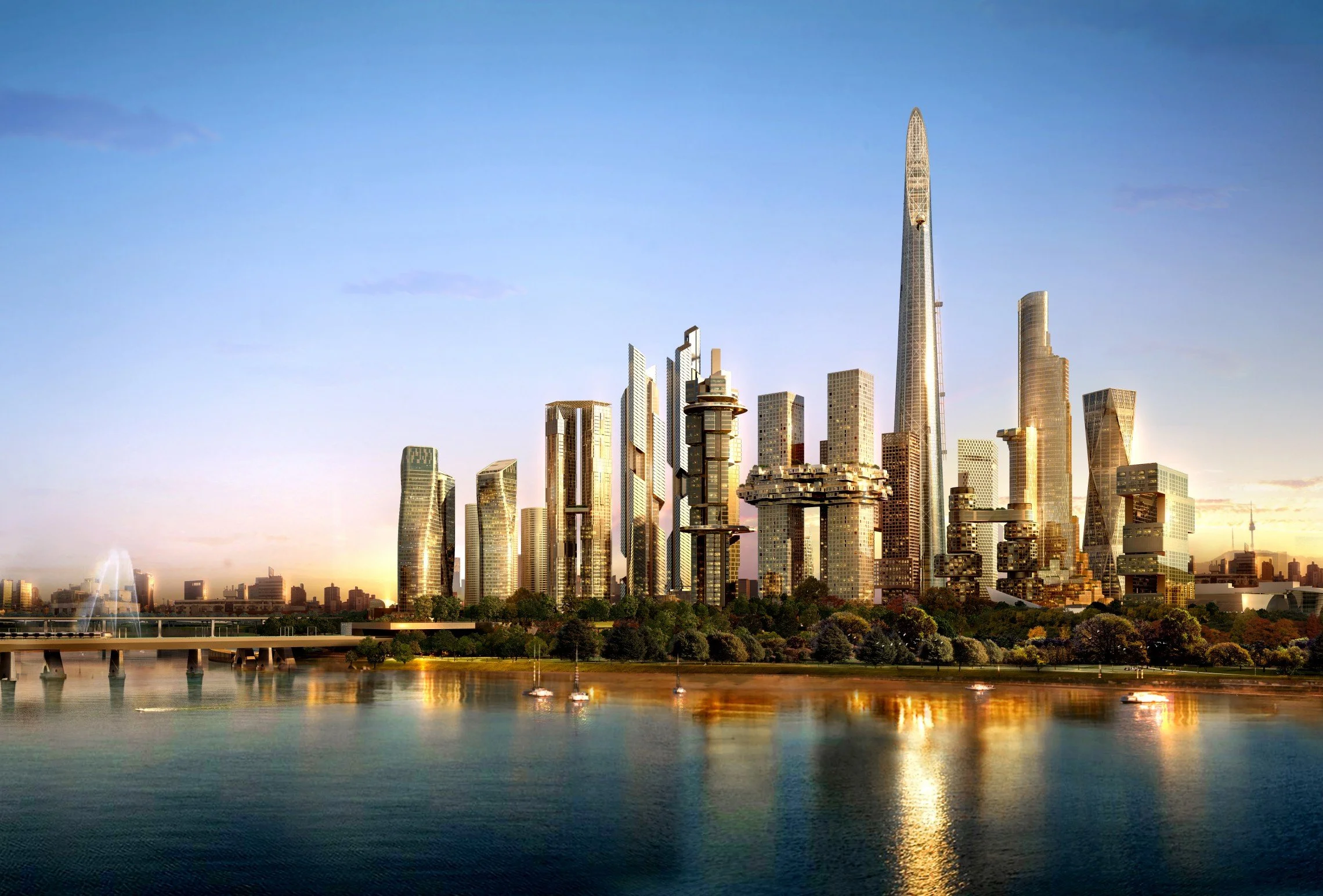
The tragedy of 2009 made visible a dynamic that normally remains hidden beneath the technical language of urban planning. Cities do not transform themselves. Behind every major operation there are political decisions, economic interests, and power relations. In Yongsan, the conflict between use value and exchange value appeared in all its harshness. For shopkeepers and residents, the neighbourhood was a place of work, memory, and everyday survival. For the agents of redevelopment, it was underused central land, an investment opportunity, a strategic piece within the global city.
This clash explains why the case remains so important. Yongsan is not merely a local story from Seoul. It is a warning about the risks of any urban model that turns the city into a machine for producing profitability while pushing the lives of those who inhabit it into the background. When modernization is understood solely as physical replacement, rising real-estate value, and the attraction of capital, popular neighbourhoods come to be seen as problems to be solved, rather than communities to be protected.
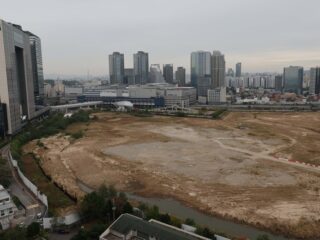
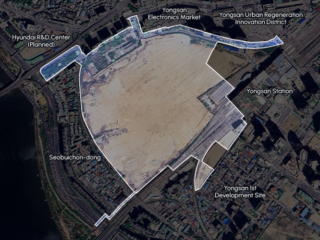
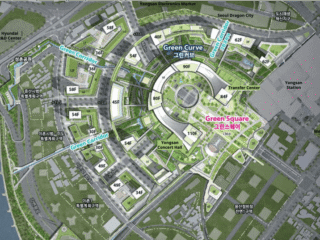
The case also forces us to broaden our understanding of gentrification. We often imagine gentrification as an aesthetic and almost gentle process: an ageing neighbourhood where modern cafés, design shops, and new middle-class residents appear. But Yongsan shows a much harsher form: new-build gentrification, based on demolishing, rebuilding, and replacing. There is no slow transition here, but rupture. No cultural seduction, but imposition. No silent substitution, but direct displacement.
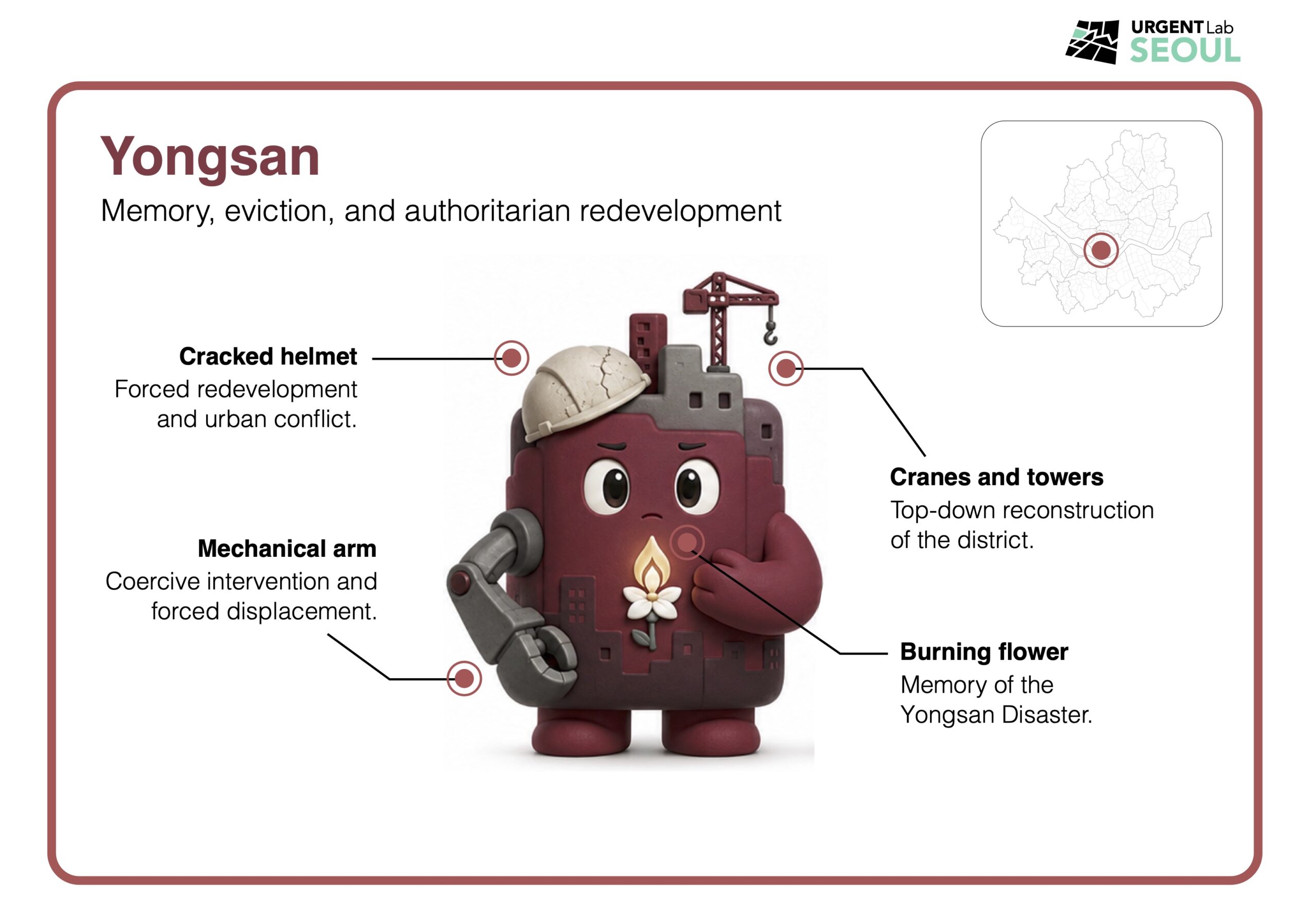
Yongsan occupies a central place in current debates on urban justice. Its history allows us to ask who decides the future of neighbourhoods, who benefits from redevelopment, and who pays its costs. It also reminds us that the right to the city is not an abstract slogan: it means being able to participate in the decisions that transform the place where people live, work, and build social relationships.
Years later, the Yongsan Disaster remains an open wound in Seoul’s urban memory. Not only because of the six lives lost, but because in a single night it condensed the conflict between two models of the city. One understands urban space as an economic asset, as a surface to invest in, demolish, and rebuild. The other understands it as an inhabited place, as a social fabric, as a collective right.
Yongsan shows that the key question is not whether cities should change. All cities change. The question is how they change, for whom they change, and who has the right to remain in them. That is the true lesson of this case: when urban modernization is imposed without social justice, it can cease to be progress and become dispossession.