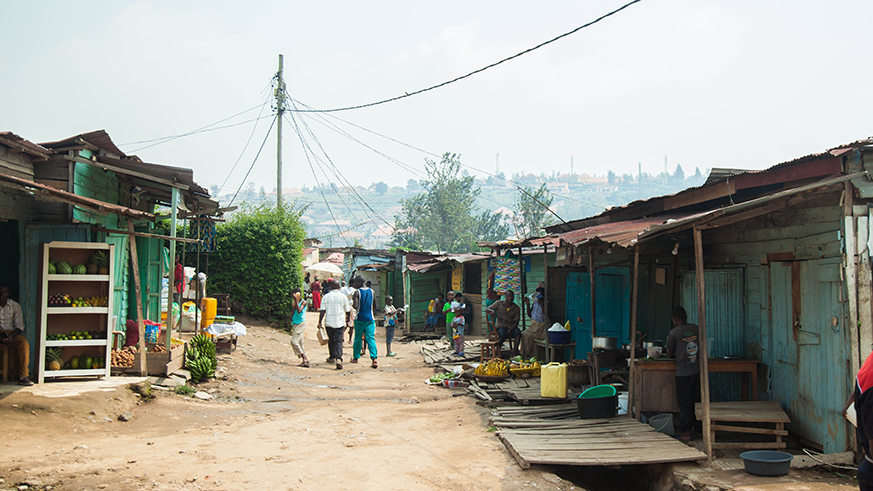
There is a photograph of Kangondo, in Kigali, taken in 2018. It shows a dirt road surrounded by small houses and shops, wooden structures, market stalls and people walking between them. It is an ordinary urban street, one of thousands that can be found across African cities. There are no impressive avenues or modern buildings, and the infrastructure is clearly inadequate. But there is something that we should not overlook: people live here, work here, buy food here and meet their neighbours here. What looks like a disorderly settlement from a planning office can be a perfectly recognisable neighbourhood for the people who inhabit it.
Kangondo I, Kangondo II and Kibiraro I were three adjoining settlements in Remera Sector, in Kigali’s Gasabo District. Together they were commonly known as Bannyahe, a colloquial name associated with the area’s poor sanitation. Their location was particularly interesting: immediately beside Nyarutarama and Kibagabaga, two of the capital’s more affluent residential areas. A neighbourhood of modest houses, workshops, small shops and rental properties stood next to some of the most desirable urban land in Rwanda.
According to research by Shakirah Esmail and Jason Corburn, published in Environment and Urbanization in 2020, Bannyahe accommodated more than 1,600 households, with some estimates reaching 2,300. The settlement had markets, schools, health posts, churches and small businesses. Many families rented their homes, while others owned properties, sometimes containing several rooms rented to different tenants.
The neighbourhood had serious problems. Sanitation, housing conditions and infrastructure needed improvement. But it was not empty land, and it was not a collection of people without any relationship to their surroundings. This distinction matters because Kigali’s authorities had a very different future in mind for the area.
A modern city, a different neighbourhood
Rwanda’s capital has undergone a remarkable urban transformation over the last two decades. Kigali has invested in roads, infrastructure, new residential developments and the image of a clean, orderly and modern city. The Kigali City Master Plan, introduced in 2013 and subsequently revised, became an important instrument for directing this transformation.
Within that planning vision, settlements such as Kangondo–Kibiraro were considered unplanned: their buildings, density and land uses did not correspond to the urban form envisaged by the authorities. By 2017, the City of Kigali and Gasabo District were advancing a redevelopment process that required residents to leave their existing neighbourhood. But the proposal was not simply to demolish their houses and abandon them. The authorities offered replacement housing in Busanza, in Kicukiro District, approximately ten kilometres from the original settlement.
A new housing estate would be constructed, with apartment buildings, roads and communal facilities. Some residents could exchange their old properties for modern housing. On paper, it sounded straightforward. A poorly serviced neighbourhood would disappear, its inhabitants would receive new homes, and Kigali would continue its transformation. The difficulty appeared when residents began examining what the exchange actually meant.
A house in Kangondo was not necessarily just a house. Some properties included rental rooms, shops or space used for small economic activities. Other residents were tenants with much weaker legal claims. And although many owners possessed recognised property titles, this did not mean they could decide whether their neighbourhood should be redeveloped.
The conflict soon moved into the courts. In 2018, 728 property owners challenged Gasabo District over aspects of the expropriation and compensation process. Their objections included valuations and the preference for compensation through replacement apartments rather than money. In February 2019, the collective case was dismissed on procedural grounds, leaving owners to pursue their claims individually.
The disagreement continued. An August 2019 report by KT Press recorded that only 79 of more than 1,200 homeowners had accepted the proposed arrangement at that stage. Not everyone opposed the move. One resident interviewed by KT Press considered the government initiative an improvement, although he recognised the difficulties of leaving behind his small kiosk business. Another complained that the proposed apartment was much smaller than his existing home. Two residents, two different assessments of the same project. And this brings us to the most important question of the story: what exactly does it mean to improve somebody’s housing conditions?
The new apartments of Busanza
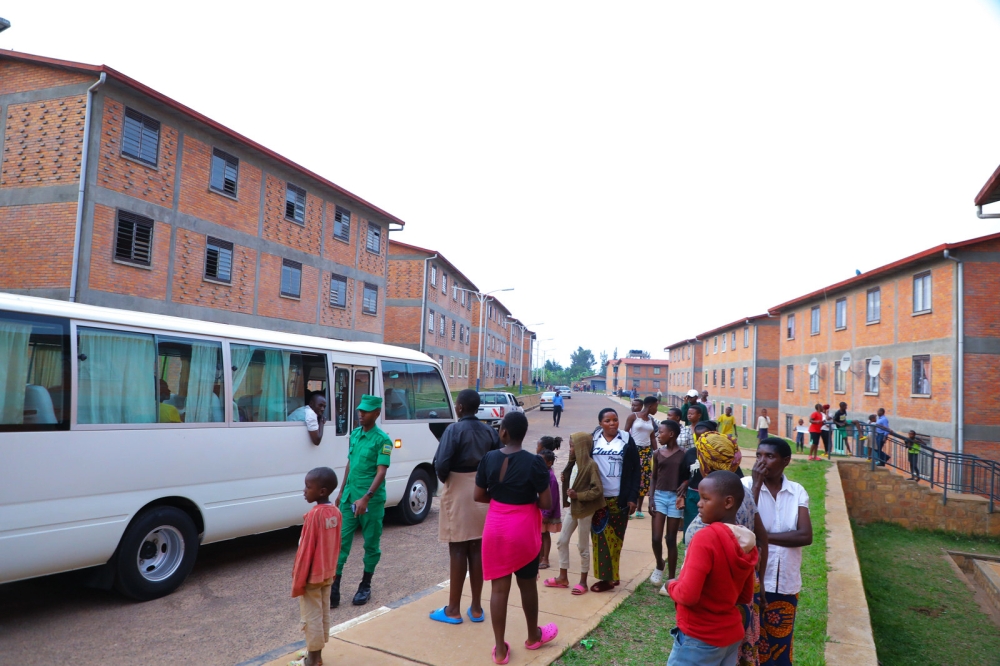
Construction at Busanza began in 2018. The initial phase envisaged approximately 1,040 apartments in three-storey blocks, accompanied by infrastructure and communal facilities. The estate represented a radically different form of housing from the houses, courtyards and incrementally developed properties of Kangondo.
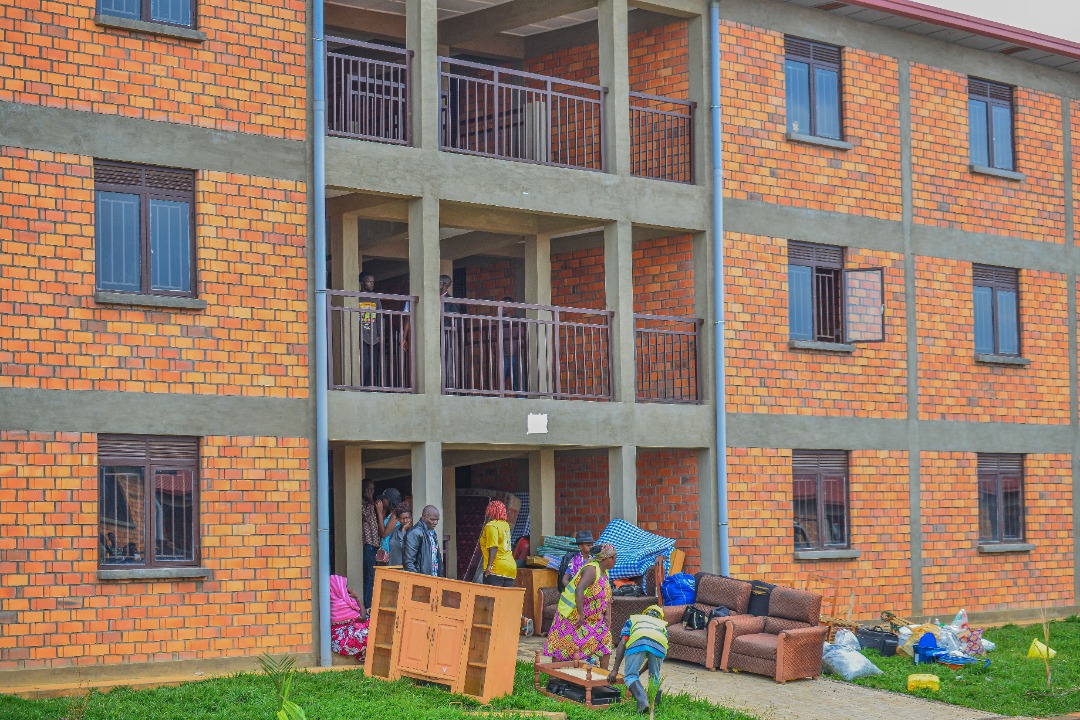
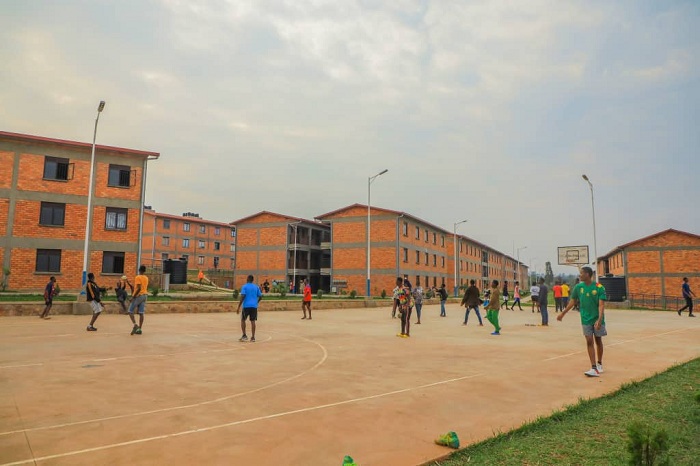
The improvements were real. New buildings provided more formal housing conditions, paved access and facilities that had been inadequate in parts of the former settlement. The estate also included recreational spaces. Kigali Today reported in September 2022 that some families welcomed their new homes and appreciated the better conditions and security. Yet the distance between Kangondo and Busanza was not simply a matter of kilometres.
Imagine a household that owns a modest house with four rooms, two of which are rented to other families. The rental income helps pay for food, school expenses and daily necessities. The household also has a small courtyard, where different activities take place. If that property is replaced by a new apartment, the family may gain a better-built dwelling but lose the additional rooms that supported its income. The walls have improved. The household economy may not have.
This was not merely a hypothetical concern. The research by Esmail and Corburn documented the importance of rental properties, household improvements and existing livelihoods for Kangondo residents. Subsequent research would show how these concerns continued after relocation.
There was also an important difference between owners and tenants. Owners could dispute property valuations and compensation, even when their claims were unsuccessful. Many tenants had no equivalent entitlement to replacement apartments through property compensation. Some non-titled households received assistance or housing under the authorities’ arrangements, but the experiences and legal positions of different groups were not identical.
Relocation also took much longer than originally anticipated. Although residents were already being told in 2019 that large-scale movement was imminent, the process continued through the following years. By September 2022, the disagreement had become particularly acute. Rwanda Today reported that hundreds of residents still resisted the compensation arrangements, despite many families having already moved to Busanza.
The final relocation phase took place in September and October 2022. Authorities presented the operation as an effort to move residents into safer, improved housing. Other reporting described a strong security presence and residents who felt compelled to leave. The conclusion of the process was not experienced uniformly: some households welcomed their new surroundings, while others continued disputing compensation and the loss of their former homes.
What happens after the moving trucks leave?
Much of the public discussion surrounding Bannyahe initially focused on expropriation, court cases and the construction of new apartments. But what happened after residents settled into Busanza Here we have especially useful evidence.
In 2025, a study published in the Journal of Global Health Economics and Policy examined the effects of redevelopment and relocation in Kigali. The researchers conducted six focus-group discussions in June 2023 with 85 participants across Busanza and Mpazi, another area of the capital where redevelopment had taken a different form. The results were revealing.
Participants recognised improvements in housing conditions, safety and protection from environmental risks. Busanza’s recreational spaces were also appreciated. But the study documented problems involving employment, income, maintenance, affordability and social relations.
Some former property owners had received one apartment in exchange for properties that previously generated income from several rental units. Others found themselves farther from their former businesses, clients or workplaces. Transport became an additional expense, while restrictions on modifying apartments limited the possibilities for adapting housing to household needs.
There were social consequences too. Residents described the difficulty of rebuilding relationships in a new environment and the weakening of neighbourhood support networks. Some households struggled with inadequate space, while others reported problems with drainage, maintenance and access to affordable healthcare.
The study was qualitative, so its findings should not be interpreted as a statistical assessment of every relocated family. They do, however, allow us to see something that the first photographs of the apartment buildings cannot show. A new house can solve one problem and create another. The researchers also compared Busanza with Mpazi, where some redevelopment occurred within the existing neighbourhood rather than through relocation to a distant site. The distinction is valuable: improving a home without moving its inhabitants away from familiar social and economic surroundings can preserve relationships that are otherwise difficult to reproduce.
In April 2024, the question of compensation was still generating legal consequences. As The New Times reported, Rwanda’s High Court recognised the entitlement of some previously relocated Kangondo and Kibiraro families to monetary compensation. The ruling showed that moving people into replacement housing had not automatically resolved every dispute over what they had lost.
A neighbourhood is more than its buildings
There is a temptation to compare Kangondo and Busanza through two photographs: one showing irregular housing and unpaved streets, the other showing modern apartment blocks and cleaner public spaces. If we judge the transformation exclusively through architecture, the conclusion may seem obvious.
But cities are not only made of buildings. They also depend on the relationships between housing and employment, the distance between homes and shops, the possibility of renting out a room, the neighbours who help look after children, and the streets where people have spent years developing their livelihoods.
Kangondo needed better infrastructure and housing conditions. That does not mean every resident needed to lose their place in the city to obtain them. Busanza provided material improvements, but those improvements did not necessarily compensate for every economic and social consequence of relocation.
This is why the story of Bannyahe is about more than a housing estate. It is about the difference between providing somebody with a new dwelling and allowing them to preserve the urban life they have built around their home. The buildings in Busanza are easy to see. Understanding what residents carried with them from Kangondo, and what they had to leave behind, requires looking beyond the buildings.