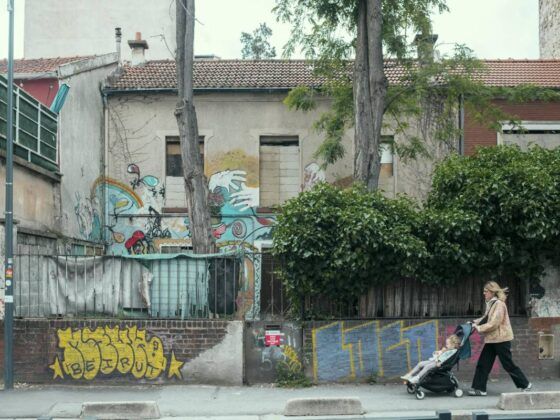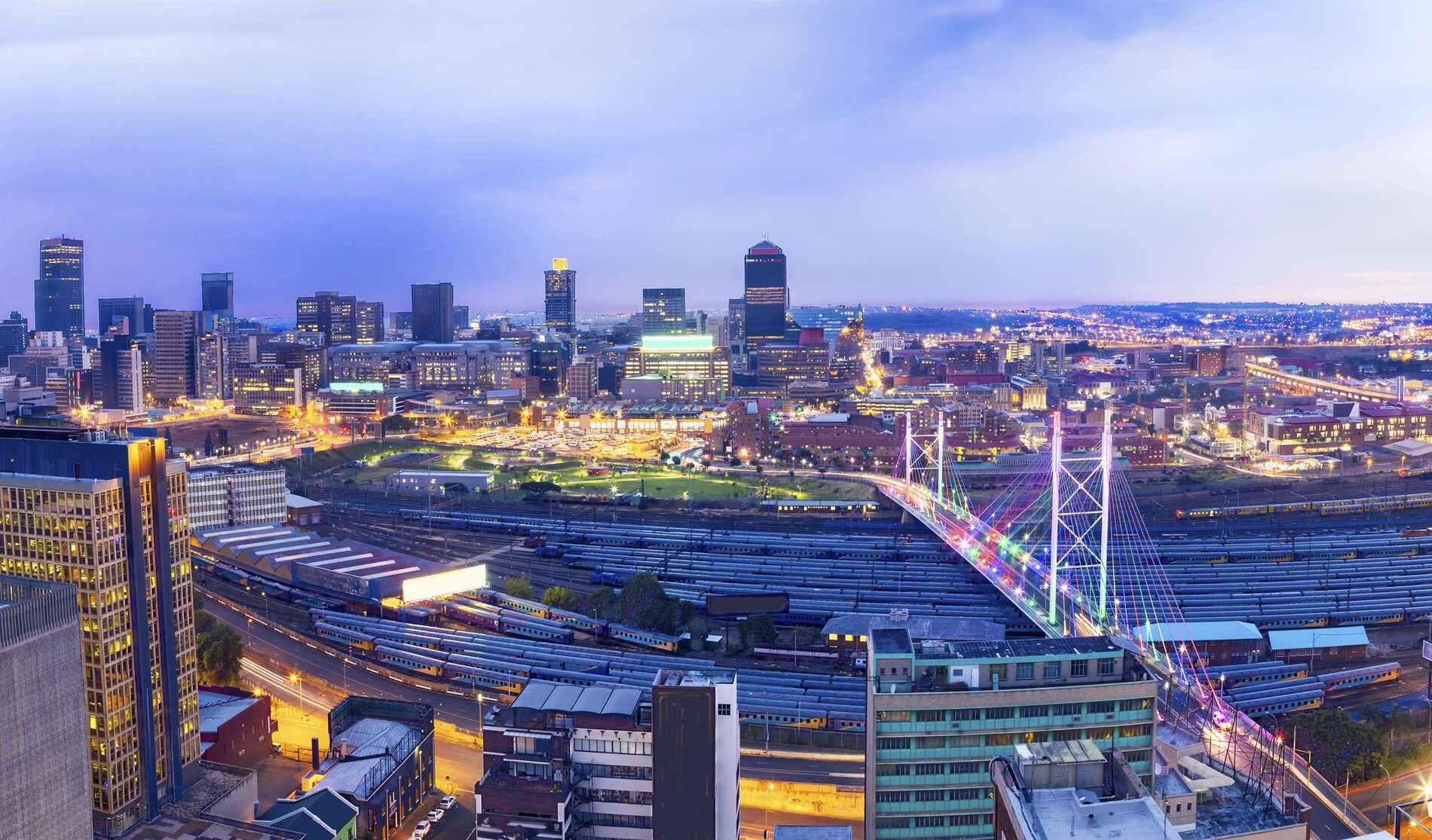
Johannesburg is not an easy city to summarise. It cannot be reduced to a single image, a single narrative or a single trajectory of urban change. It is at once a post-apartheid metropolis, a financial hub, a city of deep socio-spatial inequality, a landscape of infrastructural fragmentation and a laboratory of new forms of urban revalorisation.
This complexity is precisely what makes Johannesburg such a relevant case for URGENTLab. The Jo’burg working group aims to analyse how different forms of gentrification and urban revalorisation are unfolding across the city. Rather than assuming that gentrification follows one single model, the project starts from a different premise: Johannesburg is being transformed through multiple, uneven and sometimes contradictory processes.
Some spaces are reshaped through security, redevelopment and urban order. Others are transformed through cultural branding, tourism, ecological imaginaries or high-end residential and commercial upgrading. These processes do not advance at the same speed, nor do they produce the same effects. Some are already consolidated; others remain partial, uncertain or contested.
For this reason, URGENTLab Jo’burg approaches the city as a fragmented urban landscape where different vectors of gentrification coexist.
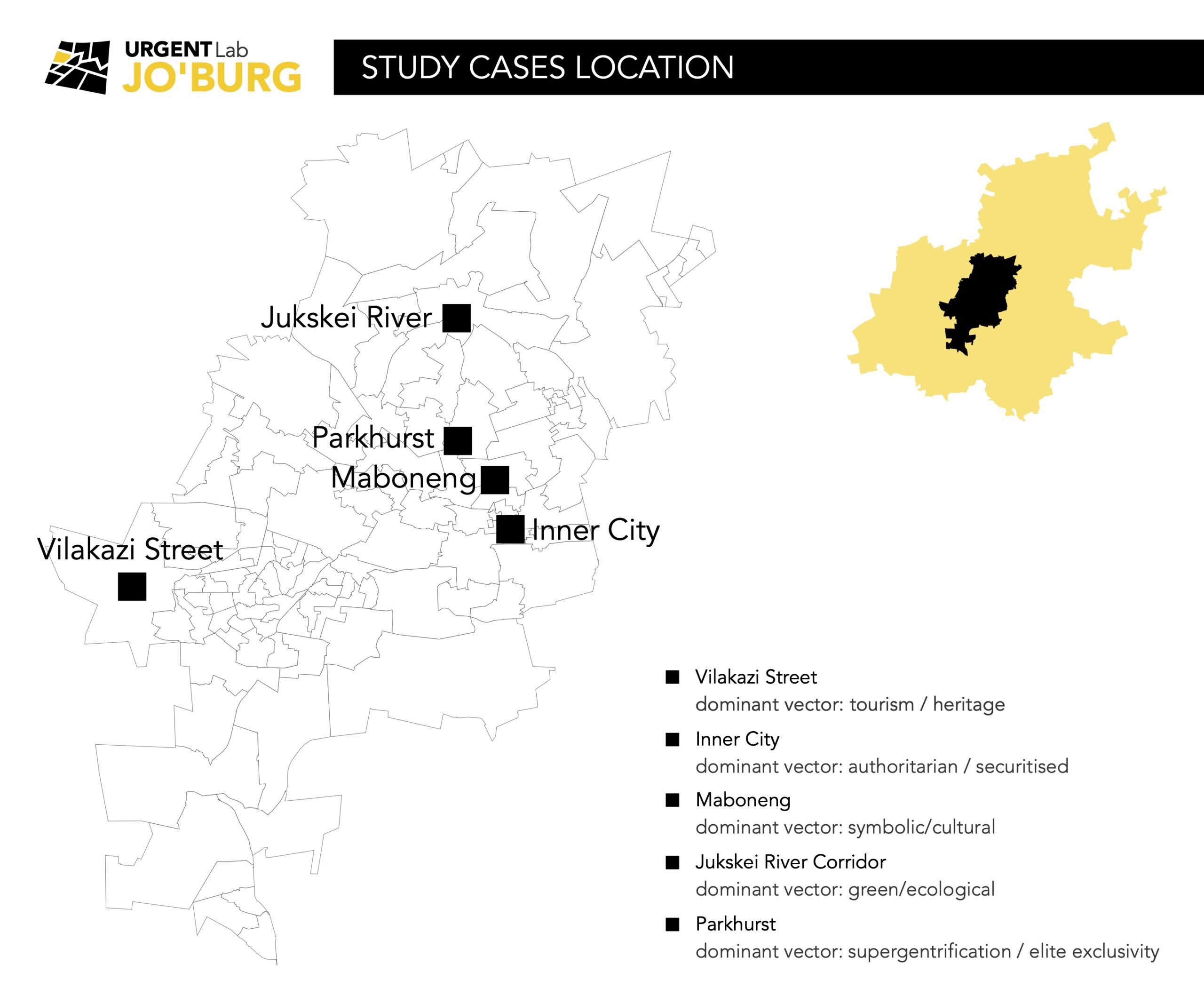
Five cases, five possible vectors
The project is structured around five case studies, each one associated with a potential dominant vector of gentrification.
The first case is the Inner City, where regeneration initiatives can be read through the lens of authoritarian or securitised gentrification. Here, the main question is how urban order, security, formalisation and redevelopment reshape central areas, and how these processes affect informal activities, low-income residents and everyday uses of space.
The second case is Maboneng, one of the most visible examples of symbolic urban transformation in Johannesburg. Its relevance lies not only in physical redevelopment, but also in the production of a new urban image. Maboneng has been associated with creativity, lifestyle consumption, cultural spaces, cafés, galleries and new representations of the inner city. It allows us to examine how symbolic capital can become a key mechanism of urban revalorisation.
The third case is Vilakazi Street, in Soweto. This case opens up the question of tourism-led gentrification. Vilakazi Street is internationally known because of its connection to Nelson Mandela and Desmond Tutu, and it has become a highly visible heritage and tourism destination. The project will analyse how tourism infrastructure, visitor-oriented businesses and heritage branding reshape local space, producing both opportunities and tensions.
The fourth case is the Jukskei River Corridor. This case is particularly important for thinking about green gentrification, although with caution. The aim is not to assume that the Jukskei River Corridor is already a fully consolidated case of green gentrification. Instead, the project asks whether ecological restoration, environmental narratives and green infrastructure can begin to reshape urban imaginaries, investment priorities and spatial expectations.
The fifth case is Parkhurst, which offers a possible lens into supergentrification or advanced affluent revalorisation. Parkhurst is associated with high-income residential and commercial landscapes, lifestyle consumption, restaurants, cafés, boutique businesses and property valorisation. Here, the project examines how already valued urban spaces may become increasingly exclusive.
A comparative framework
URGENTLab Jo’burg does not treat these five forms of gentrification as rigid or closed categories. They are analytical lenses. In practice, a case may contain more than one vector. A tourism-oriented area may also involve symbolic rebranding. A green intervention may also attract real estate interest. A high-income neighbourhood may include aesthetic, commercial and symbolic dimensions.
The value of the framework lies in its comparative capacity. It allows us to ask a common set of questions across different urban contexts: who is investing, what is physically changing, which businesses are appearing or disappearing, whether residents are being displaced, whether prices are rising, what kind of security is visible, how the area is being rebranded and what type of population is arriving.
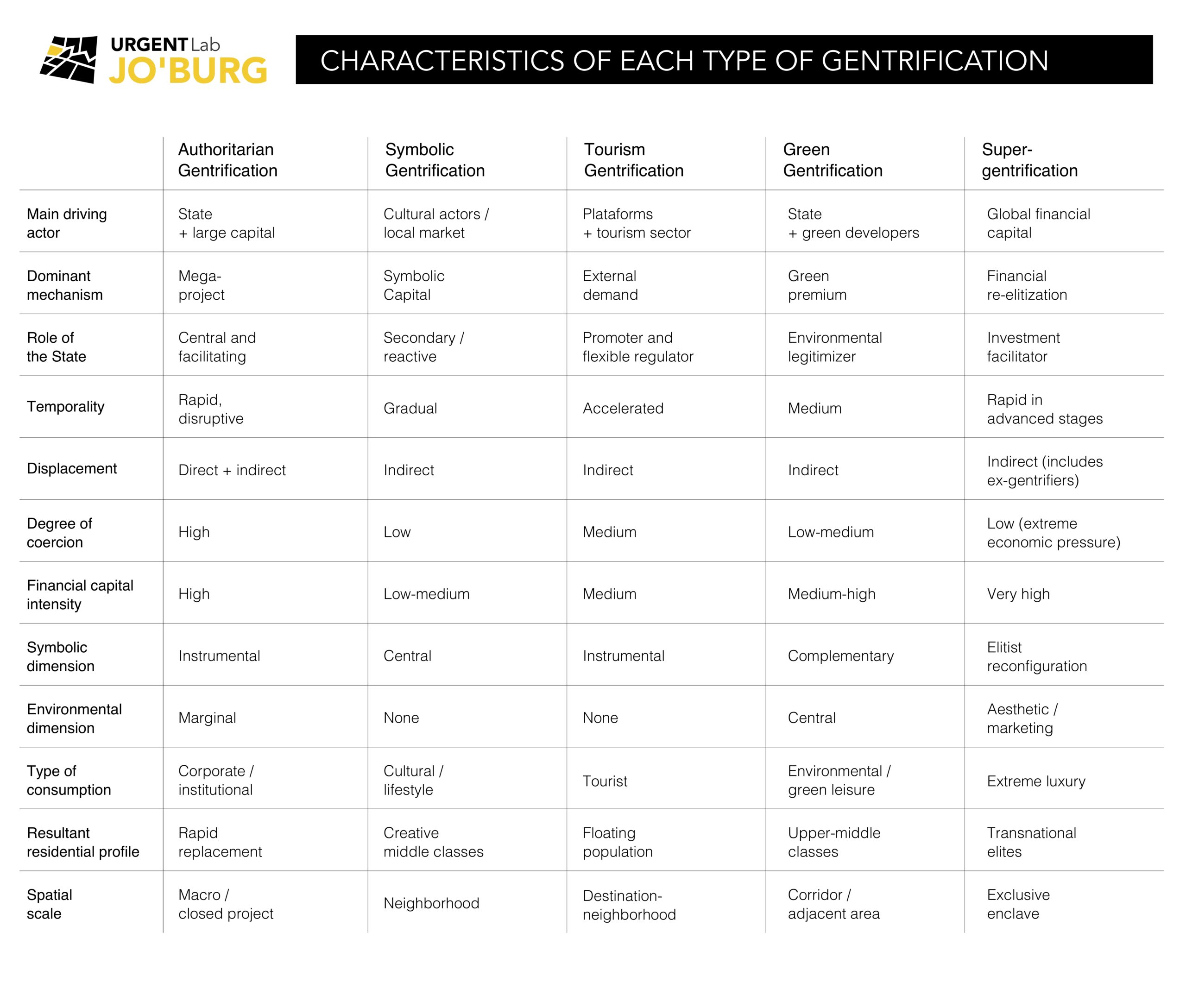
The typology compares authoritarian, symbolic, tourism, green and supergentrification across several dimensions: main actors, dominant mechanisms, role of the state, temporality, displacement, coercion, financial intensity, symbolic dimension, environmental dimension, consumption profile, residential profile and spatial scale.
This comparative approach helps avoid a common problem in gentrification studies: forcing every case into the same model. Johannesburg does not necessarily reproduce the classic sequence of disinvestment, reinvestment, middle-class arrival and direct residential displacement in a uniform way. In some cases, gentrification may appear through symbolic transformation. In others, through tourism, environmental upgrading, securitisation or elite consolidation.
For this reason, the project uses the broader idea of urban revalorisation. This concept allows us to analyse how urban space becomes newly valuable, visible, governable, desirable or consumable, even when the process is incomplete or ambiguous.
Identifying the dominant vector
One of the main methodological challenges of the project is to identify the dominant vector in each case without oversimplifying the complexity of the area. To do this, URGENTLab Jo’burg will use a set of guiding questions.
Who is investing? What is physically changing? What businesses are appearing? What businesses are disappearing? Are residents being displaced? Are rents or property prices increasing? Is there visible securitisation? Is the area being rebranded? Is the space increasingly oriented to outsiders? Is there a strong environmental intervention? Who is arriving? At what scale is change taking place?
These questions allow us to distinguish different patterns. If the main drivers are the state, developers and security-oriented redevelopment, the case may point toward authoritarian gentrification. If the transformation is led by cultural actors, galleries, creative spaces and lifestyle branding, it may point toward symbolic gentrification. If tourism businesses, short-term accommodation and visitor-oriented consumption dominate, tourism gentrification becomes relevant. If parks, river restoration, environmental upgrading or green infrastructure are central, the green vector becomes important. If high-end developers, luxury investors and elite consumption dominate, the case may be closer to supergentrification.
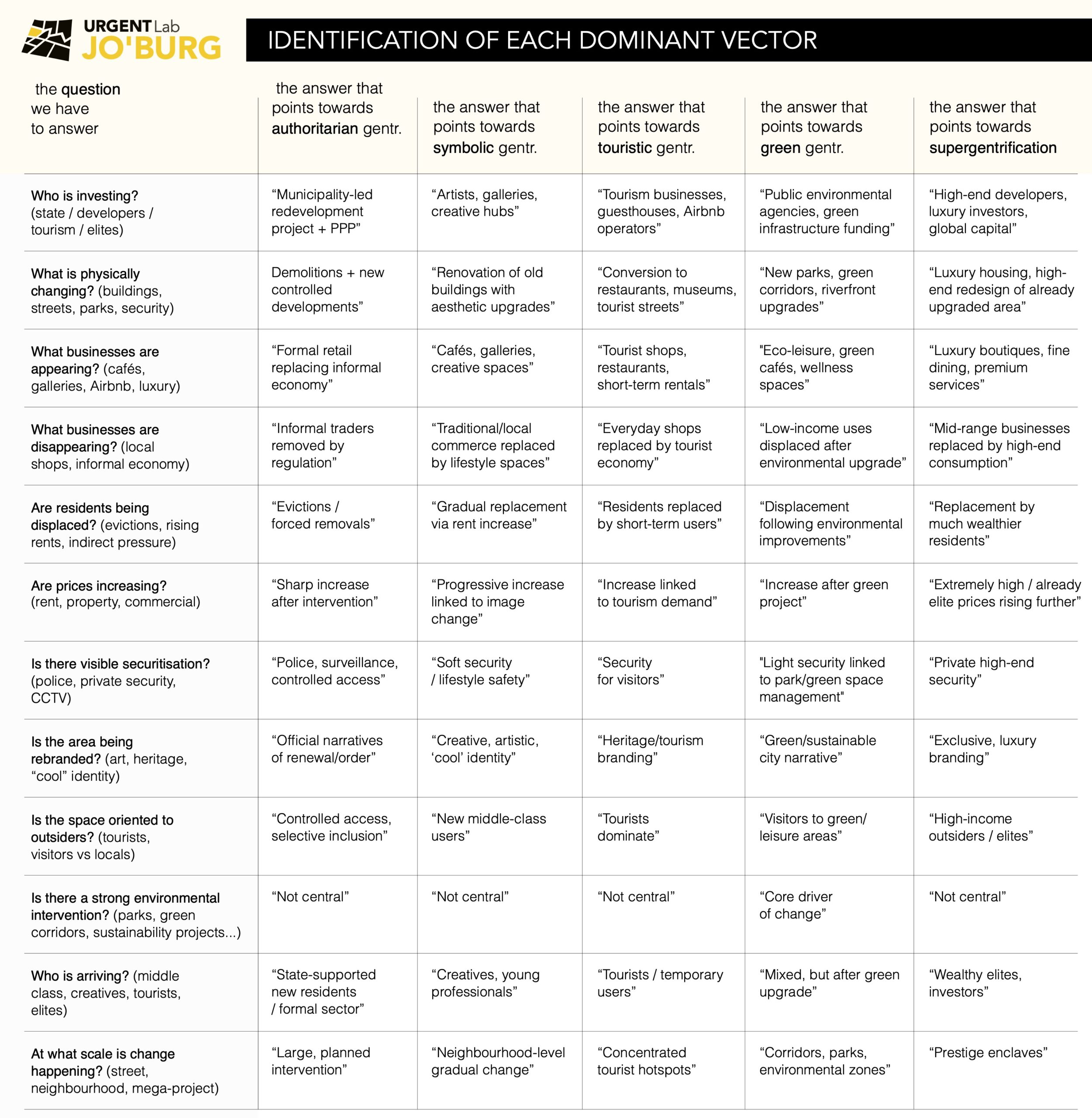
This does not mean that each case has only one explanation. The goal is not to label neighbourhoods mechanically, but to build a careful interpretation of dominant processes. The framework is useful precisely because it allows us to compare cases while remaining open to contradiction, overlap and uncertainty.
Research design and working process
The project combines conceptual analysis, case-study comparison and empirical observation. Each case will be studied through academic literature, planning documents, media sources, spatial observation and local knowledge. The aim is to produce a grounded comparative analysis of contemporary urban revalorisation in Johannesburg.
The working process is organised into several phases. First, the group defines and aligns the case studies, variables, indicators and research questions. Second, the team collects data across the five cases. Third, the cases are analysed jointly in order to identify dominant processes and refine interpretations. Fourth, the full draft of the paper is written. Fifth, the text is revised and unified. Finally, the paper is adjusted for submission.
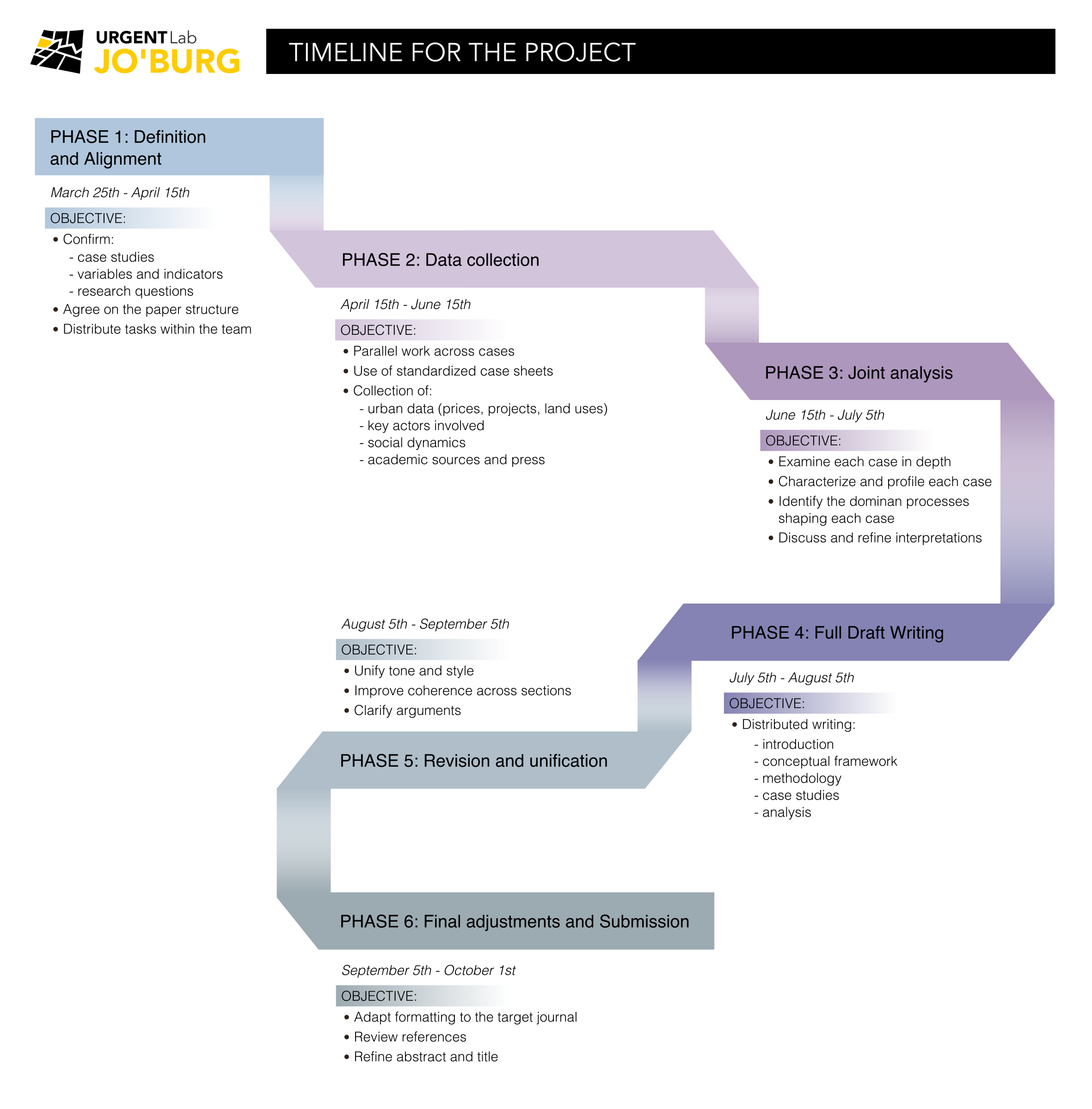
This phased structure is important because the project is collaborative. Each case requires attention to local conditions, spatial detail and specific sources. At the same time, the final paper needs a common analytical language. The challenge is to combine grounded case knowledge with a shared comparative framework.
Beyond a single model of gentrification
The main contribution of URGENTLab Jo’burg is its attempt to read gentrification as a plural, uneven and situated process. The project does not begin from the assumption that all five cases are fully consolidated examples of gentrification. Some may be advanced; others may be emerging, incomplete or contested. But all of them reveal how urban space can be revalorised through different mechanisms.
This distinction is crucial. In Johannesburg, gentrification is not only about residential replacement. It may also involve symbolic rebranding, commercial transformation, tourism-oriented consumption, securitised redevelopment, ecological upgrading or elite urban lifestyles. These processes may produce displacement directly, but they may also generate indirect forms of exclusion: rising costs, loss of accessibility, pressure on informal economies, selective visibility or changes in the social meaning of place.
Reading Johannesburg through these five vectors allows URGENTLab Jo’burg to ask a broader question: how does urban value change in a fragmented city?
A collaborative research agenda
URGENTLab Jo’burg is conceived as a collaborative research project. Its goal is to develop a comparative academic paper on uneven revalorisation in Johannesburg, but also to create a wider platform for discussion about gentrification in Southern cities.
The project is still developing. Its strength lies precisely in its open and comparative structure. By studying Inner City, Maboneng, Vilakazi Street, the Jukskei River Corridor and Parkhurst together, URGENTLab Jo’burg seeks to understand how different urban logics coexist within the same city.
Johannesburg does not offer one single story of urban change. It offers many: stories of redevelopment and abandonment, visibility and marginalisation, cultural reinvention and social tension, ecological promise and infrastructural inequality, elite consolidation and everyday precarity.
To understand Johannesburg, we need to read its fragments.
That is the starting point of URGENTLab Jo’burg.