VENTURA
  • Cultura
    • Videojuegos
    • Arte
    • Cine
    • Series
    • Literatura
    • Música
  • Divulgación
    • Geografía
    • Historia
    • Geopolítica
    • Seguridad
    • Desarrollo y Medio Ambiente
    • Ciencia y Tecnología
    • Economía
    • Religión y Teología
  • Educación
    • Historia
      • Historia (Secundaria)
        • Actividades y proyectos
        • Prehistoria
        • Historia Antigua
        • Antigua Grecia
        • Antigua Roma
        • Edad Media
        • Edad Moderna
        • UD 1 – Antiguo Régimen e Ilustración
        • UD2 – Liberalismo y nacionalismo
        • UD3 – Revolución Industrial
        • UD4 – España: S.XIX
        • UD5 – Imperialismo y 1ª GM
        • UD6 – Periodo de entreguerras
        • UD7 – Revolución rusa
        • UD8 – 2ª Guerra Mundial
        • UD9 – España: primer tercio S.XX
        • UD10 – Guerra Fría
        • UD11 – España: desde 1939
        • UD12 – El Tercer Mundo
        • UD13 – Un mundo en transformación
      • Historia (Bachillerato)
        • Edad Moderna
        • Edad Contemporánea
        • Liberalismo
        • La Restauración
        • Segunda República y Guerra Civil
        • Historia y Cultura de Aragón
    • Geografía
      • Geografía (Secundaria)
        • Actividades y proyectos
        • UD1 – La Geografía, una ciencia total
        • UD2 – Organización del territorio
        • UD3 – Geoeconomía y Geopolítica
        • UD4 – Sector primario
        • UD5 – Sector secundario
        • UD6 – Sector terciario
        • UD7 – Geografía de la población
        • UD8 – Geografía urbana
        • UD9 – Desarrollo y medioambiente
      • Geografía (Bachillerato)
        • Geografía de la Población
        • Geografía Urbana
        • Geografía Rural
        • Geografía Económica
        • Desarrollo y medioambiente
        • > Acceso a la Universidad
          • > > > Materiales para la EvAU 2024
          • > > > Materiales para la PAU 2025
      • Geografía (Universidad)
        • Geografía de la Población
        • Geografía de Hispanoamérica
        • Seminario para docentes
    • Bilingüe
      • History
      • Geography
    • Filosofía
      • 0. Listado de filósofos
      • 1. Los presocráticos y el arché
      • 2. Todo Platón
      • 3. Todo Aristóteles
      • 4. Todo Santo Tomás de Aquino
      • + El concepto de ‘sustancia’
      • + Filosofía en ‘Matrix’
    • Literatura
      • Ilustración y Romanticismo
      • Realismo
      • Generación del 27
      • El teatro
      • Literatura en el siglo XX
    • Historia del Arte
      • Pintura
      • Escultura
      • Arquitectura
    • Ciudadanía y Valores Éticos
    • Inglés
  • Reflexión
    • Reflexión sobre la Realidad
    • Reflexión sobre la Sociedad
  • AUTOR
  • BLOG
  • IDVA
  • RECURSOS
  • BMVA
  • LIBROS
  • VEN
  • MÁS
VENTURA
  • Divulgación
  • Cultura
  • Educación
  • Reflexión
  • Economic Geography & Geopolitics

Lesson 301 – Globalisation: the World connected

  • 22 mayo, 2016
  • 9.2K views
  • VENTURA Educación

We live in an increasingly globalised world. Globalisation refers to the greater interconnectedness and interdependence of people and places around the world. Globalisation propels and is propelled by spatial interaction -the connections and relations that develop among places and regions as a result of the movement or flow of people, goods, or information.

Spatial interaction and connectivity
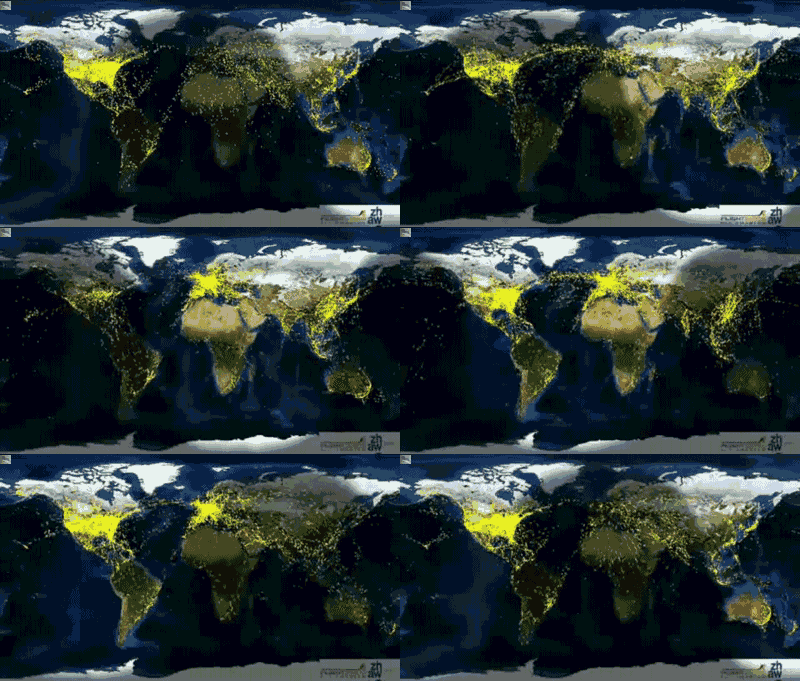
Global air traffic map in a day (24 hours)

Spatial interaction occurs in myriad ways as, for example, when you text a message to a friend, journey from home to work or transfer funds electronically. Technologies such as cellular networks, submarine cables and telephone land lines facilitate long-distance and international spatial interaction.

Those technological advances mean a closer connection between people (physically or virtually). In today’s world we can communicate with anyone in the planet thanks to the network of internet. Also, we can go to almost any place by plane, ship or car. This easy connections have -since 1980s- revolutionized our world and our lives. Globalisation has brought us together -for better or worse- and so life has changed a lot in the last three decades. A very short period of time if we think in a historical scale.
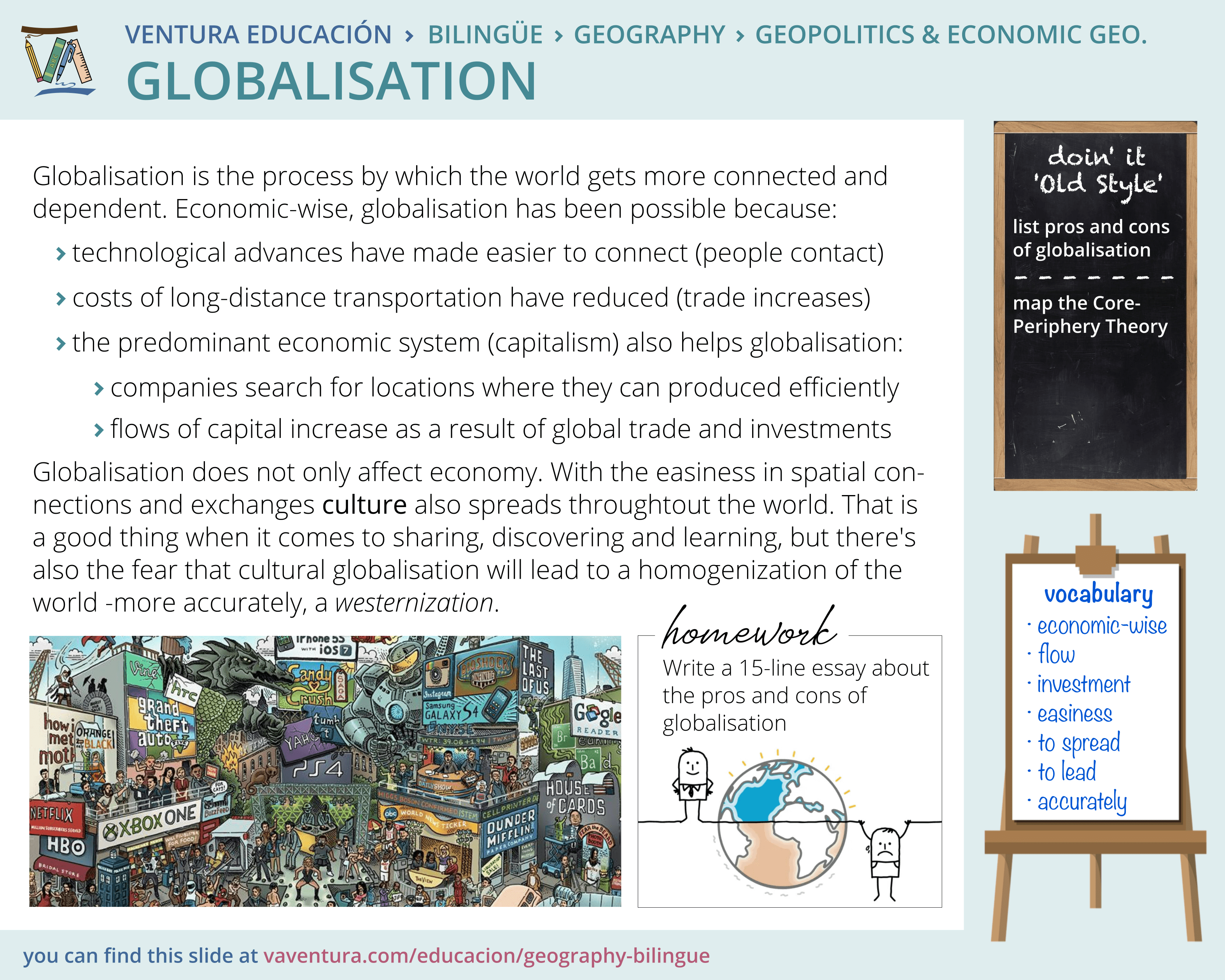
Cultural globalisation makes possible that in a town located deep in the Brazilian Amazon youngsters listen to K-Pop and follow the NBA. Also, it puts in European radios music from Colombia, and offers in Indian restaurants American dishes. Cultural globalisation threats to turn the world into a one-culture place. The endurance of the local culture is sometimes hard, but for sure will be necessary to keep the diversity of our planet.

One good way of experiencing globalisation without leaving your home is checking out some of the products that you already have as a result of this process. You may have not noticed, but globalisation has brought you many things. The next task invites students to analyse where do different goods in their homes come from. Looking at the labels on the things you have (clothes, food, smartphone…) you can understand the power of globalisation. It wouldn’t be a surprise if you had to mention countries that you never imagined were so «close» to you.

The World in your Pocket

.

DOWNLOAD THIS TASK

Globalisation… good for everybody?

If we divide the world into Core and Periphery, the Core would be the traditional economic and political center, while the Periphery would be those forgotten countries, far from Western’s point of view. The Core has lead and spread globalisation -so much that we could talk about a westernization-, and the Periphery has got this «present» without asking for it. Globalisation has brought to the Periphery:

  • new jobs -those they don’t want in the Core: low-skilled jobs.
  • new industrial regions that pollute their rivers, forests, air and lands. The new factories bring jobs, but also pollution!
  • accelerated urban growth: most of the largest cities are now in the Periphery. That’s not always a good thing: the larger the city, the more traffic jams, social problems, pollution and violence.
  • new cultural habits: changes in their culture (food, cinema, clothes, music, language…). That creates a clash of cultures that generates tension -sometimes even social unrest and revolts against cultural globalisation.
  • increase of social and economic inequalities (there are indeed more rich people, but that has only led to a higher gap between them and the poorest classes -who keep being poor despite having a job in the western industries).
Globalisation Cartoons

.

DOWNLOAD THIS TASK

Globalisation at risk?

Although globalisation helps big companies benefit of a global market and lower production costs, data shows a slow stabilization of the growth of this process. If we measure globalisation by the share that trade of goods has in the GDP, we get this graph:
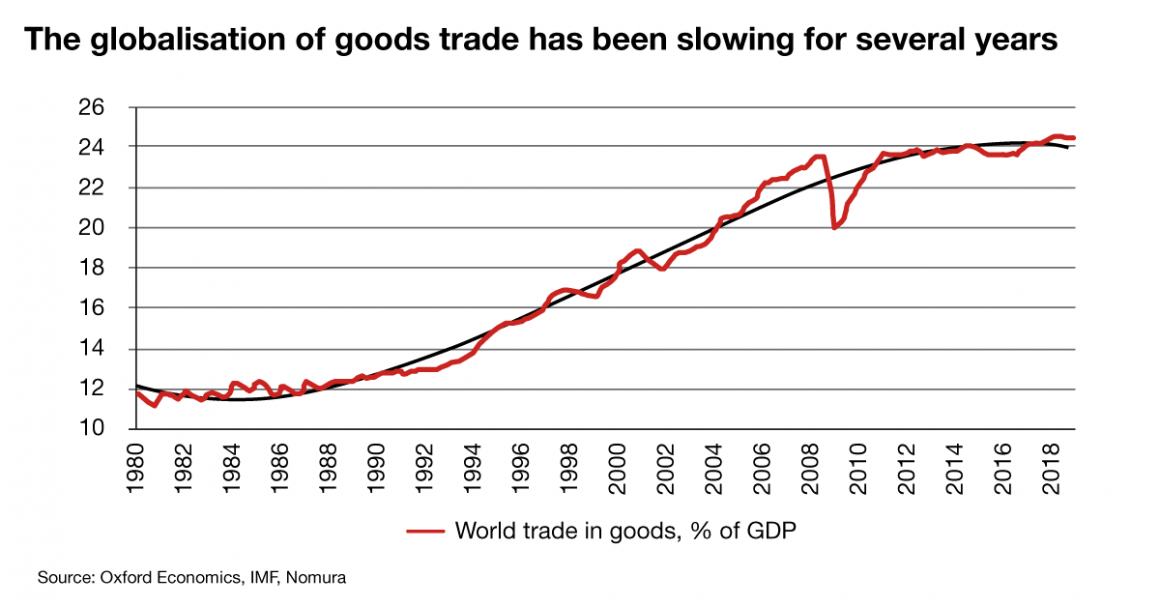
Two main reasons explain this slowing in the movement of capital flows throughout the planet:

  • Protectionism on the rise. The 2008 financial crisis gave birth to nationalisms and populisms that soon would reach power in several countries. Those new governments have rejected globalisation and embraced protectionism, looking more inside their nations than caring what’s going on outside their borders.
  • Reduction of differences in salaries around the World. The emergence of developing regions has reduced the gap between Core and Periphery’s salaries. This means companies have less interest in offshoring its production processes.

LEARN MORE!

➡️ El nacimiento del comercio internacional

➡️ Los países emergentes

➡️ Megalópolis, las ciudades más grandes del mundo

➡️ Una ciudad, dos mundos

➡️ La sociedad de consumo

➡️ Cuatro pueblos perdidos en el mundo incivilizado

Possible exam questions

Possible question 1

Define globalisation and mention three of its causes.

Possible question 2

What consequences has globalisation for the Periphery? Try to explain good consequences and bad ones.

Possible question 3

What is westernization?
VENTURA Educación

VENTURA Educación es un proyecto de VENTURA para crear materiales y apuntes de Historia, Literatura, Geografía, Inglés, Filosofía e Historia del Arte. Estudiantes y profesores pueden plantear dudas y pedir contenidos escribiendo a venturaeduca@gmail.com

Ver Publicación
  • Cine

Ciudades de película: las mejores películas por ciudad

  • Juan Pérez Ventura
  • 3 octubre, 2024
Ver Publicación
  • Teorías de la gentrificación

Gentrificación: propuesta de tipología y ejemplos de cada tipo

  • Juan Pérez Ventura
  • 16 junio, 2025
Ver Publicación
  • París

Estadios llenos, casas vacías: París 2024 y la gentrificación

  • Juan Pérez Ventura
  • 11 septiembre, 2024
Ver Publicación
  • Arte

Las fachadas de Salamanca

  • Juan Pérez Ventura
  • 16 mayo, 2024
Ver Publicación
  • Música

La Gran Migración del Blues

  • Juan Pérez Ventura
  • 23 noviembre, 2023
Ver Publicación
  • Religión

El debate central en el cristianismo: Jesús, ¿Hijo de Dios o Dios?

  • Juan Pérez Ventura
  • 1 agosto, 2024
Ver Publicación
  • Economía

El siglo de China: presencia en la economía global

  • Juan Pérez Ventura
  • 18 diciembre, 2024
Ver Publicación
  • Arte
  • Literatura
  • Religión

Bajando al Infierno (I): las legiones de Astaroth

  • Juan Pérez Ventura
  • 26 septiembre, 2024
Social Accounts
Facebook Likes
Twitter Followers
Instagram Followers
LinkedIn Followers
  • China, del Gran Salto Adelante a la Cara Oculta de la LunaChina, del Gran Salto Adelante a la Cara Oculta de la Luna
    El poder que hoy tiene China en el escenario global se hace mucho más sorprendente cuando se repasa de dónde viene el país. Las últimas décadas son una pequeña gota…
  • Basquiat, la rebeldía del arte urbanoBasquiat, la rebeldía del arte urbano
    En la escena vertiginosa y contradictoria del Nueva York de los años 80, emergió un genio que rompió barreras culturales, raciales y artísticas, redefiniendo para siempre el significado de la…
  • Aprender con ‘Las Meninas’: historias, Historia, Historia del ArteAprender con ‘Las Meninas’: historias, Historia, Historia del Arte
    Aprendemos Historia, Historia del Arte y también historias a través de 'Las Meninas', uno de los cuadros más interesantes y fascinantes de la historia.
  • La Flota Fantasma de RusiaLa Flota Fantasma de Rusia
    A primera hora del domingo 14 de junio de 2026, la Marina Real británica interceptó en el Canal de la Mancha un petrolero identificado como SMYRTOS, supuestamente vinculado a la…
  • Cuatro cuentos para no dormirCuatro cuentos para no dormir
    No sigas leyendo. No te va a gustar lo que cuentan las frases que siguen. En las profundidades de la noche, cuando las sombras se alargan y el viento murmura secretos…
  • Roma frente a Germania: los límites de un imperioRoma frente a Germania: los límites de un imperio
    Durante siglos, Roma extendió sus dominios desde las costas atlánticas hasta los desiertos de Siria y desde las montañas de Escocia hasta el norte de África. Incorporó territorios inmensos, derrotó…
  • Bretton Woods y el nuevo orden mundialBretton Woods y el nuevo orden mundial
    Una de las cuestiones que caracterizó a la Segunda Guerra Mundial y que la distingue de otras guerras importantes fue la cuidadosa planificación que se hizo durante el conflicto de…
VENTURA
  • AUTOR
  • BLOG
  • IDVA
  • RECURSOS
  • BMVA
  • LIBROS
  • VEN
  • MÁS
venturacontenidos@gmail.com

Ingresa las palabras de la búsqueda y presiona Enter.