Urban regeneration has become one of the dominant languages of contemporary city planning. Across the world, municipalities, developers and international agencies increasingly speak of revitalization, sustainability, resilience, climate adaptation, river restoration, public space recovery, low-carbon districts, green corridors and nature-based solutions. These words are not empty. Many of these interventions produce real benefits: cleaner rivers, new parks, safer streets, improved mobility, restored waterfronts, better environmental quality and more accessible public spaces. But urban improvement does not automatically produce social justice.
A park can improve the quality of life in a neighbourhood, but it can also increase land values and attract new residents with higher purchasing power. A river restoration project can reduce flood risk, but it can also justify the removal of informal settlements from valuable urban land. A new eco-district can promote sustainable mobility and energy efficiency, but it can also become an exclusive enclave for middle- and upper-income groups. A waterfront redevelopment can promise public access to nature while simultaneously producing extraordinary private real-estate gains.
This is the central contradiction behind green gentrification: environmental improvement may be real, but its benefits can be captured unequally.
The problem is not greening itself. Cities urgently need more trees, more shade, more parks, better public transport, cleaner rivers and stronger climate adaptation. The problem begins when environmental transformation becomes attached to real-estate revalorization, weak housing protection, selective urban branding and the displacement of vulnerable residents, workers or livelihoods. In those cases, the city becomes greener, but not necessarily fairer. This is where the PRG Index —Potential Risk of Gentrification— can be useful.
The PRG is not a green gentrification index. It is not designed exclusively to measure the gentrifying potential of parks, eco-districts, river restorations or climate adaptation projects. It is a broader analytical tool for assessing the potential risk of gentrification associated with urban projects, plans or regeneration strategies in general. Its purpose is to identify the structural conditions under which an urban intervention may activate land revalorization, socio-spatial exclusion or displacement.
However, because the PRG includes an ecological/green dimension, it can also detect when environmental improvement becomes part of a gentrification process. In other words, the index does not measure green gentrification as a separate phenomenon detached from wider urban revalorization. Rather, it identifies when green mechanisms —parks, waterfront restoration, climate security, ecological branding, sustainable mobility or attractive microclimates— help enact broader processes of gentrification.
That distinction is important. The PRG does not assume that green urbanism is inherently exclusionary. It does not claim that a park, a river restoration project or a sustainable mobility corridor necessarily produces displacement. It asks a more precise question: under what conditions can environmental improvement become a mechanism of urban revalorization and socio-spatial exclusion?
The PRG is therefore not an anti-green tool. It is a critical planning and research instrument. Its value lies in connecting environmental transformation with the wider political economy of urban land, housing markets, symbolic value, community participation and social protection.
From diagnosing gentrification to anticipating it
One of the major problems in the study of gentrification is that we often identify it too late. Researchers, journalists and communities frequently recognize the process once its consequences are already visible: rents have increased, local shops have closed, tourist-oriented businesses have replaced everyday services, new housing has become unaffordable, or long-term residents have already left. At that point, the analysis may be accurate, but prevention becomes much harder.
The PRG Index responds to this limitation by working as an early-warning tool. It does not claim to predict the future with certainty. A high PRG score does not mean that displacement will inevitably occur. Rather, it indicates that a project contains structural conditions that may make exclusionary revalorization more likely if no strong safeguards are introduced.
This distinction is crucial: the PRG measures risk, not destiny.
Its value lies in moving the debate from retrospective diagnosis to ex-ante evaluation. Instead of asking only what happened after a project was completed, the index asks what may happen if current project conditions remain unchanged. This is especially important for large urban projects that are still in planning, construction, commercialization, land reclamation or early implementation. In those cases, the social consequences are not fully consolidated yet, and public authorities, communities and planners may still intervene.
The PRG does not measure whether an urban project is “good” or “bad”. Nor does it claim to determine whether gentrification has already occurred. Its purpose is more specific: to identify the structural conditions under which an urban intervention may generate gentrification risk.
In practical terms, the index allows researchers, planners, public institutions and community organizations to ask a simple but decisive question before a project is fully implemented: does this intervention improve the city while protecting existing residents and communities, or does it create the conditions for future displacement?
How the PRG Index works
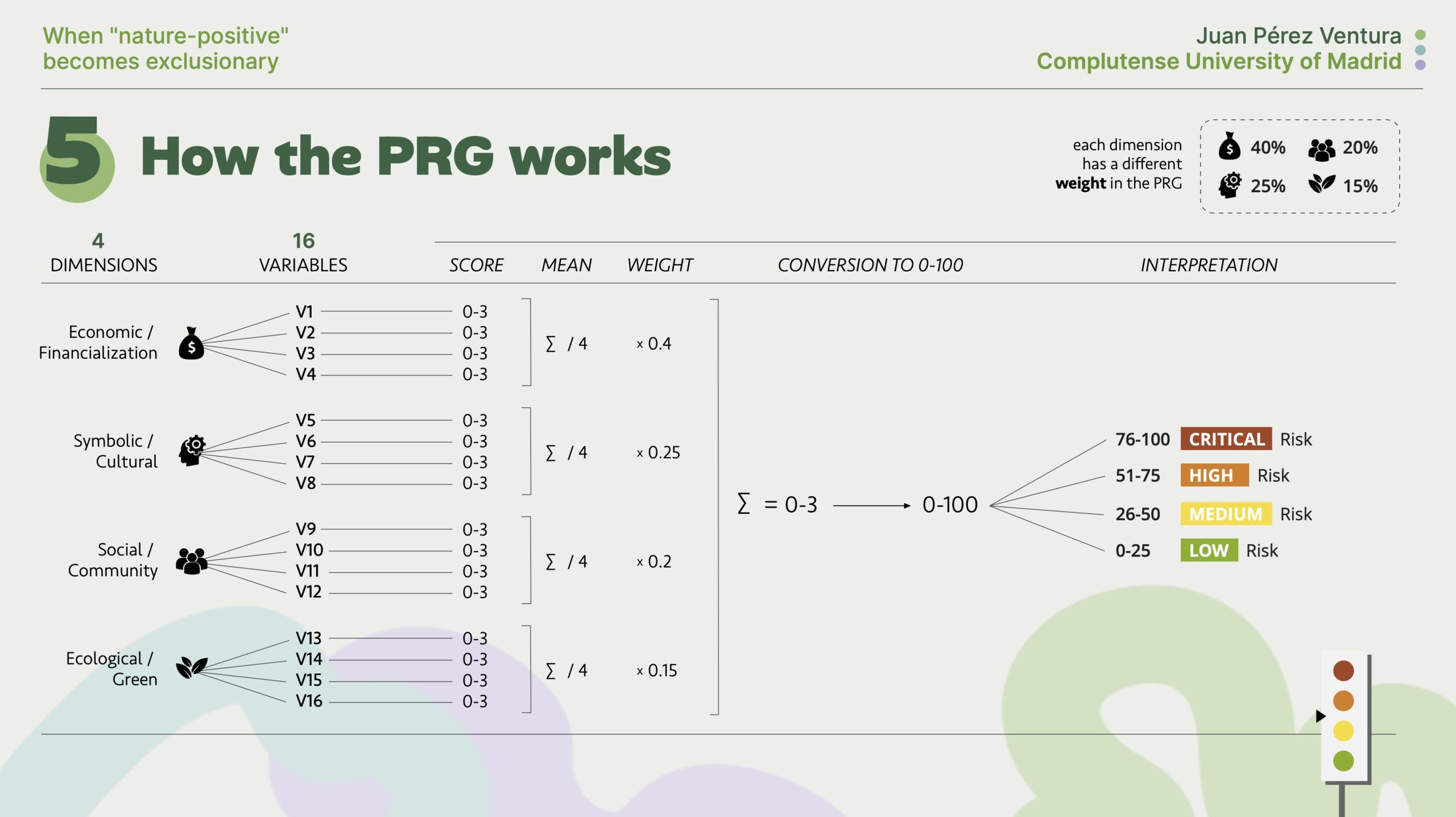
The PRG is based on a multidimensional understanding of gentrification. It does not reduce the process to housing prices, nor to the arrival of new residents, nor to the creation of parks. Contemporary gentrification usually emerges from the interaction between several dimensions: economic, symbolic, social and ecological.
For this reason, the index is structured around four weighted dimensions.
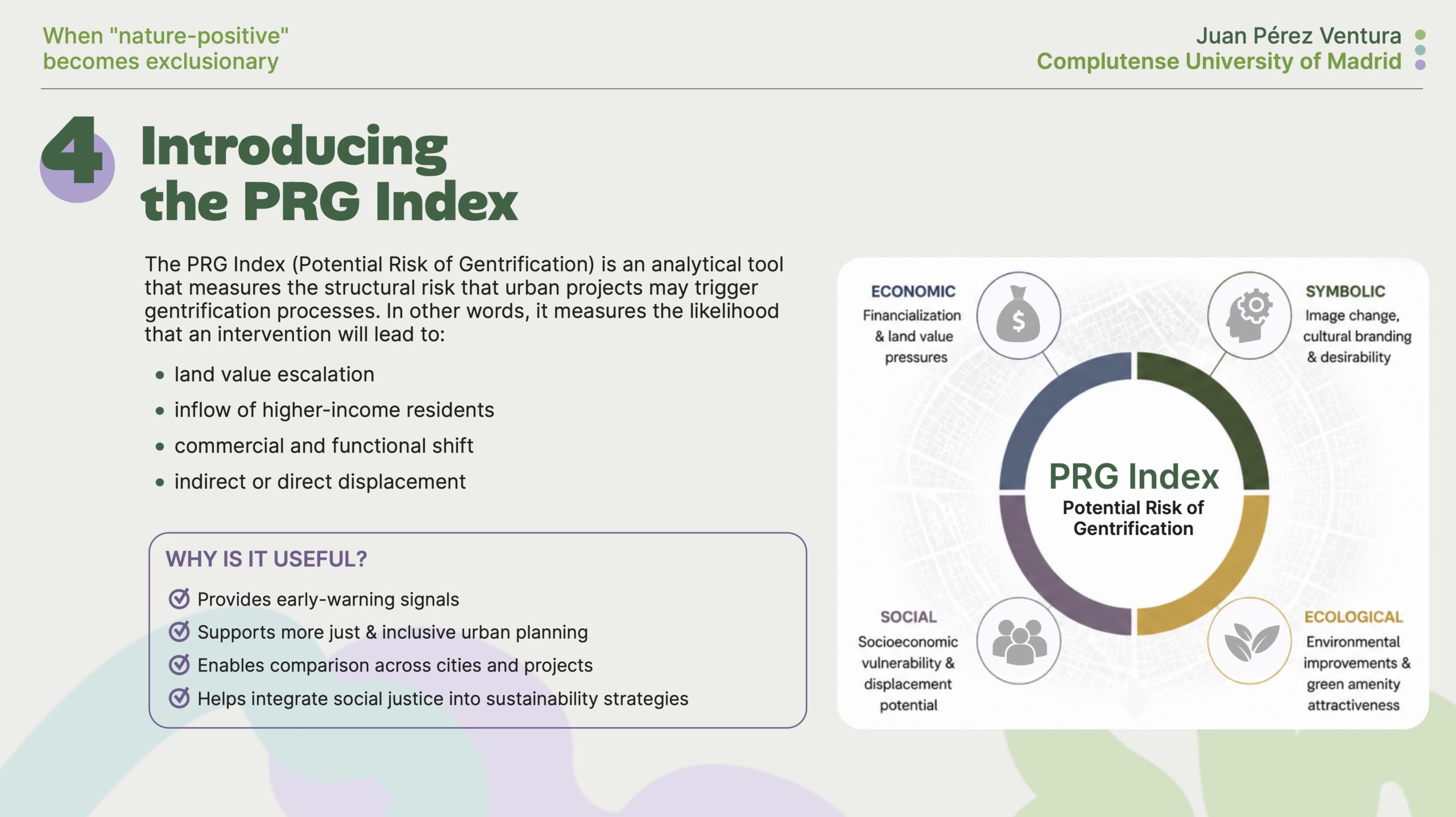
The economic dimension receives the highest weight because land value, real-estate investment and financial actors are usually central to the production of exclusionary urban transformation. But the index also incorporates symbolic, social and ecological factors, recognizing that contemporary gentrification is often legitimized, accelerated or intensified through culture, branding, sustainability and urban desirability.
The symbolic dimension analyses how a project changes the meaning, image and desirability of a place. A neighbourhood can become more valuable not only because its buildings are renovated, but because it is rebranded as attractive, vibrant, sustainable, historic, creative or culturally distinctive.
The social dimension focuses on who is protected, who participates and who may be left behind. It evaluates the presence or absence of affordable housing, the degree of community participation, the existence of local resistance and the potential impact on local networks, everyday services and community life. This dimension is essential because gentrification is ultimately not only a question of value creation, but of unequal access to that value.
The ecological dimension examines the role of environmental improvement in urban revalorization. It considers new green spaces, sustainable mobility infrastructure, environmental certifications, climate adaptation, microclimatic improvements and green branding. This dimension is especially relevant for analysing green gentrification, but it does not operate in isolation. A park or river restoration project becomes socially risky when it interacts with real-estate pressure, weak housing safeguards, symbolic upgrading and uneven access to environmental benefits.
Each dimension is broken down into four variables, producing a total of sixteen variables. These include projected housing price increases, the presence of large developers, public land transfers, high-income residential production, urban marketing, touristification, aestheticization of public space, affordable housing, community participation, local resistance, impacts on social networks, new green spaces, sustainable mobility, environmental marketing and climate gentrification potential.
Each variable is scored from 0 to 3:
- 0 means the phenomenon is absent, marginal or clearly mitigated.
- 1 means the phenomenon is present in a limited or secondary way.
- 2 means the phenomenon is clearly observable and relevant to the project.
- 3 means the phenomenon is central to the project and acts as a major driver of revalorization or exclusion.
The final result is converted into a score from 0 to 100.
The purpose of this scoring system is not to create a false impression of mathematical certainty. Urban processes always require interpretation. But the PRG makes that interpretation explicit, traceable and comparable. Instead of saying that a project “seems gentrifying”, the index requires the researcher to justify each score through evidence.
That is its methodological strength: it transforms qualitative and documentary evidence into a structured comparative diagnosis.
Why apply a general gentrification-risk index to green projects?
Although the PRG can be applied to many types of urban regeneration projects, green urbanism provides a particularly revealing field of application. This is because environmental projects often combine several elements that are central to contemporary urban revalorization: land transformation, new public spaces, symbolic branding, climate adaptation, housing market pressure, lifestyle narratives and uneven access to newly improved environments.
Green projects are also politically complex. They are often difficult to criticize because they respond to real urban problems: pollution, lack of public space, flood risk, heat stress, degraded rivers or insufficient access to nature. But precisely because their environmental benefits are real, their social risks can become less visible.
The PRG helps address this problem. It does not ask whether a project is green. It asks whether greening is connected to broader dynamics of revalorization, exclusion or displacement.
This is why the eight cases analysed here are useful. They are not selected because the PRG is limited to green urbanism. They are selected because they allow us to observe how environmental improvement can interact with land markets, symbolic branding, housing vulnerability, community participation, ecological upgrading and social safeguards.
The PRG can therefore detect the mechanisms through which green gentrification is enacted. It can show whether risk emerges through luxury urbanism, climate adaptation, infrastructural centrality, land reclamation, waterfront redevelopment, eco-district planning or the formalization of informal settlements.
Applying the PRG to eight ongoing green urban projects
The most important application of the PRG is ex-ante. In this case, the index has been applied to eight ongoing green urban projects: four in the Global North and four in the Global South. These projects are not yet fully completed or socially consolidated. That is precisely why they are useful: they allow us to evaluate risk before the full effects of transformation become irreversible.
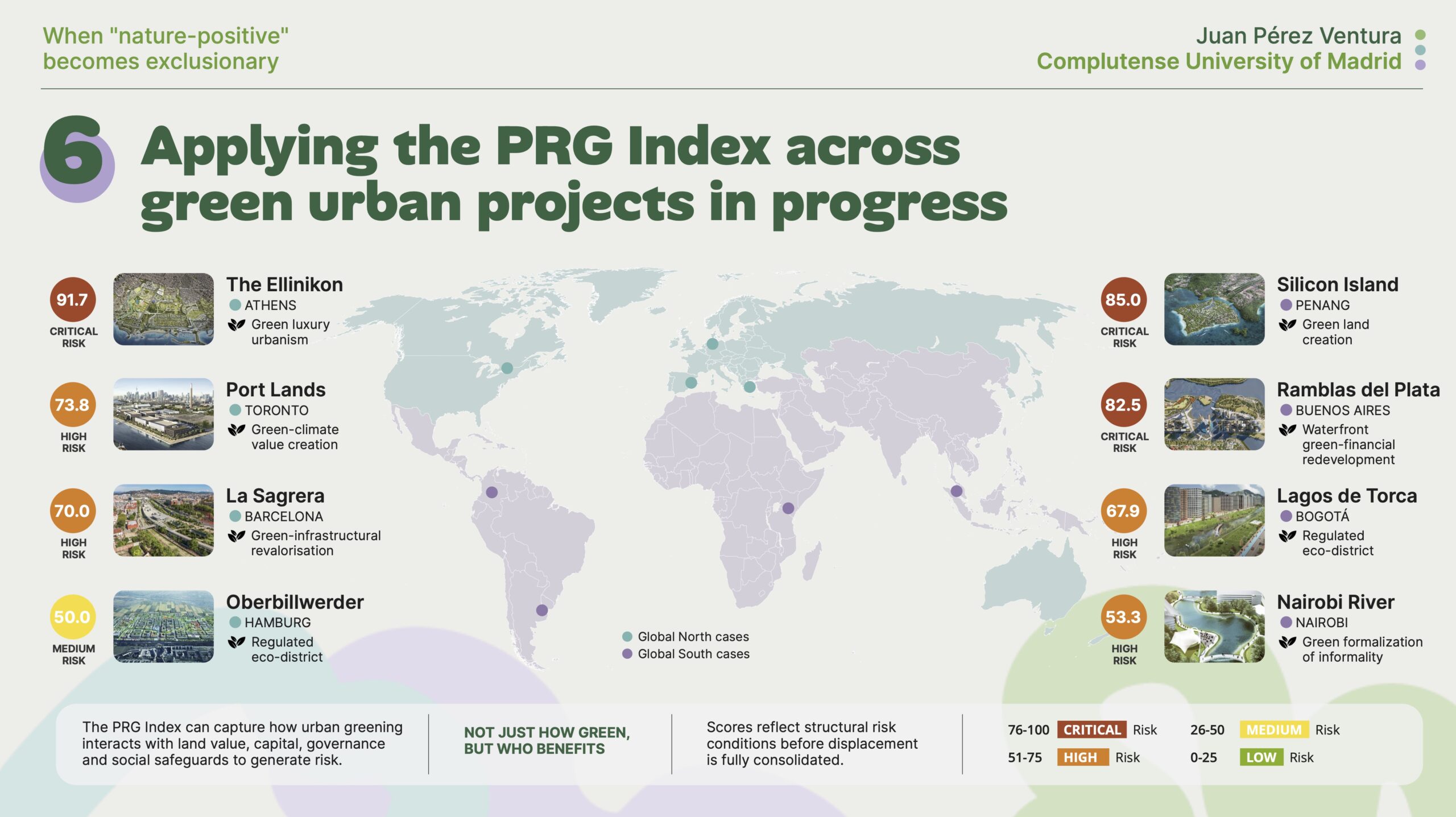
The results are revealing. They do not show that all green projects are equally risky. Nor do they suggest that the Global South is automatically more vulnerable, or that the Global North is automatically better protected. The highest score in the whole sample is The Ellinikon in Athens, with a critical PRG score of 91.7. At the same time, Silicon Island in Penang and Ramblas del Plata in Buenos Aires also fall within the critical range.
The real lesson is more interesting: green gentrification is not a single process: it is a family of risk architectures.
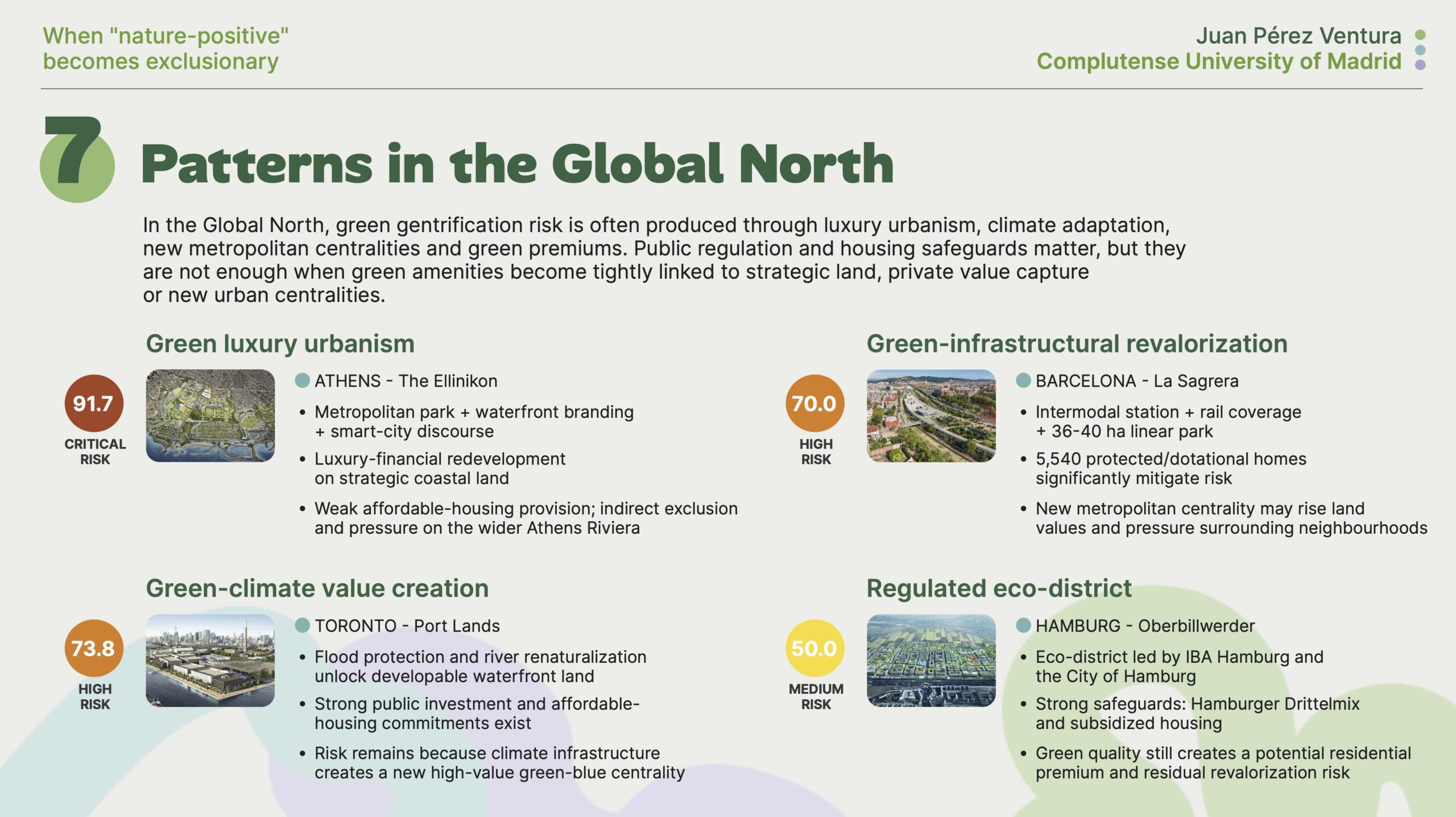
The Ellinikon: green luxury urbanism
The Ellinikon, in Athens, receives the highest score in the sample: 91.7, classified as critical risk. The project is being developed on the site of the former Ellinikon International Airport and Olympic facilities. It includes a large coastal park, public spaces, luxury housing, the Riviera Tower and the Hard Rock Hotel & Casino Athens.
The PRG score is critical because the project combines strategic land transformation, large-scale private capital and luxury-oriented urbanism. The former airport site is transformed into a high-end coastal district, marketed through the Athens Riviera, smart city narratives, Mediterranean lifestyle, iconic architecture, beaches, marina, casino and global waterfront branding.
This is not a case of direct displacement from a consolidated working-class neighbourhood inside the site. The risk is different: strategic land capture, luxury development, weak affordable-housing provision, functional exclusion and indirect pressure on the wider Athens Riviera.
The Ellinikon shows one of the clearest mechanisms through which green gentrification can be enacted: environmental improvement becomes part of a luxury-financial urban model. The park is real, but it also legitimizes an exclusive urban operation.
Port Lands: climate adaptation as value creation
Toronto’s Port Lands / Ookwemin Minising receives a PRG score of 73.8, placing it in the high-risk category. The project is built around flood protection, river renaturalization and the creation of a new island at the mouth of the Don River. Biidaasige Park opened in 2025, while future residential development is still pending.
This case is particularly interesting because the main driver is not traditional beautification, but climate adaptation. Flood protection and ecological restoration transform land previously constrained by flood risk into safe, attractive and developable waterfront land.
The green dimension reaches the maximum score in the PRG assessment. Parks, wetlands, trees, flood protection, river renaturalization, bioswales, permeable pavements and water-sensitive design are not secondary elements; they are the foundation of the project’s future urban value.
Again, the risk is not direct displacement from an existing residential neighbourhood on the new island. The risk is anticipatory and climate-infrastructural: public investment in environmental security creates a new waterfront centrality before its future social composition is settled. Port Lands shows how climate adaptation can become a mechanism of land-value creation.
La Sagrera: infrastructure, park and metropolitan centrality
La Sagrera, in Barcelona, receives a PRG score of 70.0, also classified as high risk. The project is linked to the future high-speed railway station, the covering of railway tracks, a large linear park and the creation of a new residential and economic centrality between Sant Andreu and Sant Martí.
The risk here comes from the combination of green infrastructure and metropolitan accessibility. The future station, the linear park, new housing, offices, hotels, public facilities and the stitching together of previously separated urban areas create strong conditions for land revalorization.
However, La Sagrera is not a case of luxury-led green gentrification. Its risk is moderated by a significant amount of protected and dotational housing. The project includes more than 11,000 homes, almost half of them protected or dotational. This does not eliminate risk, but it prevents the project from becoming a purely elitist operation.
La Sagrera is best understood as regulated green-infrastructural revalorization: a project where public planning and housing safeguards reduce risk, but where the creation of a new metropolitan centrality may still generate strong pressure on surrounding neighbourhoods.
Oberbillwerder: a counterpoint case
Oberbillwerder, in Hamburg, receives a PRG score of 50.0, placing it at the upper edge of medium risk. This is an important case because it shows that the PRG does not automatically penalize green urbanism.
The project is planned as a new eco-district on Hamburg’s eastern edge, with thousands of homes, jobs, schools, social facilities, mobility hubs, green areas and water infrastructure. Its ecological dimension is strong: the Green Loop, canals, water retention areas, sustainable mobility, renewable energy, photovoltaic systems and climate adaptation are central to the project.
However, the overall score is lower because the project includes significant mitigation mechanisms. It is led by public institutions, not by a dominant private developer. The housing model is mixed, and the Hamburg Drittelmix plus subsidized housing reduce the probability of extreme elitization.
Oberbillwerder is therefore a counterpoint case. It shows that green urbanism can produce value without necessarily becoming critical green gentrification. Public leadership, subsidized housing and planning regulation matter. But the score also reminds us that mitigation is not the same as absence of risk. A new environmentally attractive district may still produce a residential premium. The PRG captures this ambivalence.
Silicon Island: land creation and livelihood displacement
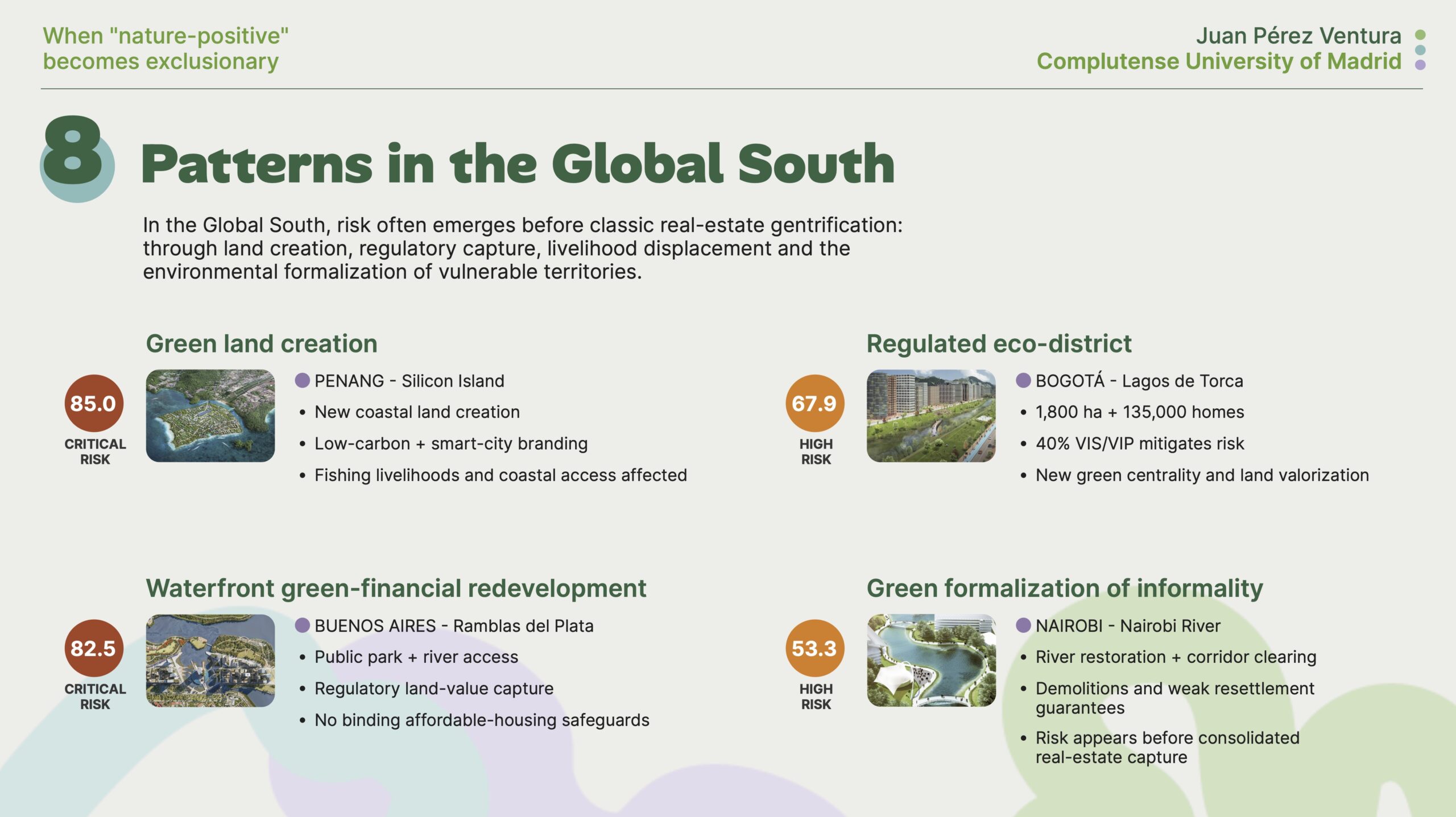
Silicon Island, in Penang, receives a critical PRG score of 85.0. This is one of the most distinctive cases in the sample because the project is not transforming an existing neighbourhood in the conventional sense. It is creating new coastal land through reclamation.
The project is planned as an artificial island linked to technological industry, waterfront development, future transport infrastructure and low-carbon urbanism. Its ecological dimension reaches the maximum score because sustainability is central to the project: green spaces, parks, beaches, mangroves, pedestrian and cycling routes, LRT connection, low-carbon accreditation, emissions reduction, solar energy, water efficiency and climate resilience.
But the social risk is also high. The main displacement mechanism is not residential eviction from the island itself. The island does not yet exist as a consolidated residential area. The risk concerns fishing livelihoods, coastal economies, access to the sea and socio-ecological relations.
Silicon Island shows a form of green gentrification that cannot be captured through housing prices alone. It is about functional and ecological displacement: the restructuring of a coastal economy and the creation of a future environmentally privileged urban space likely to benefit technological, real-estate and higher-income users.
Ramblas del Plata: public park and private value capture
Ramblas del Plata, formerly known as Costa Urbana, in Buenos Aires, receives a critical PRG score of 82.5. The project is located on the former Ciudad Deportiva de Boca Juniors site, close to Costanera Sur and Puerto Madero. It combines a large public waterfront park with major private residential, office and commercial development.
This case is especially useful for understanding the relationship between green public benefits and private value capture. Around 71% of the site is expected to become public parkland, while around 29% is allocated to private development. On paper, this may seem like a favourable balance. But the PRG shows that the green-blue public space also acts as a powerful legitimizing structure for regulatory land revalorization.
The project is led by IRSA, one of Argentina’s major real-estate groups. The regulatory framework enables large-scale development on a strategic waterfront site. At the same time, the absence of binding affordable or social housing quotas increases the risk of exclusionary outcomes.
Ramblas del Plata should not be read as direct residential displacement from within the project site. The former Ciudad Deportiva was not a consolidated residential neighbourhood. The risk lies in regulatory land revalorization, green-blue waterfront branding, private development and indirect pressure on nearby areas, especially Rodrigo Bueno and the wider Costanera Sur environment. This is green-financial waterfront redevelopment.
Lagos de Torca: regulated eco-urbanism with partial mitigation
Lagos de Torca, in Bogotá, receives a PRG score of 67.9, classified as high risk. The project is a large-scale urban development on the northern edge of the city, planned as a new metropolitan centrality with housing, educational and commercial facilities, ecological infrastructure, restored streams and the future Parque Guaymaral.
The score is high because Lagos de Torca is not simply an environmental project. It is a major operation of metropolitan land revalorization. Its scale, the role of large developers, the production of new urban land and the creation of an environmentally attractive district generate strong risk conditions.
At the same time, Lagos de Torca includes important mitigation mechanisms. The planned housing structure includes a substantial share of VIS/VIP housing, which reduces the risk of pure elitization. This explains why the project does not reach the critical range.
The case is best understood as regulated eco-urbanism with partial social mitigation. Affordable and social housing matter, but they do not automatically cancel out the pressure generated by large-scale urban expansion, ecological branding and developer involvement.
Nairobi River Regeneration: green formalization of informality
Nairobi River Regeneration receives a PRG score of 53.3, placing it in the high-risk category. Its score is lower than the critical cases because the economic-financial dimension is still relatively weak. There is not yet strong evidence of a consolidated real-estate premium or a fully developed waterfront market. But the social risk is very high.
The project involves river restoration, corridor clearing, demolitions, removals and state-led formalization of informal riverbank settlements. The risk here does not primarily emerge through luxury housing or financialized redevelopment. It appears through environmental ordering, climate-risk governance, weak resettlement guarantees and the displacement of vulnerable communities and informal livelihoods.
This case is crucial because it shows that in some Global South contexts, green gentrification risk may appear before market-led gentrification. It may begin as administrative displacement, clearance of informal settlements or state-led ecological formalization. A methodology focused only on housing prices would miss much of this process.
What the comparison reveals
The eight cases show that green gentrification is not one thing. In Athens, the mechanism is green luxury urbanism. In Toronto, it is climate adaptation unlocking waterfront value. In Barcelona, it is green-infrastructural revalorization through a station and linear park. In Hamburg, it is regulated eco-district development with meaningful safeguards. In Penang, it is green land creation and livelihood displacement. In Buenos Aires, it is waterfront green-financial redevelopment. In Bogotá, it is regulated eco-urbanism with partial mitigation. In Nairobi, it is green formalization of informal corridors.
This is the main analytical contribution of the PRG: it does not merely rank projects from better to worse. It explains why each project is risky and through which mechanism risk is produced.
That matters because safeguards must respond to the specific architecture of risk. A project driven by luxury real-estate development requires different protections than a project driven by climate-risk clearance of informal settlements. A project based on land reclamation affects different communities and livelihoods than a railway-station redevelopment. A waterfront project with no affordable housing provision creates different risks than a public eco-district with subsidized housing but possible green premiums. The PRG helps identify these differences.
Global North and Global South: not a hierarchy, but a relational comparison
The comparison between Global North and Global South cases must be handled carefully. The results do not show that green projects in the South are always more dangerous, or that Northern projects are always better regulated.
The highest score belongs to The Ellinikon in Athens. Toronto and Barcelona also show high risk. This means the North cannot be idealized. Public regulation and stronger planning systems may exist, but they are not automatically sufficient when green infrastructure is connected to luxury housing, strategic land capture or large-scale value creation.
In the Global South, however, risk often appears through a broader set of mechanisms. It is not always expressed first through housing prices or residential replacement. It may emerge through the creation of new land, the displacement of livelihoods, the loss of access to coasts or rivers, the formalization of informal settlements, regulatory capture or weak resettlement guarantees.
This is one of the most important lessons of the PRG application: in Global South contexts, green gentrification may precede clear real-estate gentrification. The market may arrive later, but social displacement can begin earlier through environmental governance, risk management or land formalization.
The comparison should therefore be relational rather than hierarchical. The PRG does not show two separate worlds, but different ways in which green urbanism becomes attached to capital, land, governance and vulnerability. In both North and South, environmental improvement can generate exclusionary pressure; what changes is the pathway through which that pressure is produced.
Safeguards matter, but they are not enough
The PRG also shows that safeguards matter. Oberbillwerder scores lower because public leadership, subsidized housing and planning regulation genuinely reduce risk. La Sagrera remains high risk, but protected housing and public facilities prevent it from becoming a critical luxury-led case. Lagos de Torca also shows that VIS/VIP housing can mitigate risk, even if it does not eliminate it.
But safeguards must be strong, binding, proportional and durable. Their mere presence is not enough. A project may include some affordable housing and still generate strong land-value pressure. It may include public space and still facilitate private value capture. It may include participation processes that are consultative rather than binding. It may offer compensation without guaranteeing long-term permanence. It may promise sustainability while ignoring the social groups most exposed to displacement. The PRG helps evaluate whether safeguards are structural or merely decorative.
This matters because green gentrification is not produced only by parks or trees. It is produced by the relationship between environmental value and social protection. A green project becomes risky when its environmental benefits are not accompanied by mechanisms of redistribution, participation and permanence.
From greener cities to fairer transitions
The political conclusion is clear: the challenge is not only to make cities greener, but to make green transitions socially just. Environmental improvement is necessary. Climate change, heat stress, pollution, flood risk and unequal access to urban nature are among the great urban challenges of the twenty-first century. But greening must not reproduce the inequalities it claims to solve.
A fair green transition requires more than parks, trees and sustainable mobility. It requires affordable housing, protection for local residents, safeguards for informal workers and livelihoods, binding participation, public capture of land-value increases, limits on speculation, protection of local commerce and long-term monitoring of displacement. The PRG Index offers a way to make these issues visible before it is too late.
Its greatest value is not the final number. The number matters, because it allows comparison. But the real contribution lies in the process behind the score: identifying which variables produce risk, how they interact and what kind of exclusion may emerge if no corrective action is taken. The PRG does not oppose urban greening. It asks that greening be evaluated not only by its environmental promises, but also by its social consequences.
Because a city can become greener and more unequal at the same time. And if we want genuinely just urban futures, that is precisely what we must learn to anticipate.