VENTURA
  • Cultura
    • Videojuegos
    • Arte
    • Cine
    • Series
    • Literatura
    • Música
  • Divulgación
    • Geografía
    • Historia
    • Geopolítica
    • Seguridad
    • Desarrollo y Medio Ambiente
    • Ciencia y Tecnología
    • Economía
    • Religión y Teología
  • Educación
    • Historia
      • Historia (Secundaria)
        • Actividades y proyectos
        • Prehistoria
        • Historia Antigua
        • Antigua Grecia
        • Antigua Roma
        • Edad Media
        • Edad Moderna
        • UD 1 – Antiguo Régimen e Ilustración
        • UD2 – Liberalismo y nacionalismo
        • UD3 – Revolución Industrial
        • UD4 – España: S.XIX
        • UD5 – Imperialismo y 1ª GM
        • UD6 – Periodo de entreguerras
        • UD7 – Revolución rusa
        • UD8 – 2ª Guerra Mundial
        • UD9 – España: primer tercio S.XX
        • UD10 – Guerra Fría
        • UD11 – España: desde 1939
        • UD12 – El Tercer Mundo
        • UD13 – Un mundo en transformación
      • Historia (Bachillerato)
        • Edad Moderna
        • Edad Contemporánea
        • Liberalismo
        • La Restauración
        • Segunda República y Guerra Civil
        • Historia y Cultura de Aragón
    • Geografía
      • Geografía (Secundaria)
        • Actividades y proyectos
        • UD1 – La Geografía, una ciencia total
        • UD2 – Organización del territorio
        • UD3 – Geoeconomía y Geopolítica
        • UD4 – Sector primario
        • UD5 – Sector secundario
        • UD6 – Sector terciario
        • UD7 – Geografía de la población
        • UD8 – Geografía urbana
        • UD9 – Desarrollo y medioambiente
      • Geografía (Bachillerato)
        • Geografía de la Población
        • Geografía Urbana
        • Geografía Rural
        • Geografía Económica
        • Desarrollo y medioambiente
        • > Acceso a la Universidad
          • > > > Materiales para la EvAU 2024
          • > > > Materiales para la PAU 2025
      • Geografía (Universidad)
        • Geografía de la Población
        • Geografía de Hispanoamérica
        • Seminario para docentes
    • Bilingüe
      • History
      • Geography
    • Filosofía
      • 0. Listado de filósofos
      • 1. Los presocráticos y el arché
      • 2. Todo Platón
      • 3. Todo Aristóteles
      • 4. Todo Santo Tomás de Aquino
      • + El concepto de ‘sustancia’
      • + Filosofía en ‘Matrix’
    • Literatura
      • Ilustración y Romanticismo
      • Realismo
      • Generación del 27
      • El teatro
      • Literatura en el siglo XX
    • Historia del Arte
      • Pintura
      • Escultura
      • Arquitectura
    • Ciudadanía y Valores Éticos
    • Inglés
  • Reflexión
    • Reflexión sobre la Realidad
    • Reflexión sobre la Sociedad
  • AUTOR
  • BLOG
  • IDVA
  • RECURSOS
  • BMVA
  • LIBROS
  • VEN
  • MÁS
VENTURA
  • Divulgación
  • Cultura
  • Educación
  • Reflexión
  • Spain in the 19th Century

Liberalism in Spain (1833-1874)

  • 23 marzo, 2014
  • 3.9K views
  • VENTURA Educación

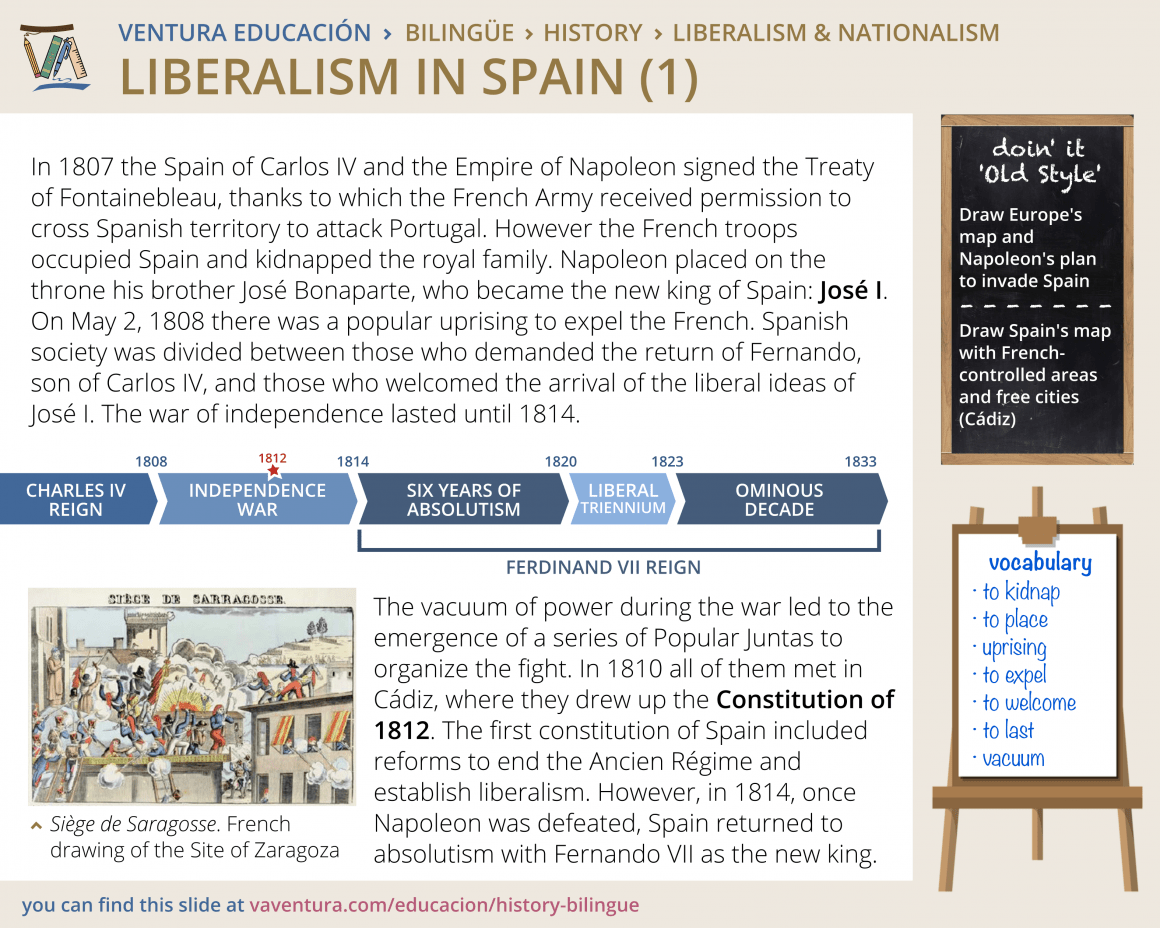
Carlos IV was not very interested in running his own country. In his place, Manuel Godoy served as ruler. In 1807 he signed the Treaty of Fontainebleau with Napoleon, by which Spain gave France permission to cross its territory. Napoleon’s objective was to attack Portugal, but the French Army took advantage of the occasion to occupy Spain and retain the royal family. In a very foolish way, Spain had lost control over its own territory. Napoleon then placed his brother Joseph Bonaparte on the throne of the country as Joseph I. Then the people revolted against the invaders. Thus began the Spanish War of Independence (1808-1814).

Spain was divided between the Frenchified and the Fernandinos. The Frenchified were enlightened who supported José I trusting that the new monarch would make reforms. On the other hand, the Fernandinos remained loyal to Fernando VII, rejecting the French invasion. Several cities in the country, such as Zaragoza, suffered heavy attacks from the French Army. In Cádiz, the only city not occupied in 1810 by the enemy, the Central Board – the Boards were the local governments that had been formed against José I – called the Cortes, to change the absolutist political system.

The Cortes abolished the privileges of the clergy and the nobility and developed the Constitution of 1812. A liberal regime inspired by the French of 1791 was established, whose main characteristics were the following:

  • Recognition of individual rights, such as freedom of expression, the right to property, equality before the law, etc.
  • National sovereignty, which abolished the divine right of the kings and caused power to derive from the Spanish nation.
  • Universal suffrage for the election of mayors and deputies.
  • Separation of powers, which attributed the executive power to the king, the legislative power to the Courts and the judicial power to the courts. With this the absolutist system was ended.
  • Confessional state, in which the Catholic religion was the official religion of the kingdom.

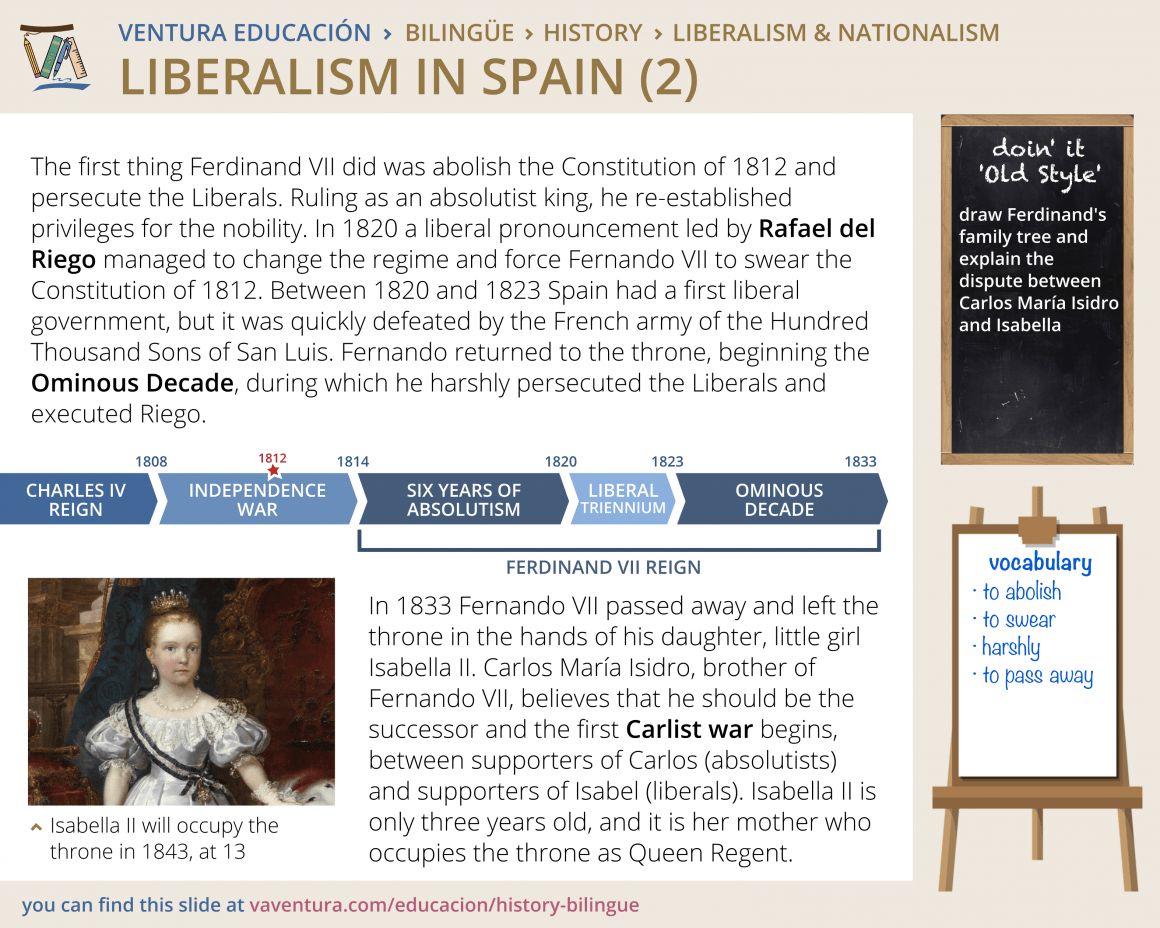
The Constitution of 1812 was never applied, because in 1814, after the defeat of the French, Ferdinand VII returned to re-establish absolutism during the Absolutist Sexennium (1814-1820). In 1820 the successful military pronouncement of Rafael del Riego forced Fernando VII to swear the Constitution of 1812 and began the so-called Liberal Triennium (1820-1823). Although the first liberal government of Spain tried to make reforms, quickly the European army of the Hundred Thousand Sons of San Luis invaded Spain to restore Ferdinand VII to the throne. During the Ominous Decade (1823-1833) the king persecuted the liberals. In 1833 he died leaving the throne to his little daughter Isabel, aged three.

SpainLiberalismPhases

Who should occupy the throne after Fernando VII?

In Spain the Salic Law was in force, which prevented women from reigning. As Fernando VII had not had male children, in 1830 he promulgated the Pragmatic Sanction, which repealed the Salic Law. This way his daughter Elizabeth could reign. Many absolutists did not accept it and supported the brother of Fernando VII, Carlos María Isidro. Then the First Carlist War broke out (1833-1840), between Elizabethans (liberals who supported Elizabeth II and wanted to make reforms) and Carlistists (absolutists who supported Carlos María Isidro and wanted to maintain the Ancien Régime). There were up to three Carlist wars during the 19th century, but the heirs of Carlos María Isidro could never prevail over the defenders of Isabel II.

Reign of Elizabeth II

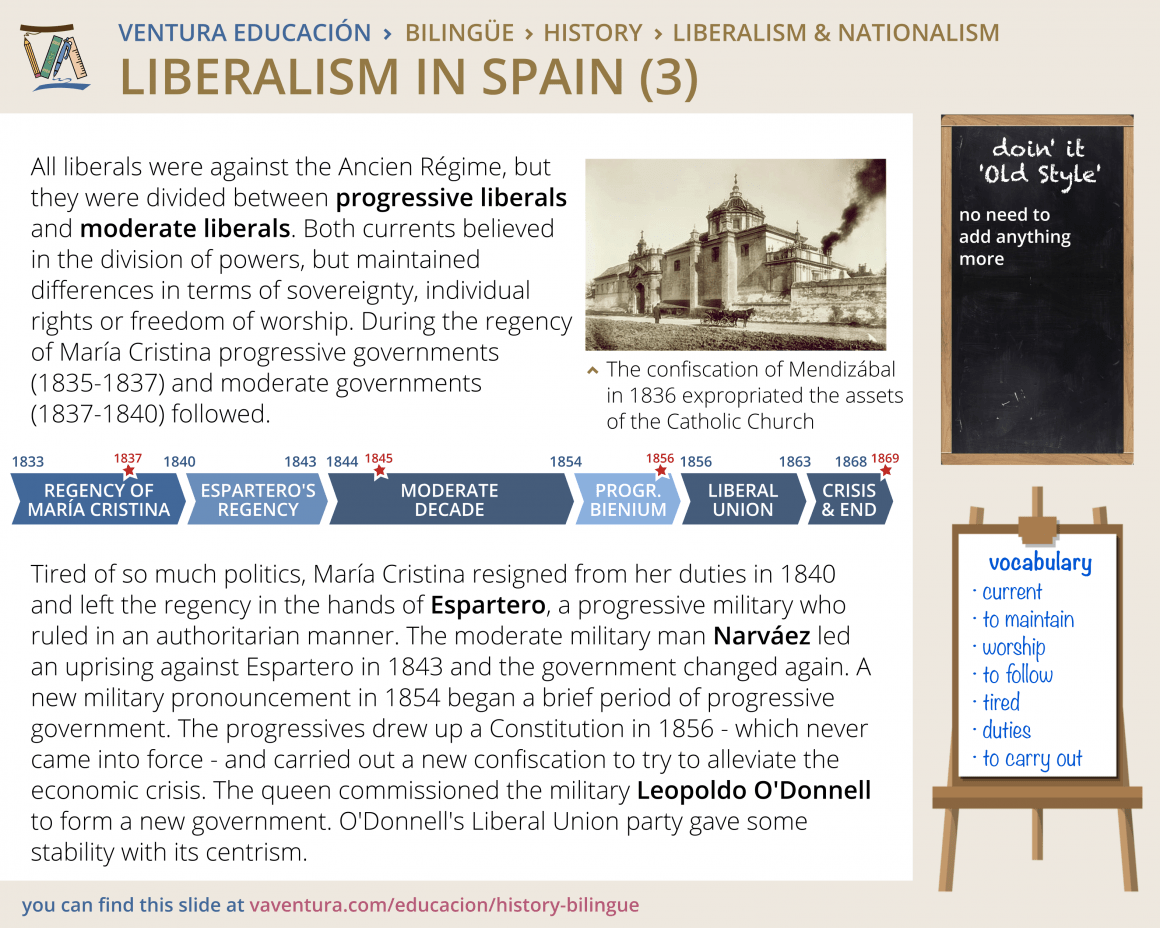
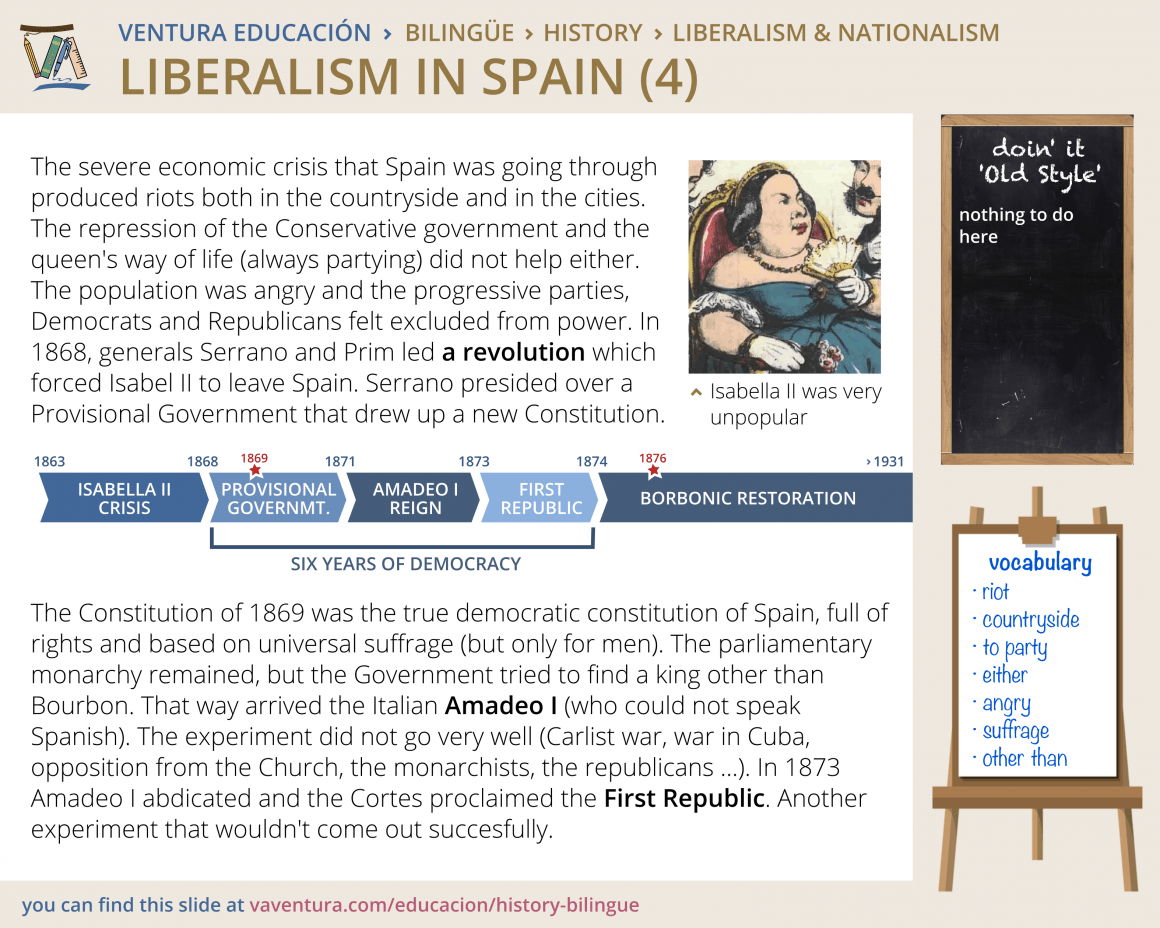
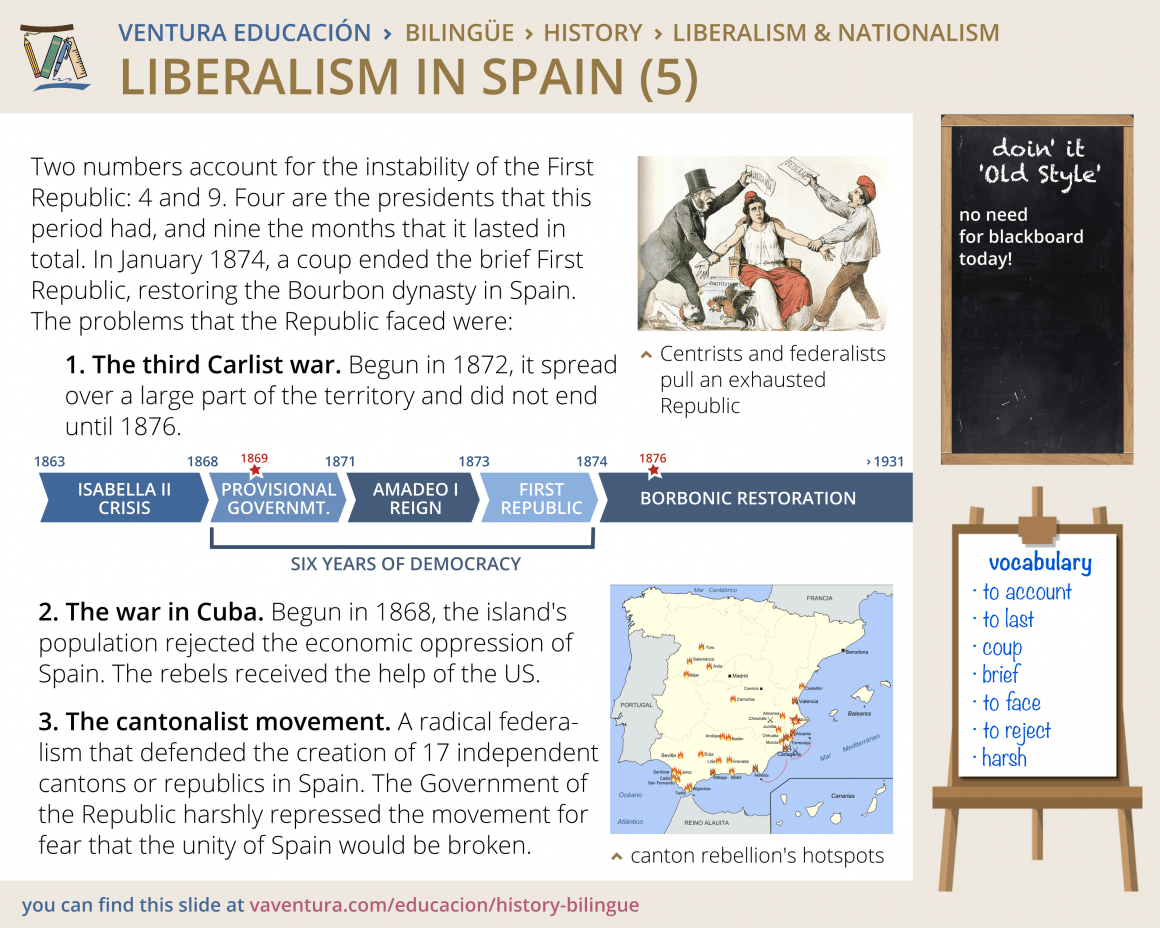
The reign of Elizabeth II was like a roller coaster, the best example of political instability. A succession of governments, coups d’etat, rebellions, constitutions, pronouncements, wars … From the regency of María Cristina (1833-1840) to the Glorious Revolution (1868) there were a lot of governments. You can read a summary on liberalism here. After the reign of Isabel II (1833-1868) a new stage marked by instability began, the Democratic Sexenio, in which Spain had a provisional government, a foreign king and a republic. Everything ended with a new coup d’état that gave way to the Restoration, a stage of stability based on the manipulation of elections and bipartisanship.

Possible exam questions

Possible question 1

Where was the Constitution of 1812 signed? Name five of its principles.

Possible question 2

In which two sides did the Spanish society divide with the arrival of José I? Why?

Possible question 3

What did the carlists defend? When was the First Carlist War?

Possible question 4

How long did the First Spanish Republic last? Explain the problems it had to face.
VENTURA Educación

VENTURA Educación es un proyecto de VENTURA para crear materiales y apuntes de Historia, Literatura, Geografía, Inglés, Filosofía e Historia del Arte. Estudiantes y profesores pueden plantear dudas y pedir contenidos escribiendo a venturaeduca@gmail.com

Ver Publicación
  • Cine

Ciudades de película: las mejores películas por ciudad

  • Juan Pérez Ventura
  • 3 octubre, 2024
Ver Publicación
  • Teorías de la gentrificación

Gentrificación: propuesta de tipología y ejemplos de cada tipo

  • Juan Pérez Ventura
  • 16 junio, 2025
Ver Publicación
  • París

Estadios llenos, casas vacías: París 2024 y la gentrificación

  • Juan Pérez Ventura
  • 11 septiembre, 2024
Ver Publicación
  • Arte

Las fachadas de Salamanca

  • Juan Pérez Ventura
  • 16 mayo, 2024
Ver Publicación
  • Música

La Gran Migración del Blues

  • Juan Pérez Ventura
  • 23 noviembre, 2023
Ver Publicación
  • Religión

El debate central en el cristianismo: Jesús, ¿Hijo de Dios o Dios?

  • Juan Pérez Ventura
  • 1 agosto, 2024
Ver Publicación
  • Economía

El siglo de China: presencia en la economía global

  • Juan Pérez Ventura
  • 18 diciembre, 2024
Ver Publicación
  • Arte
  • Literatura
  • Religión

Bajando al Infierno (I): las legiones de Astaroth

  • Juan Pérez Ventura
  • 26 septiembre, 2024
Social Accounts
Facebook Likes
Twitter Followers
Instagram Followers
LinkedIn Followers
  • Brujería en la historia y en el arteBrujería en la historia y en el arte
    La luz de la Luna ilumina el camino, que serpentea siguiendo el curso del riachuelo. El cielo nocturno está despejado, pero una densa neblina cubre la cima del monte, a…
  • ‘El Gran Inquisidor’, un cuento filosófico y teológico‘El Gran Inquisidor’, un cuento filosófico y teológico
    El episodio del «Gran Inquisidor» en Los hermanos Karamázov (Dostoyevski, 1880) es uno de los momentos más profundos y filosóficamente cargados de la novela. Es una pieza central para entender el…
  • Historias de vikingos a través de los libros antiguosHistorias de vikingos a través de los libros antiguos
    Casi todo lo que se conoce de la historia medieval de Escandinavia procede de antiguos libros que se han conservado con el paso de los siglos. Permanecieron ocultos en bibliotecas…
  • Pink Floyd vs Led ZeppelinPink Floyd vs Led Zeppelin
    Nos proponemos cometer un delito. Para cualquier amante de la música y del rock en particular, el ejercicio que vamos a llevar a cabo no sólo es inútil, también imperdonable.…
  • Top 10 compositores soviéticosTop 10 compositores soviéticos
    Por alguna extraña razón, en un breve espacio de tiempo (1870-1940) y en una zona geográfica bastante concreta (el oeste del Imperio Ruso/Unión Soviética) floreció una generación de compositores de…
  • La Puerta del Paraíso, una obra maestra de la esculturaLa Puerta del Paraíso, una obra maestra de la escultura
    Florencia olía a cera caliente y a piedra antigua. El sol, cada mañana, se filtraba con obstinación por la ventana de mi taller, y se posaba como una bendición sobre…
  • La Revuelta del Arrabal de CórdobaLa Revuelta del Arrabal de Córdoba
    Capítulo 1. Sombras sobre al Guadalquivir El sol descendía lentamente sobre Córdoba, cubriendo la ciudad con un resplandor ámbar que se reflejaba en las aguas tranquilas del Guadalquivir. Desde lo alto…
VENTURA
  • AUTOR
  • BLOG
  • IDVA
  • RECURSOS
  • BMVA
  • LIBROS
  • VEN
  • MÁS
venturacontenidos@gmail.com

Ingresa las palabras de la búsqueda y presiona Enter.