In 2009 and 2010, a remarkable number of publications appeared around a common subject: the relationship between justice and urban space. Geographers, urban planners and social theorists were revisiting questions that had occupied critical urban thought for decades. What makes a city just? How is injustice produced through space? Who benefits from urban development, and who is left behind?
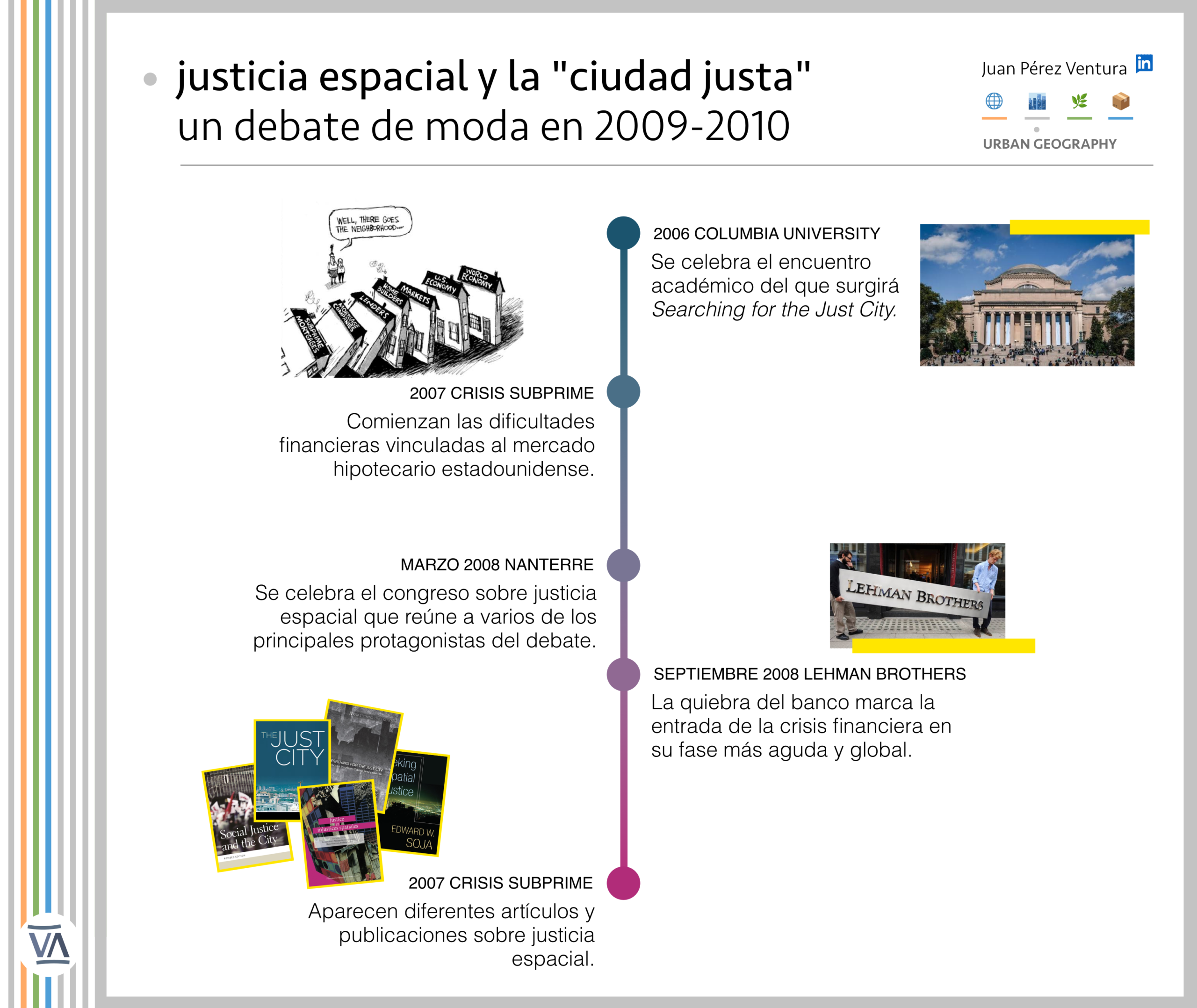
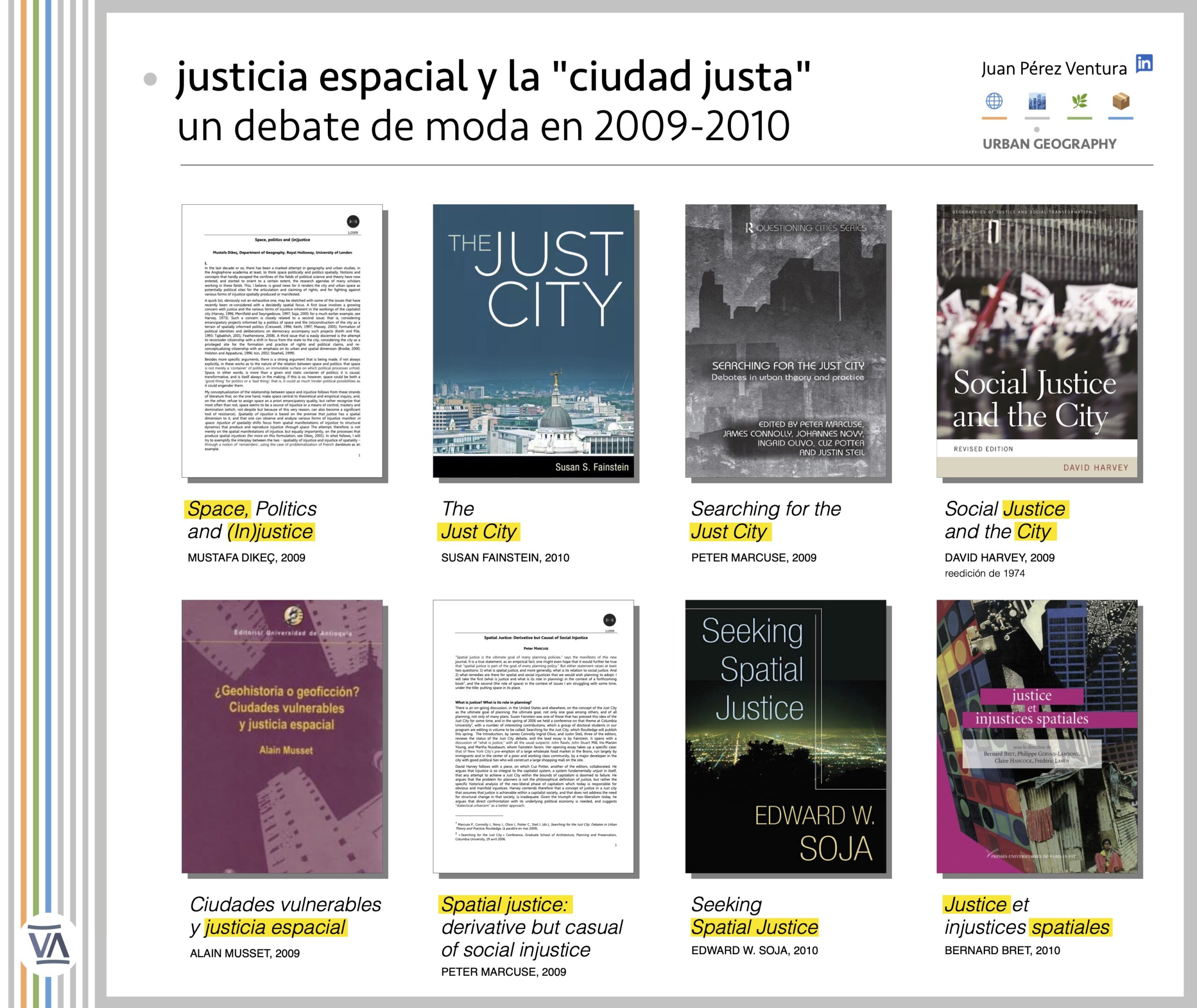
The titles themselves are revealing. Space, Politics and (In)justice by Mustafa Dikeç (2009), The Just City by Susan Fainstein (2010), Searching for the Just City, edited by Peter Marcuse and colleagues (2009), Social Justice and the City by David Harvey (2009 edition), Seeking Spatial Justice by Edward W. Soja (2010), and Justice et injustices spatiales, associated with Bernard Bret (2010), all belong to this particularly concentrated period of academic production. Alain Musset’s ¿Geohistoria o geoficción? Ciudades vulnerables y justicia espacial (2009) and Peter Marcuse’s article Spatial Justice: Derivative but Causal of Social Injustice (2009) complete a striking collection.
After all, this was no ordinary moment for the global economy. The financial crisis that had begun in the United States housing market in 2007 had spread across international financial markets. On 15 September 2008, Lehman Brothers filed for bankruptcy, becoming one of the most recognisable symbols of the collapse. The crisis exposed the fragility of a financial system increasingly connected to mortgage lending, securitisation and real estate investment. It also revealed the consequences of treating housing not simply as a place to live, but as an asset through which capital could circulate and generate returns. Was it a coincidence that the debate on the just city became so visible precisely during these years?
A crisis that was also about cities
The financial crisis was not exclusively a banking crisis. Its origins and consequences were deeply geographical. Housing markets, urban development and financial institutions had become increasingly interconnected. Mortgage loans were bundled into financial products and circulated through international markets, linking the purchase of a home in one neighbourhood to investment decisions made thousands of kilometres away. When the system began to collapse, the consequences were experienced in very specific places: foreclosed homes, abandoned developments, declining property values, unemployment and households struggling to remain in their neighbourhoods.
The geographer Manuel B. Aalbers was already examining these connections in his 2008 article The Financialization of Home and the Mortgage Market Crisis. In 2009, his paper Geographies of the Financial Crisis went further, examining how the mortgage crisis and credit crunch affected different countries, cities and neighbourhoods. The crisis had a geography because its effects were not distributed evenly. This was precisely the kind of problem that critical urban theory had been examining for decades. Cities were not neutral settings in which economic events simply unfolded. They were part of the mechanisms through which wealth was accumulated, resources were distributed and inequalities were reproduced.
The question of urban justice therefore acquired renewed relevance. If the financial system depended increasingly on housing and urban land, what did that mean for the people who actually lived in those places? And if urban development generated economic growth, who was entitled to benefit from it?
The just city: a different way of thinking about urban development
Susan Fainstein’s The Just City, published in 2010, is perhaps the clearest expression of this renewed interest in the relationship between justice and urban planning. Fainstein proposed three central principles for evaluating urban development: equity, diversity and democracy. These principles offered an alternative to approaches that judged cities primarily through economic growth, competitiveness or their capacity to attract investment.
Her argument was not that economic development should simply be abandoned. Rather, urban policies and planning decisions should be assessed according to their social consequences. A successful development project cannot be considered successful merely because it attracts businesses, increases land values or improves the city’s international image. We must also ask whether it improves people’s lives, whether its benefits are distributed fairly and whether different groups have a meaningful place in the decisions that shape their surroundings.
RELATED POST: Susan Fainstein and The Just City (Juan Pérez Ventura, 2025)
There is an important detail here: Fainstein’s book was not an improvised response to the financial crisis. It brought together approximately two decades of research and reflection. Its publication in 2010, however, gave particular visibility to an argument that was especially relevant in the aftermath of the economic collapse.
The same distinction applies to Searching for the Just City, published in 2009 and edited by Peter Marcuse. The book brought together different perspectives on the theoretical foundations, limitations and practical possibilities of the just city. Contributors included the own Fainstein, David Harvey and Mustafa Dikeç. The debate was not confined to a single definition of justice: it involved questions of redistribution, participation, recognition, planning and political power.
From social justice to spatial justice
Another important feature of this period was the growing attention paid to the spatial dimension of injustice. The distinction is worth understanding. Social inequalities do not simply happen to be located somewhere. Their distribution across space can contribute to their reproduction. Access to public transport, housing, education, healthcare and employment opportunities depends, among other things, on where people live and how different parts of a city are connected.
Edward W. Soja explored this relationship in Seeking Spatial Justice (2010). His central argument was that justice has a geography: the distribution of resources, opportunities and access is inseparable from the spatial organisation of society. The book drew on concrete struggles, including the successful campaign of the Los Angeles Bus Riders Union in the 1990s. Its legal victory forced the city’s transport authority to reorganise public transport in ways that better served poorer residents. This was not an abstract philosophical discussion. It was an example of how changing the organisation of urban space could change people’s everyday opportunities.
Mustafa Dikeç approached the issue from a related perspective in Space, Politics and (In)justice, published in the inaugural issue of Justice Spatiale / Spatial Justice in September 2009. He argued that space should not be understood as a passive container in which political processes take place. Space itself can participate in the production of injustice, but it can also become a means through which political claims and resistance are articulated. Peter Marcuse made a complementary argument in his 2009 article Spatial Justice: Derivative but Causal of Social Injustice. Spatial injustice is both a consequence of wider social inequalities and a mechanism through which those inequalities can persist.
These approaches helped move the discussion beyond the simple observation that some neighbourhoods are wealthier than others. The more important question was how urban structures, planning decisions and political arrangements actively produce those differences.
Why does this matter today?
Looking back at this period is more than an exercise in intellectual history. Many of the questions raised between 2009 and 2010 remain central to contemporary urban debates.
The financialisation of housing has not disappeared. In many cities, property continues to operate as an investment asset, while access to affordable housing becomes increasingly difficult. Tourism, short-term rentals, large-scale regeneration projects and the arrival of new forms of capital have added further pressures to neighbourhoods already experiencing social and economic transformation.
The language has also evolved. Gentrification, touristification, displacement, environmental justice and the right to the city now occupy prominent positions in discussions about urban change. Yet the underlying question remains remarkably similar: what happens when the economic value of urban space takes precedence over the needs and rights of the people who inhabit it?
Perhaps this is why the publications of 2009–2010 still deserve attention. They remind us that urban development is never simply a technical process involving buildings, infrastructure, investment and planning regulations. It is also a political question about the distribution of resources, the recognition of different communities and the power to decide how cities should change.
The financial crisis did not invent the debate on spatial justice. But it arrived at a moment when critical urban thought was already questioning the foundations of the prevailing model of urban development. The coincidence is therefore not proof of a direct causal relationship. It is something more interesting: a historical moment in which an economic crisis and a long-standing intellectual debate made the same underlying problem particularly difficult to ignore.
A city can become wealthier without becoming fairer. And perhaps that was the question urban scholars were trying to bring back to the centre of the discussion in 2009 and 2010…