Look at a map of Lagos, and you will immediately notice something unusual. Water is everywhere. The city extends across islands, lagoons, creeks and reclaimed land, creating an urban landscape in which the boundary between land and water is constantly changing.
Now look more closely at Lekki, one of Lagos’s most valuable residential areas. Along its waterfront, luxury estates and modern buildings stand beside places that, until recently, were occupied by fishing communities. One of them was Otodo Gbame, a settlement of approximately 30,000 people that was violently demolished between November 2016 and April 2017. But the most interesting part of this story is not only what happened to its residents. It is what happened to the land…
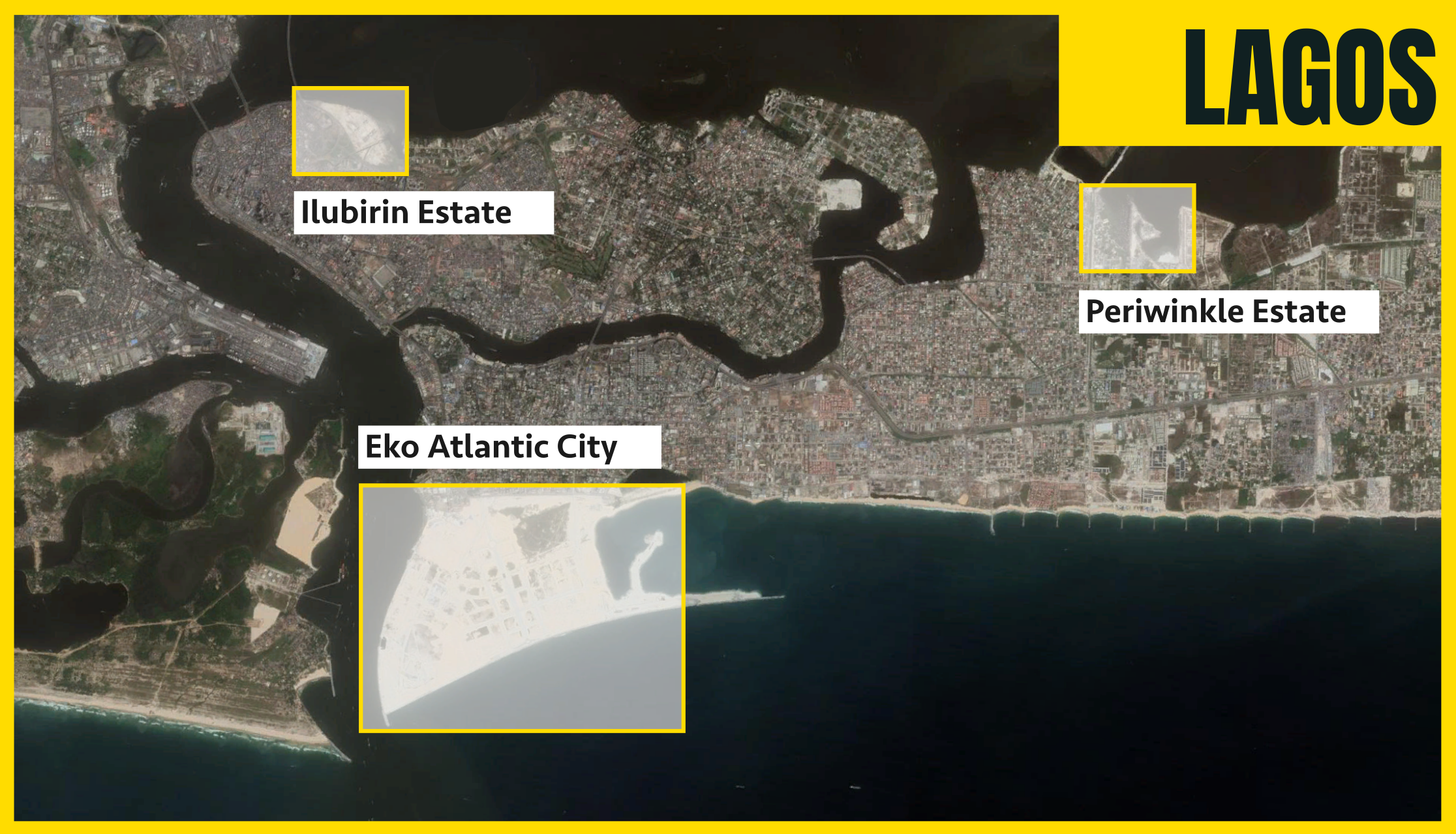
In 2017, while former residents were struggling to find accommodation and demanding justice, a new real-estate development was being promoted on part of the land and water area they had previously occupied. The project was called Periwinkle Estate.
To understand how a fishing community could disappear while a luxury residential development emerged nearby, we need to examine three interconnected questions: who claimed ownership of the land, who had the authority to decide its future, and who would benefit from its transformation.
A valuable waterfront with a long history
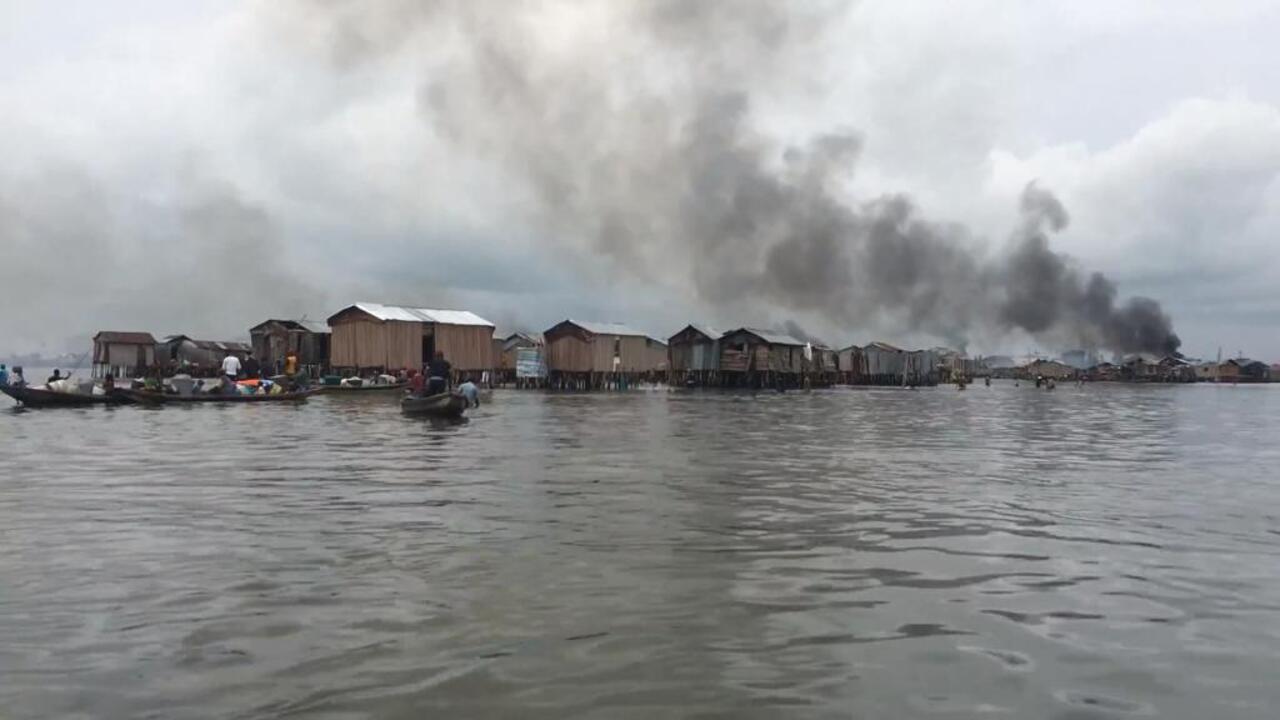
Otodo Gbame was not an empty space waiting to be developed. It was an established fishing community, predominantly inhabited by Egun, also known as Ogu, whose homes and economic activities were closely connected to the Lagos Lagoon.
According to research by Gideon Olaniyi Omoniyi, published in 2017, the community occupied approximately 56 acres. Houses were built on both land and water, sometimes supported by wooden stilts, while fishing, commerce and canoe transport formed part of everyday life. The lagoon was not simply a landscape. It was an economic resource, a transport route and an essential part of the community’s identity.
Yet Otodo Gbame was also located in a highly attractive real-estate corridor. On one side stood the affluent neighbourhoods of Lekki Phase 1; on the other, modern residential developments were gradually extending towards the waterfront. In a city undergoing rapid expansion, this geographical position created enormous opportunities for investment. But those opportunities depended on the possibility of controlling and transforming the land.
Two communities, competing claims
The ownership dispute surrounding Otodo Gbame involved more than a disagreement between residents and the government. The community’s inhabitants defended their historical presence and customary rights over the land. Many families claimed that their ancestors had settled along the waterfront generations earlier, developing fishing activities and social relationships long before the surrounding urban landscape became so valuable. At the same time, the Elegushi royal family, a traditional ruling family associated with the Ikate area of Lagos, claimed ownership of the territory, which it identified as Ebute Ikate Elegushi. The two interpretations were fundamentally different.
For the residents, Otodo Gbame was a community whose long occupation and customary arrangements provided legitimate claims to the land. For the Elegushi family, the same territory formed part of its traditional landholding, and the residents’ occupation was subject to its authority. As Brianna Castro explains in a 2023 study, published in the International Journal of Urban and Regional Research, land governance in Lagos involves overlapping forms of authority. Traditional institutions, state agencies, formal courts and community organisations may all participate in determining whose claims are recognised. This makes ownership more complicated than simply checking a name on a property document.
In November 2015, residents of Otodo Gbame initiated legal proceedings against the Lagos State Government, Elegushi Property Investment Limited and several members of the royal family. Their complaint followed land reclamation activities near the settlement, which they argued threatened access to fishing grounds, waterways and other economic resources.
The community wanted the courts to recognise its own claims to the land. The Elegushi family, meanwhile, pursued a separate legal action seeking possession of the waterfront. On 10 October 2016, the Lagos State High Court granted the Elegushi applicants the right to take possession of the land identified in their case. However, as Amnesty International documented, that ruling did not establish safeguards for the residents already living there. The distinction is important. A judicial decision granting possession to one party does not automatically settle every question concerning the rights of existing residents or the lawful procedures required for eviction. And the wider dispute was far from over.
Who belongs to Lagos?
The conflict also had a social and political dimension. In January 2017, the Lagos State House of Assembly adopted a resolution supporting the Elegushi family’s claim. It described many Otodo Gbame residents as Egun people from Cotonou and Togo, presenting them as outsiders occupying the land without authorisation.
The residents challenged this account, arguing that the issue of ownership remained before the courts and that the legislative assembly had no authority to settle it conclusively. This episode reveals how disputes over land can become disputes over belonging.
Otodo Gbame’s residents were not only defending houses and fishing grounds. They were also challenging a narrative in which their ethnic identity and alleged foreign origins were used to weaken their legitimacy as inhabitants of Lagos.
The controversy raises a difficult question: how many generations must a community live in a city before its presence is recognised as belonging? Historical occupation does not automatically resolve every legal dispute over land ownership. But neither does a contested title make the social and economic existence of an entire community irrelevant. In Otodo Gbame, competing claims were evaluated within institutions where the parties possessed very different forms of political and economic influence.
From fishing grounds to reclaimed land
While the ownership dispute continued, the physical landscape of the waterfront was also changing. Land reclamation is a relatively straightforward process to understand. Sand and other materials are deposited in shallow water, gradually creating new surfaces that can support roads, plots and buildings.
In Lagos, this technique has become an important instrument of urban expansion. New areas of development can be created where previously there was water, and existing waterfronts can be reshaped to accommodate different uses. But reclamation also has consequences for people whose livelihoods depend on the lagoon.
A Pulitzer Center investigation published in 2017 documented complaints from fishing communities about dredging activities. Residents described how the extraction and movement of sand affected fishing grounds, water conditions and access to the waterfront.
In Otodo Gbame, residents reported that reclamation activities had begun affecting their surroundings before the major demolitions of 2016. The physical transformation of the lagoon was therefore not simply something that happened after the community was removed. The struggle over reclamation was already part of the earlier dispute.
Between November 2016 and April 2017, the settlement was subjected to repeated forced evictions. Those events are documented in detail in our previous article, Otodo Gbame: The Waterfront Community Evicted Despite Court Orders. The final operation on 9 April 2017 effectively ended Otodo Gbame as a functioning residential community. Yet the transformation of the waterfront continued.
The arrival of Periwinkle Estate
On 25 June 2017, less than three months after the final eviction, a construction sign was photographed near the former Otodo Gbame area. The sign identified the Elegushi royal family as the joint-venture title owner of a land reclamation project associated with Periwinkle.
A marketing video subsequently presented Periwinkle Estate as a residential, mixed-use and commercial development. Amnesty International compared aerial images from the promotional material with satellite images of Otodo Gbame and confirmed that they referred to the same area.
AIreportAccording to Amnesty International’s 2017 report, land plots in Periwinkle Estate were being marketed for between 45 million and 200 million Nigerian naira, equivalent at the time to approximately US$125,000–554,000. These were advertised prices in 2017, not verified transaction values or current market prices. Nevertheless, they make the intended economic transformation quite clear. The waterfront was being promoted as an exclusive residential environment for buyers with substantial purchasing power.
Where families had previously lived in modest houses connected to fishing and small-scale commerce, developers were marketing land for high-value property investment. However, we must be precise about the spatial relationship: Amnesty documented that Periwinkle Estate was being developed on part of the land and water area formerly occupied by Otodo Gbame. This does not establish that the entire former settlement was incorporated into the project, or that Periwinkle was the sole explanation for every demolition.
Other nearby projects, including the proposed Imperial International Business City, also appeared in contemporary reporting. These developments should not be treated as interchangeable without establishing their exact geographical boundaries and contractual relationships. The documented connection with Periwinkle is already significant. It does not need to be exaggerated.
One of the most revealing ways to examine this transformation is through satellite imagery. We have compared images of the waterfront from 2015, 2018 and 2024. They show the development of a very different urban landscape across less than a decade.
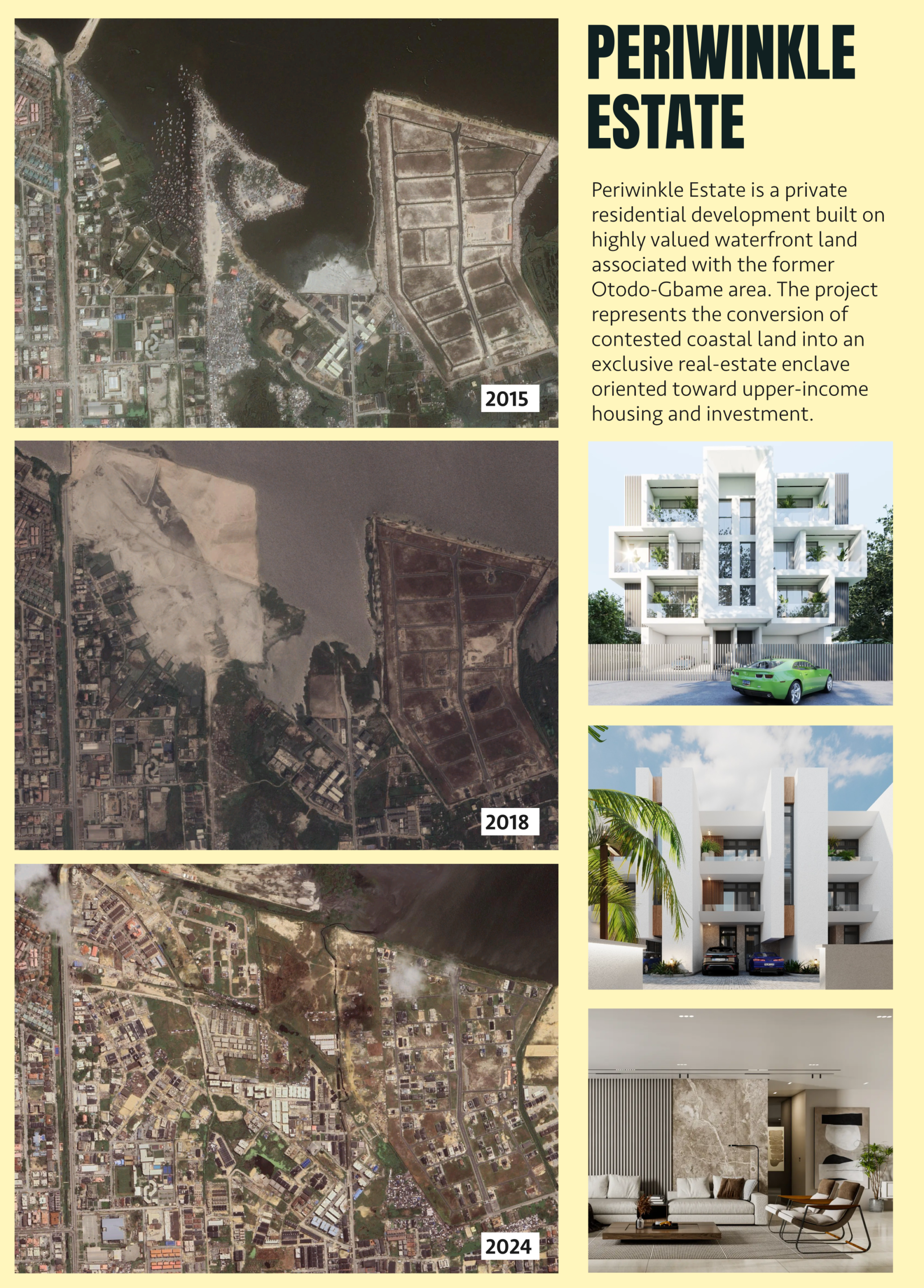
In the 2015 image, we can identify a densely occupied waterfront, with buildings concentrated along the lagoon and existing reclaimed plots nearby. By 2018, extensive sand-filled surfaces and new road alignments are visible. The landscape has changed considerably, and large areas appear prepared for a different pattern of development. The image from 2024 shows a much more consolidated urban layout, with a clearer network of roads, individual plots and new buildings.
The value of land and the value of a place
In urban economics, the value of land is often associated with its location, permitted uses, accessibility and development potential. Along the Lagos waterfront, proximity to affluent residential districts and access to valuable coastal land can make property particularly attractive to investors. But the same location may have a very different value for its existing inhabitants.
For a fisherman in Otodo Gbame, the lagoon provided access to work. For a family, the settlement offered housing and support networks. For a trader, it provided customers and a place to conduct business. These forms of value were not necessarily reflected in the prices used to advertise future real-estate plots.
In this sense, the transformation of Otodo Gbame illustrates a fundamental contradiction in urban development: the land can become more attractive to investment while becoming inaccessible to the people who previously depended on it. The former residents lost homes, livelihoods and access to the lagoon. Meanwhile, development interests promoted a new residential landscape on part of the same territory. The 2017 investigation by The New Humanitarian documented reclamation and construction activity associated with Periwinkle Estate, while displaced residents continued seeking compensation and resettlement.
This is not proof that every actor shared one intention or that all the evictions were organised exclusively to benefit a particular development. The evidence does, however, show that forced displacement and the creation of opportunities for higher-value land use were closely connected in time and space. It also shows why the struggle for urban land cannot be understood solely through property titles.
Otodo Gbame’s residents defended long-standing occupation, social belonging and economic dependence on the waterfront. The Elegushi family defended its claims through traditional authority and legal proceedings. Government institutions exercised regulatory and coercive powers, while private development actors sought to transform parts of the waterfront into marketable real estate. In 2017, the former residents of Otodo Gbame obtained a favourable High Court judgment protecting waterfront communities against further forced evictions and requiring consultation concerning resettlement. But the judgment came after the settlement had already been destroyed.
The continued demands for resettlement documented by Amnesty International Nigeria in 2022 remind us that legal recognition does not automatically restore a lost home, fishing ground or neighbourhood. The transformation of the Lagos waterfront can therefore be read in two ways. From a real-estate perspective, it is a story of land reclamation, new plots and investment opportunities. From the perspective of Otodo Gbame’s former residents, it is a story of contested rights, lost livelihoods and a community that has struggled to recover its place in the city.