Green gentrification is not simply the arrival of parks, trees or ecological language in the city. For an urban process to be understood as green gentrification, environmental improvement must become a driver of urban revalorisation: it must change the image of a place, increase its attractiveness, generate or anticipate new forms of investment, and potentially create pressures of exclusion or displacement. In Johannesburg, this relationship is difficult to identify because the city does not offer a single, obvious case. Instead, it presents a fragmented landscape of green interventions, private enclaves, state-led renewal projects and symbolic restorations.
For URGENTLab Jo’burg, the question is therefore not whether Johannesburg contains green spaces or environmental projects. It clearly does. The question is more precise: where does the green vector actually organise the process of urban transformation? After comparing four possible cases — Alexandra Renewal Project, Waterfall City, The Wilds Nature Reserve and the Jukskei River Corridor — the most useful case is the Jukskei. Not because it is already a fully consolidated case of green gentrification, but because it is the case where environmental restoration is most clearly the central mechanism of urban revalorisation.
1. Alexandra Renewal Project: environmental renewal, but not primarily green gentrification
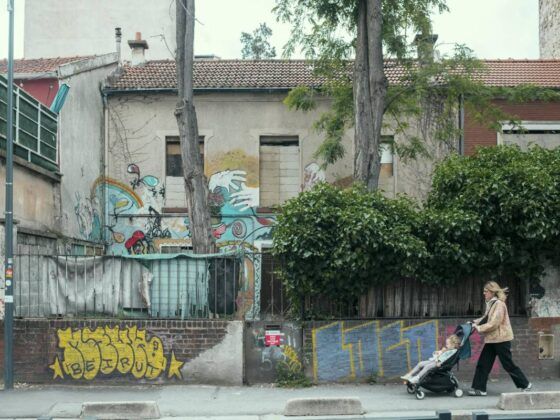
The Alexandra Renewal Project is an essential comparison because it contains many green elements. Launched in 2001, it sought to improve housing, infrastructure, services and environmental conditions in Alexandra, with the Jukskei River playing an important role in the official narrative. The project proposed cleaning the river, removing precarious settlements from vulnerable riverbanks, creating green areas and improving the general urban environment. The planned relocation of 6,000 to 7,000 low-income families from river-edge areas and the movement of around 11,000 residents during the first phase of the project. It also notes environmental improvements, including reduced river pollution, tree planting, sports facilities, parks and better basic infrastructure.
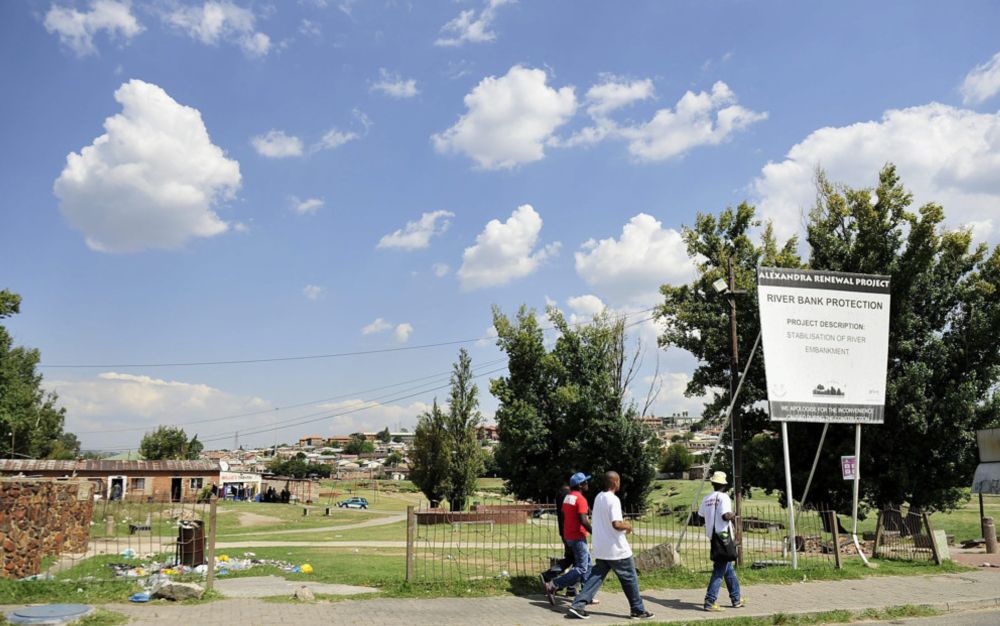
However, Alexandra does not work as our main case of green gentrification because the dominant mechanism is not green revalorisation but state-led urban renewal, relocation and control. The green component exists, but it is embedded in a much broader programme of housing, sanitation, infrastructure, de-densification and township redevelopment. In other words, the environmental discourse helps legitimise the intervention, but it does not clearly produce a green real-estate premium, a lifestyle-oriented green branding strategy or a market-led transformation of the area.
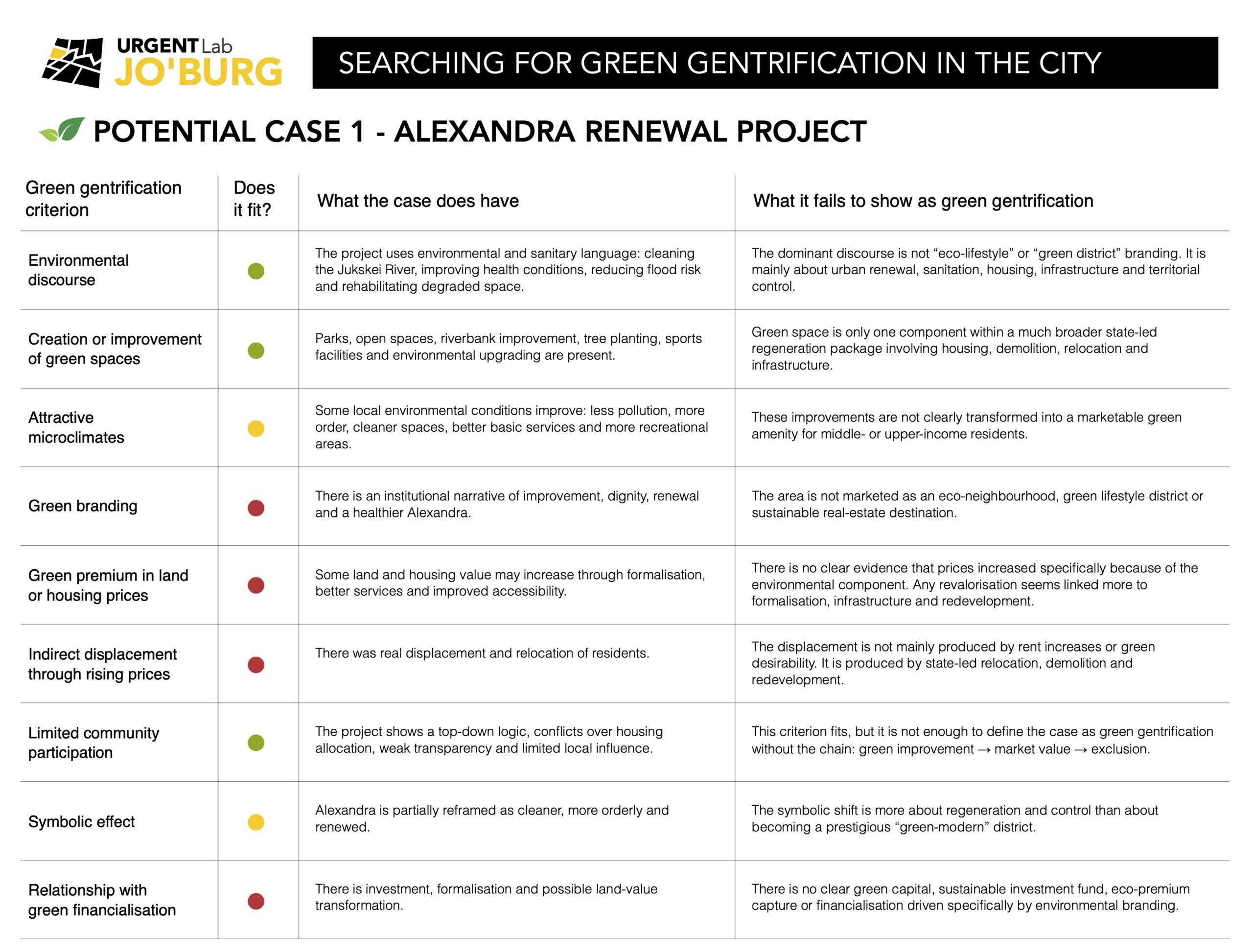
What fails, then, is not the presence of green elements. Alexandra clearly has them. What fails is the operational definition of green gentrification. The displacement is real, but it is not clearly caused by a green premium or by the conversion of environmental amenities into a new market value. It is mainly produced by state relocation, demolition, housing allocation and infrastructural reordering. The project is better understood as authoritarian regeneration with environmental components than as a case where the green vector itself drives gentrification.
Alexandra is therefore useful as a warning. It shows how ecological arguments — river cleaning, flood risk, sanitation, environmental health — can be used to justify displacement. But it does not allow us to isolate the green vector as the main driver. It is too broad, too state-centred and too infrastructural. For URGENTLab Jo’burg, Alexandra remains important, but more as a case of authoritarian urban renewal than as the clearest example of green gentrification.
2. Waterfall City: green branding, but the real driver is elite financialised urbanism
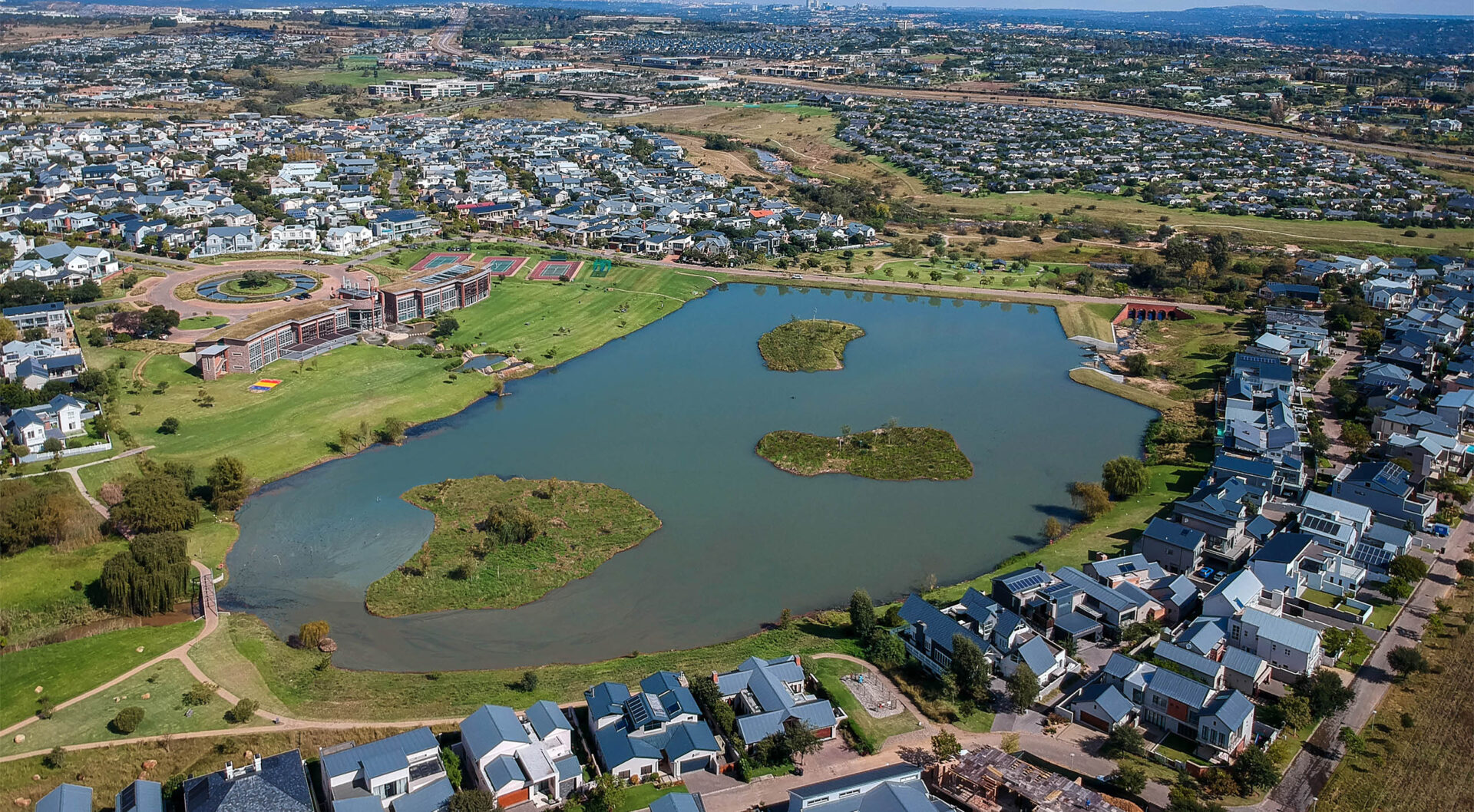
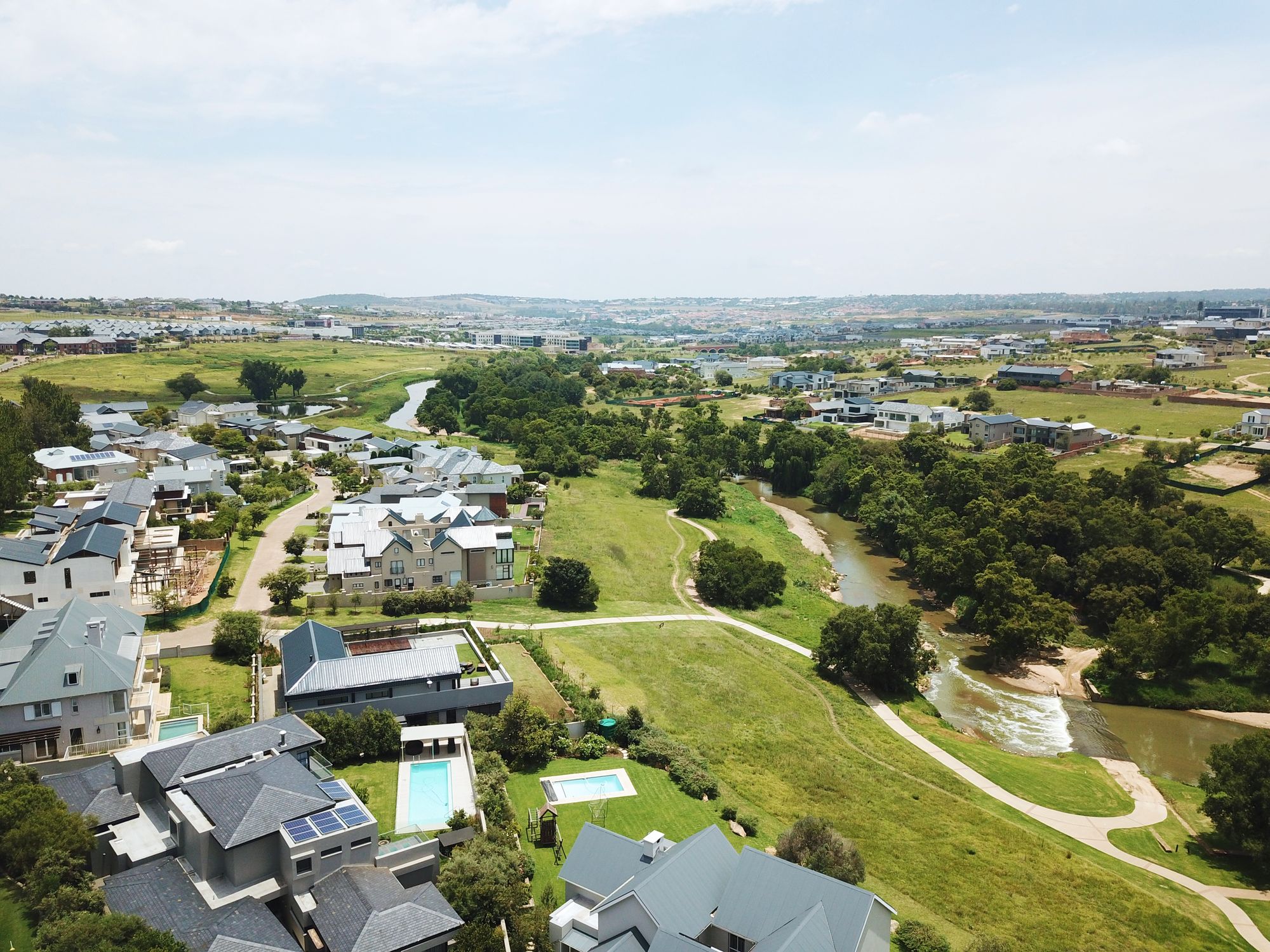
Waterfall City appears, at first sight, to be a strong candidate. It is marketed as smart, sustainable and environmentally advanced. It includes parks, artificial lakes, pedestrian routes, cycling paths, water reuse systems, solar infrastructure, green certifications and a carefully designed landscape. The project is also strongly connected to private development, institutional investment, corporate governance and real-estate value. Waterfall City is a 2,200-hectare private megadevelopment in Midrand, linked to actors such as Attacq, AWIC, Atterbury and institutional investors. It also notes that property values have risen strongly, although this increase cannot be clearly attributed to green amenities alone.
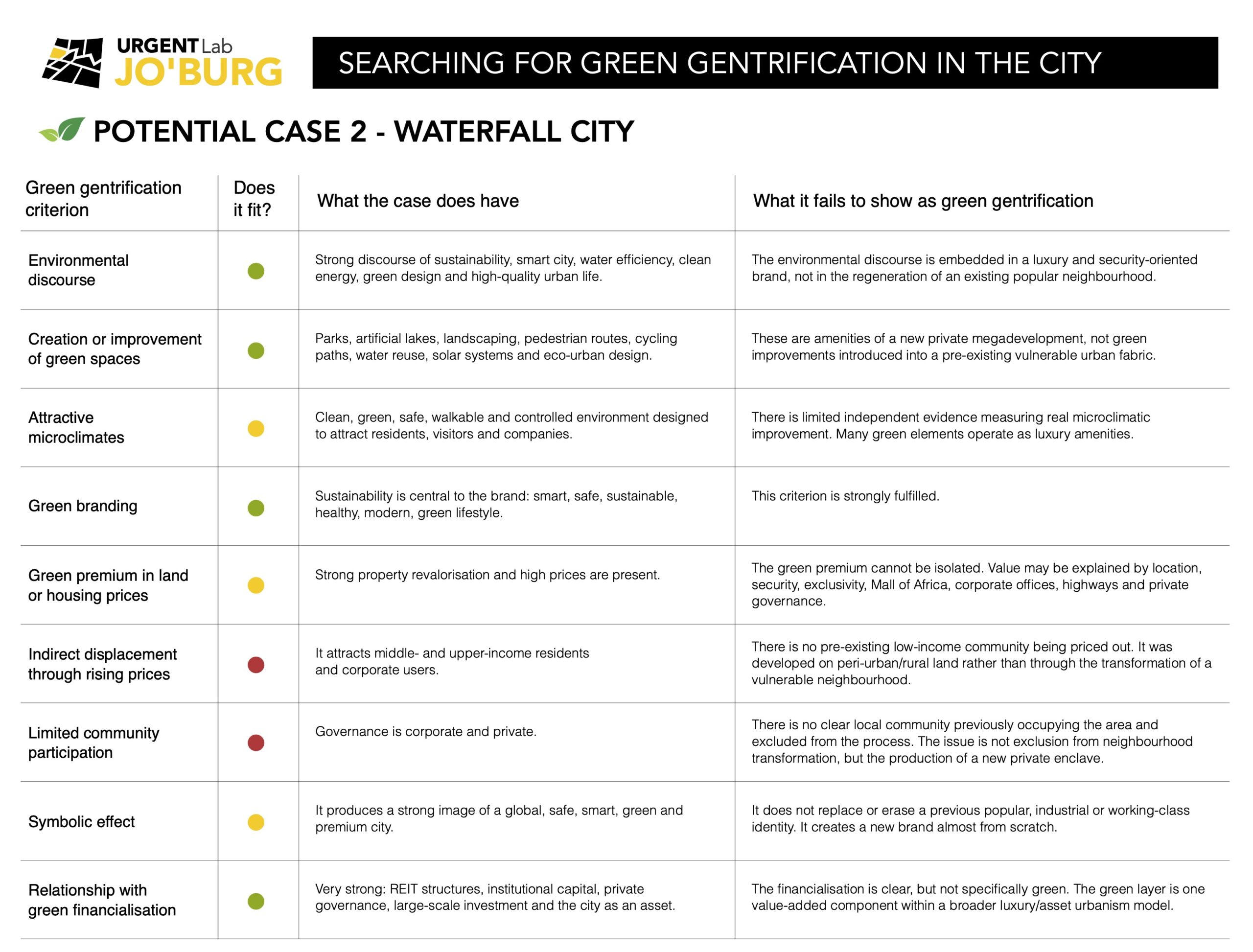
The problem is that Waterfall City fulfils almost everything related to “green” but fails at the core of “gentrification” in the strict sense. There is no pre-existing low-income neighbourhood being transformed. There are no original residents being indirectly priced out by green amenities. There is no clear conflict over the right to remain. The project was developed on peri-urban land and functions more as an elite private urban enclave than as a gentrifying neighbourhood.
Its green elements are real, but they operate as part of a broader package of luxury, safety, exclusivity, corporate urbanism and strategic location between Johannesburg and Pretoria. The “green premium” cannot be isolated: price increases may be explained by location, security, prestige, private governance, infrastructure and the general property boom in Gauteng.
Waterfall City therefore fails for the opposite reason to Alexandra. Alexandra has displacement but not a clearly green market logic. Waterfall has green branding and strong market revalorisation, but not displacement from a pre-existing vulnerable community. It is best defined as green-financialised urbanism or eco-branded elite urbanism, not as the main case of green gentrification for our purposes.
3. The Wilds Nature Reserve: green-symbolic revitalisation without gentrification
The Wilds Nature Reserve is a fascinating case, but it is also the clearest example of what should not be confused with green gentrification. The park, located in Houghton, had suffered abandonment, insecurity and loss of use. Its revitalisation was driven largely by artist James Delaney, volunteers and Johannesburg City Parks. The intervention involved removing invasive vegetation, repairing paths and water features, restoring indigenous plants, reactivating waterfalls and installing animal sculptures that changed the public image of the park. The Wilds is a 16-hectare urban park transformed from a neglected and feared space into an “urban oasis”, with around 10,000 visitors per month.
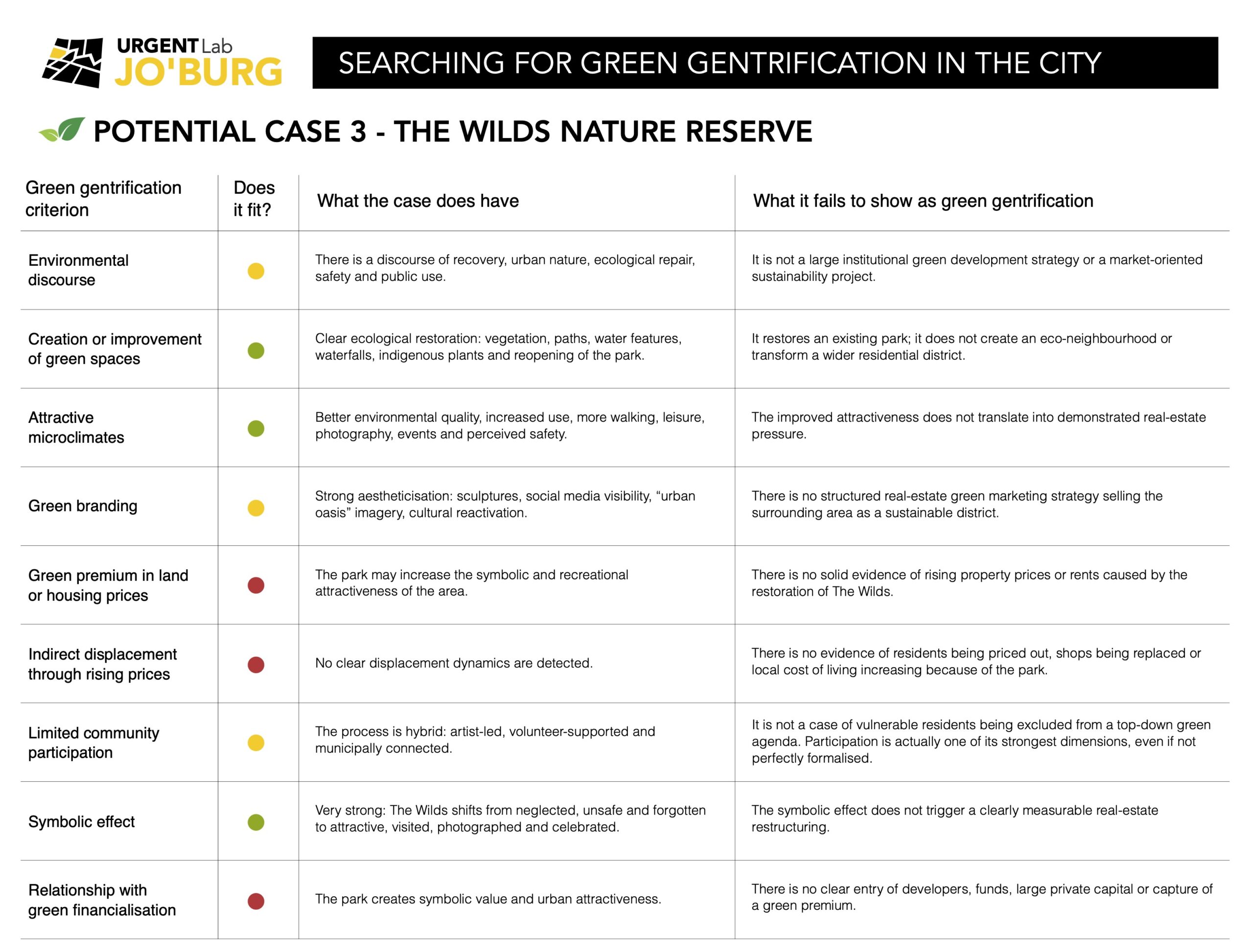
The case is strong in environmental and symbolic terms. It shows ecological repair, public art, increased use, improved visibility and a major shift in perception. The Wilds moved from abandonment to urban attractiveness. It became safer, more visited and more present in the cultural imagination of Johannesburg.
But it fails as green gentrification because there is no evidence of the elements that define gentrification: no displacement, no clear property-price effect, no real-estate capture, no major private redevelopment project and no measurable demographic transformation. There are no precise published data on property values or rents attributable to The Wilds, and no studies demonstrating local demographic change.
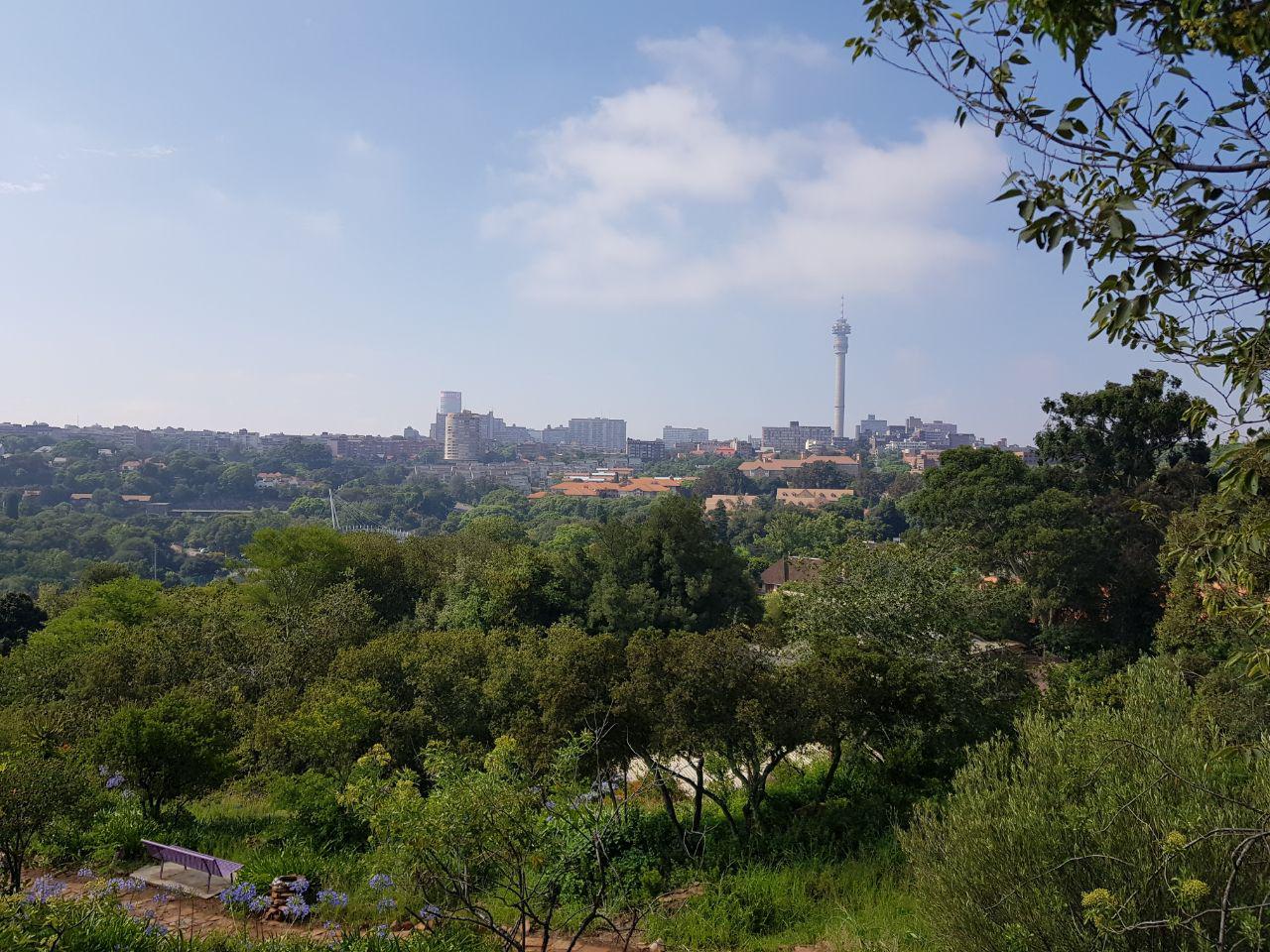
The Wilds is therefore best read as green-symbolic revitalisation. It is a successful case of environmental and cultural recovery, but not a strong case of gentrification. It helps us sharpen the criteria: not every improved green space produces exclusion, and not every symbolic revaluation becomes real-estate pressure.
4. Jukskei River Corridor: the strongest case because the green vector dominates
The Jukskei River Corridor is the most convincing case for URGENTLab Jo’burg because it is the only case where the environmental intervention itself appears as the main organising force of urban change. The upper Jukskei corridor, from central Johannesburg towards Alexandra, has become the object of ecological restoration projects led by actors such as Water for the Future, SUNCASA/WRI, the City of Johannesburg and the Alexandra Water Warriors. These interventions include river cleaning, removal of invasive species, revegetation, pocket forests, ecological seating, public art, wetland restoration and nature-based solutions for water management and climate resilience.
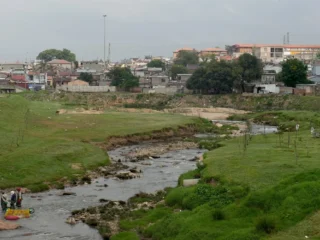
MORE INFORMATION: «The Jukskei River and Beyond: Rehabilitation of the upper Jukskei River through community participation, green technology, and enterprise»
This is not a luxury enclave like Waterfall City. It is not a broad state renewal programme like Alexandra. It is not only symbolic park recovery like The Wilds. The Jukskei is a corridor where the environmental problem (water, flooding, pollution, biodiversity, riverbanks, climate adaptation) becomes the very basis of urban intervention. The green vector is not decorative; it is structural.

The case is also analytically interesting because it remains incomplete. There is still no quantitative evidence of a clear green premium in property prices, rents or land transactions. There is no confirmed displacement directly caused by the recent green interventions. Investment signals are still anecdotal, and the process remains public-community oriented rather than driven by major private capital. Yet this is precisely why the Jukskei matters. It allows us to study green gentrification before it becomes fully consolidated.
The Jukskei can therefore be interpreted as emergent green gentrification or green revalorisation in formation. It already has the environmental discourse, the green infrastructure, the symbolic reframing, the institutional visibility and the first signs of possible attractiveness. What it does not yet have is the fully measurable real-estate outcome. That makes it a better research case than a finished example, because it allows us to ask how green value is produced, how it circulates, and whether it may later become exclusionary.
Why we choose the Jukskei
The comparison clarifies the decision. Alexandra is too dominated by state renewal and relocation. Waterfall City is too dominated by private financialised urbanism and elite real-estate production. The Wilds is too symbolic and lacks evidence of real-estate pressure. The Jukskei, instead, sits exactly at the point where the green vector becomes analytically visible: ecological restoration is the driver, the river corridor is the spatial object, community actors are present, international and municipal institutions are involved, and future revalorisation is plausible but not yet fully proven.
This is why the Jukskei is the most useful case. It does not give us a closed story of green gentrification. It gives us a process in motion. It allows URGENTLab Jo’burg to study how environmental repair, resilience narratives, public space improvement and symbolic rebranding may create the conditions for future urban revalorisation. It is not yet a case of consolidated displacement, but it is a case where the foundations of green urban value are being built.
The final argument, therefore, should be cautious but clear: the Jukskei River Corridor is not selected because it is the most spectacular or the most advanced case, but because it is the case where green urban transformation is most clearly emerging as a specific vector of revalorisation. It allows us to analyse green gentrification not only as an outcome, but as a process: incomplete, uncertain, community-based, institutionally supported and potentially vulnerable to future capture by real-estate interests.
In Johannesburg, the politics of green gentrification may not begin with luxury apartments or immediate evictions. It may begin with a river being cleaned, a wetland being restored, a corridor being renamed, a public narrative of resilience being built, and an environmentally degraded space becoming newly visible. That is why the Jukskei matters.